Your Dreams Are Smarter Than You
Originally published on my Substack, Writings From The Edge of the Known, where I write regularly. Subscribe there for new essays.
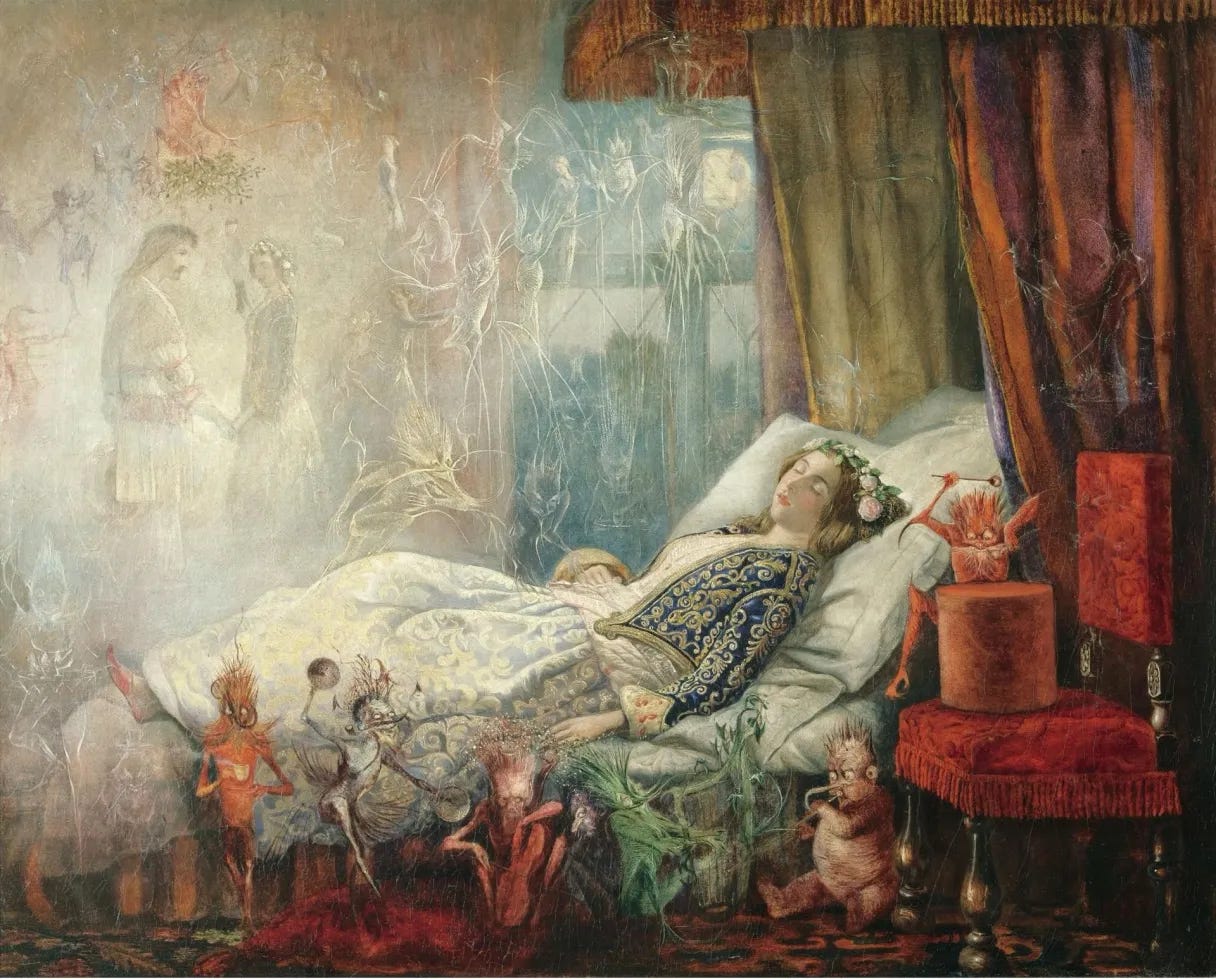
The Stuff That Dreams Are Made Of - by John Anster Fitzgerald (1858)
I want to tell you about a dream I had recently. It contains something worth examining in public, and examining it honestly means sharing the parts that are uncomfortable to admit.
Most writing about dreamwork presents it as a path toward insight and self-knowledge. That’s true. What gets left out is that the insights are often uncomfortable, and the self-knowledge involves meeting parts of yourself you’d rather not have to acknowledge. This essay is an attempt to show you the full picture: the dream, the method I used to work with it, and what I actually found when I did.
If you want to start working with your own dreams, this is how it actually goes.
The Dream
I’m on my way to a Vipassana meditation retreat. For those unfamiliar, Vipassana is a ten-day silent practice. No talking, no reading, no phone, no eye contact. You sit with yourself for ten days straight. It’s one of the most effective and demanding inward journeys I know.
In the dream, I’ve already landed. I’m in an airport, home-adjacent, ready to collect my things and get to the retreat center. I’m possibly even late.
And I stop to get a haircut.
Casually, indulgently, as though this feels more important right now. As though my needs, my appearance, my identity deserve tending before I can walk through the door of silence.
In the barbershop, I ask about geometric stencils. Pentagrams. Hexagrams. Sacred symbols. I want them placed on top of my hair. Decorative. Surface.
The barbers, these mysterious figures who seem to know something I don’t, give me something I didn’t ask for instead. A long red mohawk, swept back rather than spiked. Viking energy. Fire. Something untamed and unapologetically itself.
My reaction is immediate: this isn’t what I wanted. Too much. Too long.
So I start searching on my phone for a reference photo to show them. I want something like Machine Gun Kelly’s hair. Short, spiky, undercut. Young. Hot. Aesthetically clean.
But every photo of MGK that comes up shows him old. Weathered. Thin and frail. The glamorous pop star image I was reaching for kept showing up worn down and depleted.
A woman is beside me throughout all of this. She watches. She mentions warmly that she once met MGK, that he was sweet. She doesn’t interfere.
Meanwhile, the retreat center waits.
The Method: How to Work With a Dream
I work primarily with two frameworks: Robert A. Johnson’s four-step process from his book Inner Work, and the approach developed by my friend Erick Godsey, which draws heavily on Jung. Both insist on the same foundational principle: the meaning of a dream lives in your personal associations, not in a dictionary.
There’s no universal symbol guide that will tell you what your dreams mean. The unconscious speaks in a private language assembled from the specific texture of your lived experience. A snake means something different to a herpetologist than to someone with a deep fear of them. A haircut means something different to a monk than to a rock musician. Any interpretation that doesn’t account for who you specifically are is just guesswork dressed up as insight.
The process moves through four steps. I’ll explain each one, then show you exactly how I applied it to this dream.
Step One: Associations
For each major symbol in the dream, sit with the image and allow spontaneous associations to arise. Interpretations and analysis come later. For now, just raw uncurated responses. What does this image remind you of? What feeling does it carry? What memory does it pull up?
Write down three to five associations per symbol. Pay particular attention to the one that surprises you or produces a small sting of recognition. That discomfort is how you know you’ve touched something real. The unconscious uses discomfort as a marker. If everything you write down is flattering or comfortable, you haven’t gone deep enough.
Step Two: Dynamics
Every figure in a dream represents some aspect of your own psyche. The woman beside me, the barbers, even MGK are inner energies, autonomous parts of the self that the dream has cast as characters in order to show you something about yourself.
For each figure, ask: what part of me does this represent? What quality or energy does this character embody? This is the step most people resist, because it means owning the villain and the fool as much as the hero. If a menacing figure appears in your dream, that menace is something inside you. The dream didn’t import it from outside.
Step Three: Interpretation
Hold the associations and the dynamics together and allow meaning to crystallize. Don’t force it. Let the image speak.
The most important guideline here, one I return to constantly, is this: if the interpretation didn’t surprise you, you’ve missed the gold. The unconscious isn’t sending confirmation of what you already consciously believe. It’s sending precisely what you’re not yet willing to see. If your interpretation makes you feel good about yourself, keep looking.
Step Four: Ritual
This is the step that distinguishes dreamwork from mere analysis. Once you’ve received the dream’s message, perform a small, physical, solitary act that shows the unconscious you heard it. Something subtle and specific to the dream’s content. Something that registers in the body, not just the mind.
The unconscious is paying attention to whether you actually do something with what it sends you. The ritual is your reply.
Applying the Method: What the Dream Was Actually Saying
Here is what my associations revealed, in the order they stung.
The geometric stencils placed on top rather than cut in.
My immediate association with pentagrams and hexagrams is ceremonial magick. Esoteric practice. Higher consciousness. These are symbols I’ve organized significant portions of my life around, study, practice, community, identity.
But in the dream I wanted them on the surface. Decorative. Worn rather than inhabited.
When I sat with that honestly, something arrived that I didn’t want to acknowledge: there are ways I’ve used esotericism and magical identity more as an aesthetic than as a living practice. As something I wear to indicate a certain kind of depth rather than something I’m actually inhabiting in a given moment. The difference between pointing toward the sacred and standing inside it. That distinction is uncomfortable when you find it in yourself, which is exactly how you know it’s real.
The red Viking mohawk that felt like too much.
My association here was immediate and specific: Maynard James Keenan. Lead vocalist of Tool, A Perfect Circle, Puscifer. An artist whose work has shaped me deeply, whose commitment to authentic creative expression I’ve consciously aspired toward for years.
The barbers gave me Maynard energy. Fire. Something primal that couldn’t be mistaken for aesthetic posturing. My response was overwhelm at something more honest than I was prepared to wear. The discomfort wasn’t rejection.
The barbers represent the dream-making intelligence itself, the part of the psyche that sees more clearly than the ego and offers what is actually needed rather than what is requested. My resistance to their gift was its own information.
Machine Gun Kelly appearing old, weathered, and frail.
This is where it got uncomfortable enough to be useful.
I was reaching for MGK’s image as a reference for what I wanted the barbers to create. Young, hot, glamorous, aesthetically manageable. And every time I tried to find it, the image decayed. He kept showing up worn down, depleted, unrecognizable from the version I was looking for.
My honest association: I used to be that guy. The young, magnetic, almost pop-star-adjacent version of myself. There was a period when that energy was real and present and working in exactly the register MGK represents: primarily as something women responded to. Somewhere along the way, that version of me was lost. The MGK images weren’t just showing me the bankruptcy of borrowed identities. They were showing me my own face, reflecting a grief I hadn’t fully named.
I used to have that and now it’s gone.
The dream’s own imagery makes this reading precise: the woman beside me, warm and almost swooning in her recollection of MGK, represents the female gaze itself. She’s the part of my psyche that holds the memory of being desired in that particular way, and she’s watching while I search for a reference photo of the man I used to be. The dream knows what the search is actually for.
That sentence, when I wrote it in my journal, produced the specific quality of sting that Johnson identifies as the marker of real association. The one that slightly catches in the chest. That’s how you know.
Taken together, these associations point toward the same thing: the ego caught mid-negotiation, searching for the right image to present, while something older and more essential waits for the search to stop.
The woman beside me.
She represents more than one thing simultaneously, which is how the unconscious works. She’s the feeling-witness, the part that watches without judgment. But she’s also, more specifically, the internalized female gaze: the part of my psyche that remembers being desired in a particular way and still carries that memory warmly. Her fondness for MGK is the dream naming precisely what that image represents: a self whose primary currency was attracting women. She doesn’t condemn it. She never interfered. But she watched the whole search, and that watching is the dream’s own commentary.
The Shadow I Didn’t Know I Had
Here’s the thing about Jungian shadow work: it’s almost never what you expect.
If you’d asked me before this dream whether I wanted to be a pop star, I would have said no without hesitation. I identify with Tool and everything Maynard is about, and whatever MGK represents culturally is absolutely not my vibe. I do Vipassana retreats. I study ceremonial magick. I care about depth, authenticity, the examined life.
All of that is true.
But running underneath it, unacknowledged, was a pull toward the glamour self. The young, surface-attractive version of a man that a certain kind of woman desires. I had actually lived that version of myself at some point, and I was grieving its loss without fully realizing that was what I was doing.
This is what Jung meant by the shadow: the embarrassingly human thing you’ve pushed underground because it doesn’t fit your conscious self-image. The part that operates quietly from below, shaping attraction patterns, influencing identity negotiations, driving certain choices without ever being examined in the light.
The MGK pull and the Maynard aspiration aren’t opposites at war. They’re the same man in different registers. The desire for magnetism, for being seen and wanted and vital, is real and human and not shameful. The question is whether it runs you from underground or whether you can hold it consciously, acknowledge it, integrate it, let it inform rather than control.
When it’s underground, it leaks. Into the search for someone else’s photo to hand the barbers. Into the identity negotiation at airports while the retreat center waits.
When it’s conscious, it becomes something you can actually work with.
The Central Image
I keep returning to this: the ego tending to itself in the airport while the Self waits at the retreat center.
Going, but finding one more thing to tend to at the mirror first. Just this. Just my appearance. Just a few more minutes of figuring out who I am before I walk through the door that would temporarily dissolve the question entirely.
This is probably the most recognizable spiritual predicament there is. Most of us don’t refuse the inward journey. We just keep finding pleasurable, identity-focused reasons to linger at the threshold.
The barbers gave me the right hair. Something with fire in it. Something that didn’t need a reference photo because it came from the process itself rather than from someone else’s image search.
And I looked at it and said: too much.
The Ritual
Johnson is clear that the ritual following a dream should be small, physical, solitary, and specific to the dream’s content. The unconscious doesn’t need grand gestures. It needs evidence that you heard it.
Mine was simple. I have a shaved head. There’s no MGK option, no reference photo to hand anyone, no identity negotiation available at the chair. You sit down and the choice is already made. I let the barber do the one thing there is to do, and I listened to Tool while it happened.
Maynard in my ears while the head was cleared. The dream had named exactly this energy as what I actually needed, and here it was, the literal soundtrack of a mundane Tuesday morning errand. That specificity felt like the unconscious acknowledging receipt.
And before the retreat began, before silence opened, I consciously set down one borrowed identity marker. Just as an offering to the quiet. Just long enough to find out what remained when the negotiation stopped.
What This Practice Actually Requires
Dreamwork requires the willingness to be surprised by yourself in ways that aren’t flattering. The gold in a dream is almost always the thing you didn’t already consciously know, which means it’s almost always the thing that produces a small but real sting of recognition. The oh that comes with seeing something you’d been successfully not-seeing.
It requires treating every figure in the dream as an aspect of yourself rather than a commentary on the external world. The woman in my dream is a part of my own psyche. The barbers are the dream-making intelligence itself, which apparently knows what I need more clearly than I do.
And it requires doing something with what you receive. The ritual moves the work from the mind into the body, from insight into integration.
The unconscious is paying attention. It knows whether you heard it. And if you did, if you received the message and responded with some small physical acknowledgment, it will send you more. That’s the real reward of this practice. The ongoing relationship with the intelligence that generates the dreams.
The barbers are always working. The question is whether you trust what they give you.
* * *
To begin working with your own dreams, I recommend Robert A. Johnson’s Inner Work. It is an excellent book, practical, grounded in the Jungian tradition, and accessible without being academic.
— Jake Kobrin
May 2026
Mill Valley, CA
Read more of my writing and subscribe on Substack: jakekobrin.substack.com.
