The Sleeper Awakens
Originally published on my Substack, Writings From The Edge of the Known, where I write regularly. Subscribe there for new essays.

Oil painted illustration of Alia Atreides from Dune: Messiah byHilary Clarcq
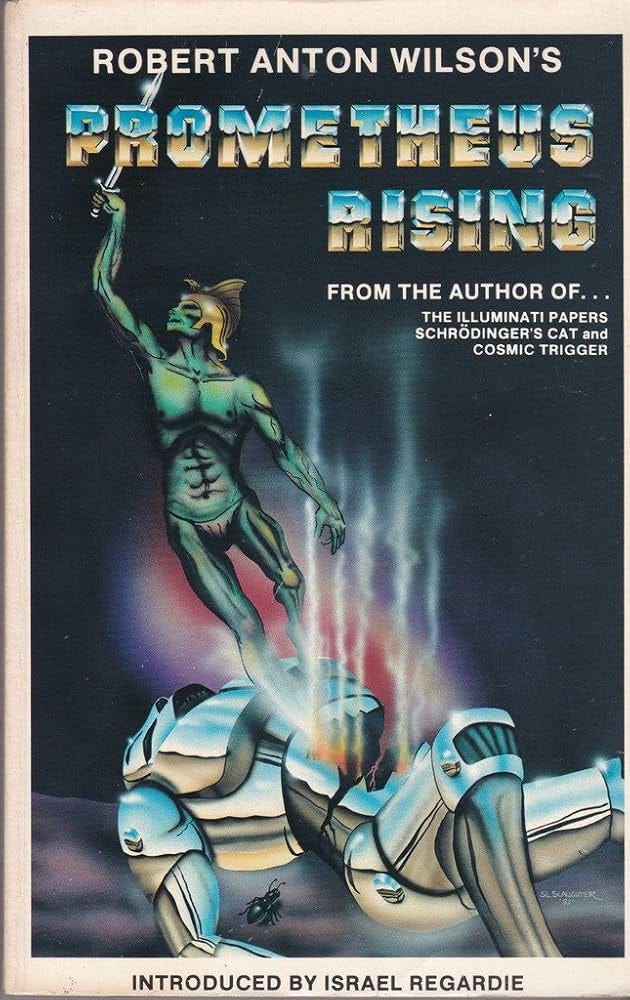
I’m a total nerd. And so I wanted to write about two books that I really love, which are Robert Anton Wilson’s magnum opus, Prometheus Rising, a consciousness manual from 1983, and Frank Herbert’s Dune series, in my opinion the greatest sci-fi series of all time. Dune is about more than giant sandworms and space messiahs. I’ll admit that I’ve only read the first four Dune books and some of the Brian Herbert continuations, and I’m still working through the rest of the series. Regardless, this book series has deeply impacted the way that I think about things, especially when it comes to our latent abilities, just like Prometheus Rising did.
And so here’s this essay’s actual argument. Robert Anton Wilson wrote Prometheus Rising to make the case that enlightenment is a real physical event in the nervous system, something that happens in the body. And he calls it the neurosomatic circuit, circuit five in his model. And he meant something real and specific and physical by that. On the other hand, Frank Herbert spent the Dune books exploring that same principle using a young man, Paul Atreides, who became a Messiah, and who also instigated a jihad that killed something like 60 billion people. Paul also became the Mahdi, Muad’Dib, the Fremen Messiah, who also, like Robert Anton Wilson describes in Prometheus Rising, underwent circuit five brain change. I think that these two books agree on that illumination process as being something fundamentally real.
Robert Anton Wilson’s Prometheus Rising has a powerful quote in it, which is that we’re all born giants raised by small people who train us to walk around with what he calls a perpetual mental crouch. And the book, he says, is a guide for learning to stand up to our full mental height. Basically, what he’s saying is that we have latent abilities within our brains and nervous systems that most people never access. The book walks us through Tim Leary’s eight circuits of the nervous system, starting with basic survival responses and building up through what he calls neurosomatic consciousness, the fifth circuit. That’s the one that produces bliss, ecstasy, and what mystics across every tradition have described using different vocabulary. Christian mystics called it the descent, the dark night of the soul, and its arrival rapture. Kabbalists and magicians call it crossing the abyss. Zen Buddhists call it enlightenment. And Wilson treats this as an ordinary, repeatable brain change open to anyone. Wilson’s argument is that these are all the same event wearing different religious and cultural identities, and that it’s reachable on purpose through deliberate practice.
Wilson leans hard on my old friend, Aleister Crowley, in this chapter, who I have a personal connection to through my own practice of Thelemic magick. He points out that Aleister Crowley, who filled his books with riddles and jokes and told his students never to believe him, really took this idea of brain change very seriously. Crowley’s writings describe a variety of different practices, including pranayamic breathing, which is the specific yogic technique that Wilson credits with reliably triggering this circuit. Pranayama is when you consciously and deliberately modify your breathing to reach altered states of consciousness. And for this, Wilson says Crowley was very serious. Crowley was a lot of things, and some of that deserves real scrutiny, but he wasn’t a fraud when it came to sharing the technical side of his experiments in consciousness. That was something that he really did and very deeply explored and was a pioneer in. And the exercises in his A∴A∴ curriculum, which is his system of training to become an adept and a magician, exist because he had actually done this work himself and wanted other people to have a repeatable method. And I think he got there, I think Aleister Crowley actually did achieve this brain change, and I think Robert Anton Wilson thought so too.
Wilson then makes the same point later again in the book with various examples. He lines up the Buddha, Muhammad, Jesus, and Paul, the four men whose brain change basically built the religious architecture of more than half the planet. And he asked what they had in common. Their doctrines disagreed completely. Their ethics disagreed completely. They didn’t even really agree on what had happened to them. The Buddha called his own enlightenment natural awakening and refused any assumptions of divinity. He famously answered the question of what he’d become with one word, which is awake. Muhammad had said he’d spoken with an angel. It was the archangel Gabriel, to be specific. Paul said he’d been struck blind and shown things that are not lawful to describe. And Wilson even quotes Aleister Crowley making the same observation about these four men, that despite sharing no doctrine and no ethics, something about them reads as one continuous event. Wilson’s own read is that the content of their awakening varied while the underlying brain change stayed identical, and that it’s the same signature showing up in four unrelated lives wearing different cultural perspectives and contexts.
Wilson also describes the dark side of this awakening process, the Sith side to the Jedi, so to speak. And that’s really the heart of this essay. He brings up Patty Hearst, who was the kidnapped heiress turned bank robber, and says that most people would call what happened to her bad, and what happened to the Buddha good. He argues that the two brain changes are functionally the same process expressed through two completely different lives with two completely different outcomes. And I feel like he’s making the same argument that Frank Herbert made in Dune with his fictional Messiah, Paul Atreides, but instead, Robert Anton Wilson is using this real kidnapping victim as an example.
And so here’s where Dune ties in. Paul Atreides, the anti-hero and messiah of the early Dune series, goes through the same event, which was triggered by a massive spice exposure. He drank the Water of Life instead of yoga or ritual, but he did also have years of Bene Gesserit training, which would profoundly affect his neurology. But when he survived the ingestion of the spice essence, he became the Fremen Mahdi, and the Kwisatz Haderach, the voice from the outer world, and the one figure the Bene Gesserit spent generations of careful breeding trying to produce, someone who can access both the male and female lines of ancestral memory at once, what they call Other Memory, along with full prescience, the ability to see into the future. Wilson has a circuit for this, the neurogenetic circuit, which is one level up from the neurosomatic one, and he specifically notes it can be triggered instantly by a strong enough dose of the right substance, instead of years of practice. Paul’s ingestion of the Water of Life nearly kills him, yet he comes out the other side able to see every branch of every possible future at once, while carrying the accumulated memory of his entire ancestral lineage. That is functionally exactly what Robert Anton Wilson means when he talks about this circuit opening.
His followers were not wrong to treat him as a prophet. He really did become what Muhammad became, what the Buddha became, a person who underwent total brain change and came out the other side operating on a completely different level than everyone else around him. Frank Herbert was exploring a phenomenon that is real in the same way that Wilson argues that it’s real. But the trouble starts afterwards when Paul becomes emperor, and the jihad of his religion that was set off in his name kills something like 60 billion people across the galaxy. He didn’t want it, he saw it coming and couldn’t stop it, which is his own kind of hell reserved specifically for prophets. But it happened under his name because of what his followers believed he was. And they were right. What they believed he was was true. He really was that. He was a prophet. And he was also responsible for the worst atrocities in the history of his fictional universe. Both things are true about the same person at the same time. This is what this whole article is about.
In a nutshell, enlightenment or awakening (this process of brain change that Wilson describes) is a physical event that can engender a person with remarkable and extraordinary abilities, but it does not have a moral component to it. Most of the morality around our ideas of enlightenment is cultural in nature, whereas enlightenment, Wilson argues, is a physical process.
Frank Herbert’s fictional Dune story illustrates something Wilson’s real-world examples can’t quite do. Patty Hearst is a minor, small-scale story that most people have forgotten. In fact, I had never heard of Patty Hearst other than reading about her in this book. The Buddha’s story got sorted by history into the “good” column a long time ago, although there have been debates about whether his philosophy was sexist, etc., yet no one’s had to sit with the discomfort of him doing something monstrous. But Paul Atreides does both at once at the scale of an entire civilization in a story that you’re inside of while it happens, and before history got the chance to sort him into these neat categories of either hero or villain. You have to hold that he’s a real prophet and also a war criminal at the same time, which is a more challenging thing to do than just agreeing with Wilson’s argument in the abstract.
I said earlier that I believe Aleister Crowley achieved this state. I still believe that. And Dune is part of the reason why I can hold that belief without needing him to have been a flawless or perfectly good man. He wasn’t always one. Some of the things that he did to people close to him were careless or cruel. And none of it erases the seriousness of the work in his A∴A∴ curriculum, or the fact that Robert Anton Wilson, decades after Aleister Crowley’s death, still treated him as one of the clearest sources on what this exact transformation looks like. This capacity for profound transformation and a person’s character are different axes. You don’t get to infer one of them from the other in either direction. Paul Atreides is the clearest illustration of that I’ve ever read. And I think Aleister Crowley is the clearest example of a real person that I know of.
Wilson makes one more claim worth sitting with. He says that if just over half the population reached this circuit, it would count as the biggest evolutionary leap in human history. Reading it again next to Dune, I noticed the hope depends on an assumption that Wilson doesn’t explicitly spell out, that people would arrive there the way he actually recommends, which is through years of serious practice, holding this awakening within the context of some sort of moral structure, as well as slowly enough for the rest of a person’s ego and personality to catch up with. Even Aleister Crowley’s own instructions call for daily practice repeated for years. But Paul never gets that option. His awakening is instant, involuntary, and nearly fatal, and he spends the rest of his life visibly unable to metabolize what happened to him fast enough to act well on it. And so Dune reads like a footnote to Wilson’s hope, which means that how you get there might matter almost as much as whether you get there at all.
I think about how people say Donald Trump or Vladimir Putin should drink ayahuasca or take iboga or undergo some psychedelic initiation, and I think Paul Atreides is an illustration of why putting a person with obvious character flaws in a position of tremendous power and then undergoing the ingestion of a powerful psychedelic to awaken latent capacities and abilities might actually be a very bad idea.
So, that’s my nerdy consciousness crossover essay, comparing Robert Anton Wilson’s consciousness manual from 1983 and Frank Herbert’s sci-fi fiction epic about a desert messiah. They’re making the same argument, just from opposite directions. And reading them together at the same time has taught me something that neither one says outright on its own. Waking up is real. Enlightenment is a real process. It’s available, it’s describable, and people have been reaching it on purpose for thousands of years under a hundred different names. But what you do once you’re awake is a separate project entirely, one that doesn’t come free with the transformation. And nobody, not Paul Atreides, not Aleister Crowley, not the Buddha, gets to skip that part. And so, even though I’m still working through the rest of the final Dune books, I already know how this ends for Paul Atreides. And I’m more interested in what this means for the rest of us.
Personally, I find these ideas both very inspiring because of the claim that there are latent evolutionary capacities that humanity has yet to reach and that we can strive for individually. But I also think that the story of Paul Muad’Dib is also a warning that with great power comes great responsibility.
The sleeper must awaken…
— Jake Kobrin
Mill Valley, CA
July 2026
Thanks for reading Writings From The Edge of the Known! This post is public so feel free to share it.
Writings From The Edge of the Known is a reader-supported publication. To receive new posts and support my work, consider becoming a free or paid subscriber.
Read more of my writing and subscribe on Substack: jakekobrin.substack.com.
