The Sacred Wound: Grief, Loss, and the Heartbreak That Transforms Us
Originally published on my Substack, Writings From The Edge of the Known, where I write regularly. Subscribe there for new essays.
Listen on audio:
The Sacred Wound: Grief, Loss, and the Heartbreak That Transforms Us
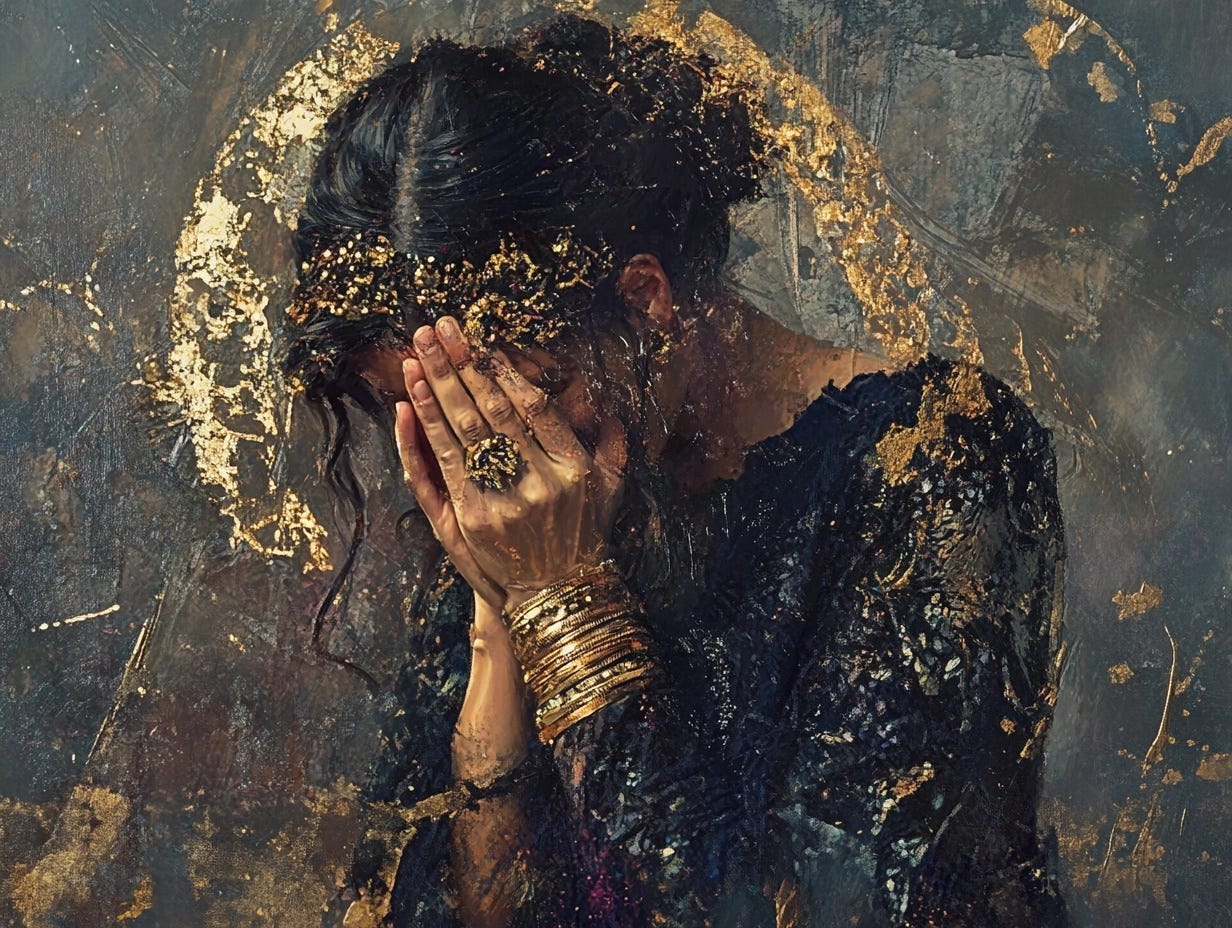
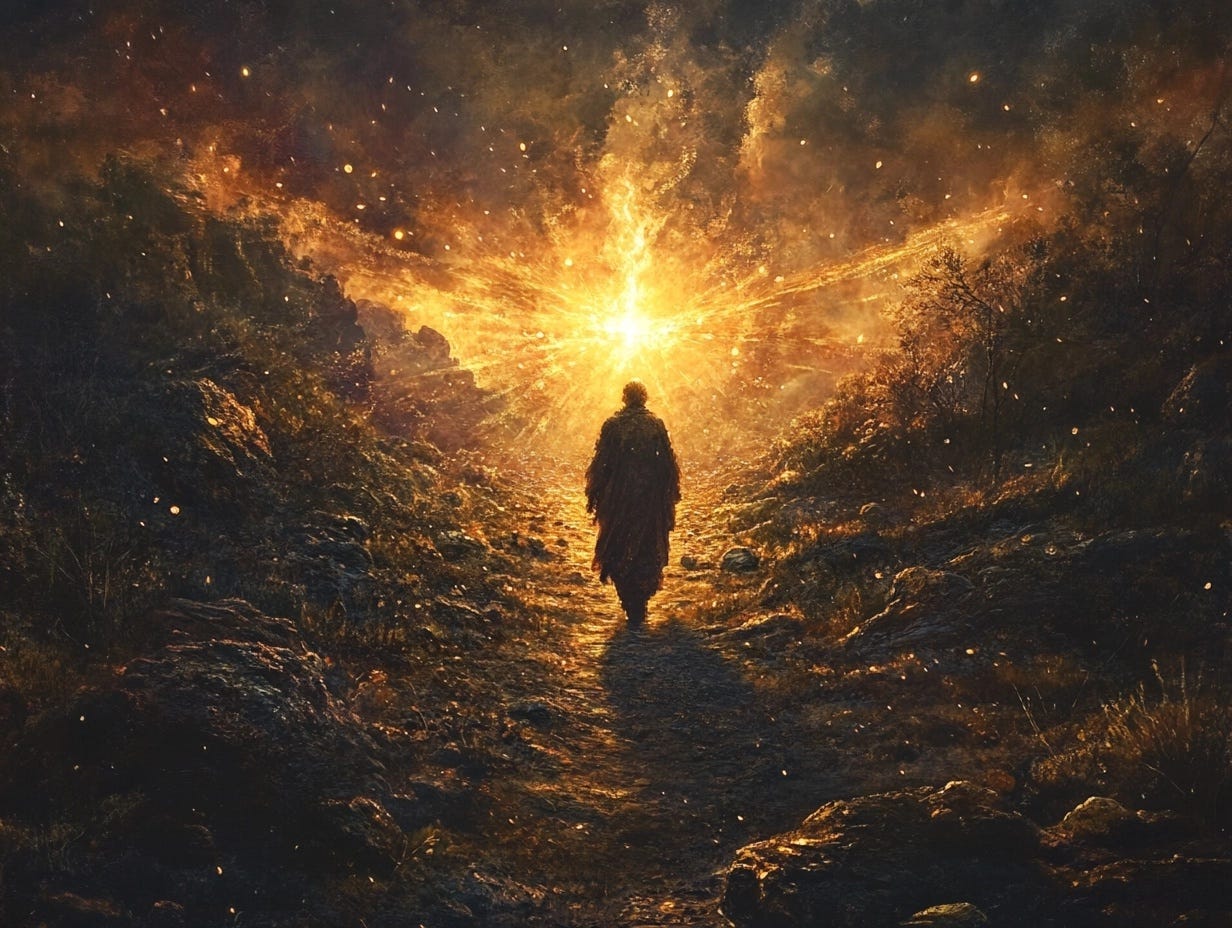
"The wound is the place where the Light enters you." – Rumi

I’m not getting over it.
This is the story of my recent dark night of the soul, and the initiation into carrying the sacred wound of heartbreak.
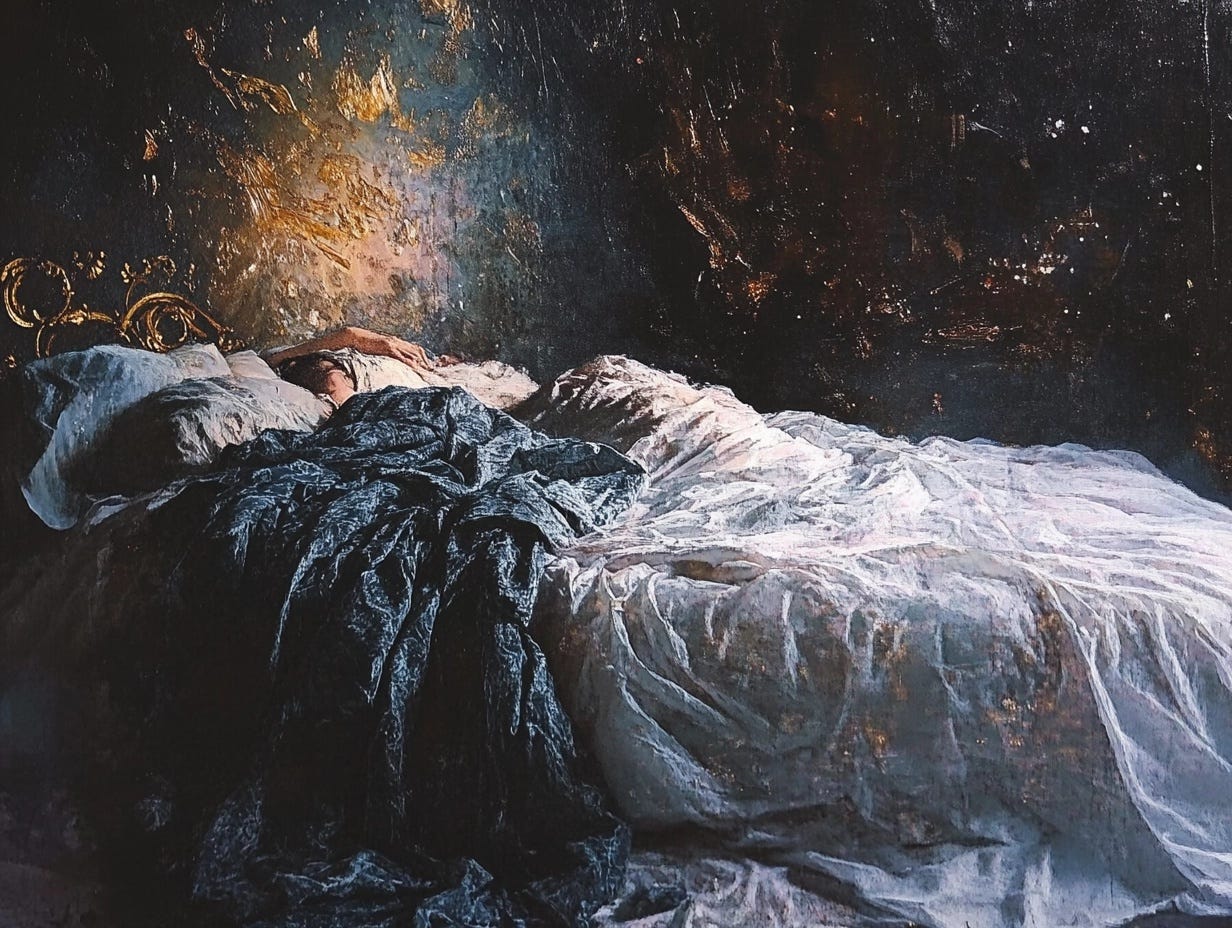
I still awaken with an ache in my chest where she used to lie. It has only been a few months since we parted, and the breakup’s wounds are fresh and throbbing. I’ve known heartbreak before. I’ve grieved the endings of many relationships, some slowly fading, others unraveling over time. But I’ve never experienced a loss like this, so sudden, so absolute, and so unresolved. To be left in the middle of love, with no warning and no closure, is a kind of devastation that eclipses ordinary heartbreak. It wasn’t just the end of a relationship but felt like being torn from a myth I was still living inside. And that’s exactly what I have come to understand, and what this piece is about - the archetypal myth of the sacred wound, the sacred grief that forever changes and molds us.
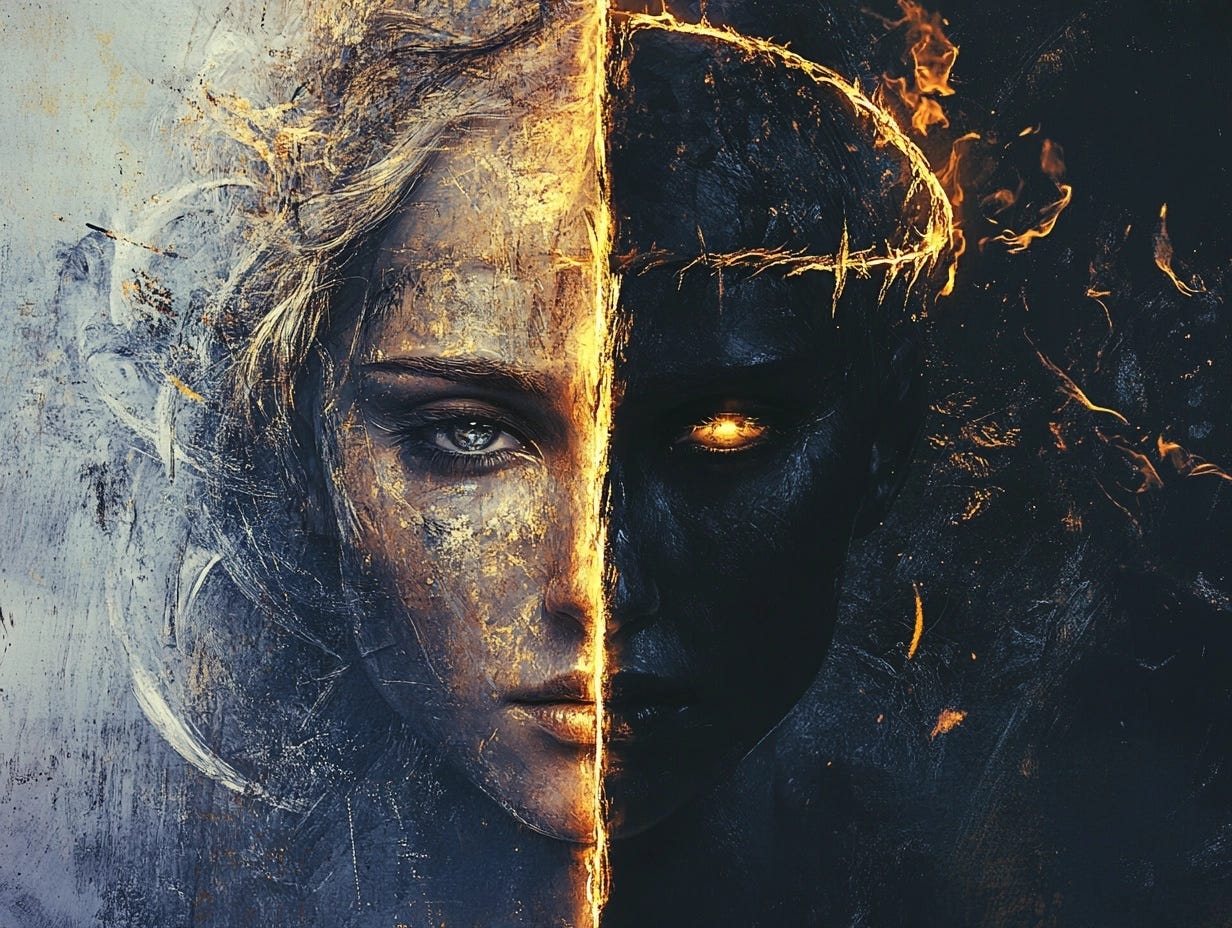
In the quiet morning light, I sense the missing presence of my beloved as an exiled living myth. She comes to me now in dreams and reveries as a Fallen Angel, a fallen and wounded exile from heaven who illuminated my life briefly with intensity, vulnerability, and otherworldly light. At times I see her as Lilith, the mythical seductress and the first wife of Adam who refused to submit, a dark feminine muse whispering forth forbidden wisdom and magic. She was my Wild Muse. We loved each other with a fierce, intense, mythical and unyielding passion, and yet that passion carried both nectar and venom. Like Tristan and Iseult under the spell of a love potion, we were intoxicated by a love that felt fated and profound, an enchantment as beautiful as it was ultimately unsustainable and destructive.

There are wounds we carry that do not ever fully heal.Not because they refuse to heal, but because they are not meant to. They are not merely ruptures of the flesh or even the heart, but cracks in the soul through which something mythic seeps through. These are what I callsacred wounds—the kinds of wounds that reshape a life, not as scars to be concealed, but as openings through which destiny whispers. These are the stories where heartbreak becomes initiation, and grief becomes our guide.
There may be a part of me, a private chamber of my heart, that will always long for her, a part of me that remains in the shadowy underworld with her. But as I understand and realize that this is in fact part of the mythic fabric of human kind, I find acceptance in that. I understand that I would not be who I am now, nor the man I am to become, without the sting of this sacred wound. It has carved my character, opened my heart in unexpected ways, and set me on a path I never would have walked otherwise. And many characters from both life and mythology resonate and reflect this tragic and permanent wounding that shapes destiny.
They say “grief is love with no place to go,” and indeed my love for her became an untethered force, reshaping me into something new. Some losses resist closure; some griefs are not meant to be “gotten over.” Instead, they become part of our being, woven into the fabric of our identity. I now think of this enduring sorrow as a Sacred Wound: an injury of the heart that never quite mends, because it is not supposed to. It stays with us, and in staying, it teaches us and transforms us.
The poet Hafiz says, “Don't surrender your loneliness so quickly. Let it cut you more deep. Let it ferment and season you as few humans and even divine ingredients can. Something missing in my heart tonight has made my eyes so soft, my voice so tender, my need for God absolutely clear.”
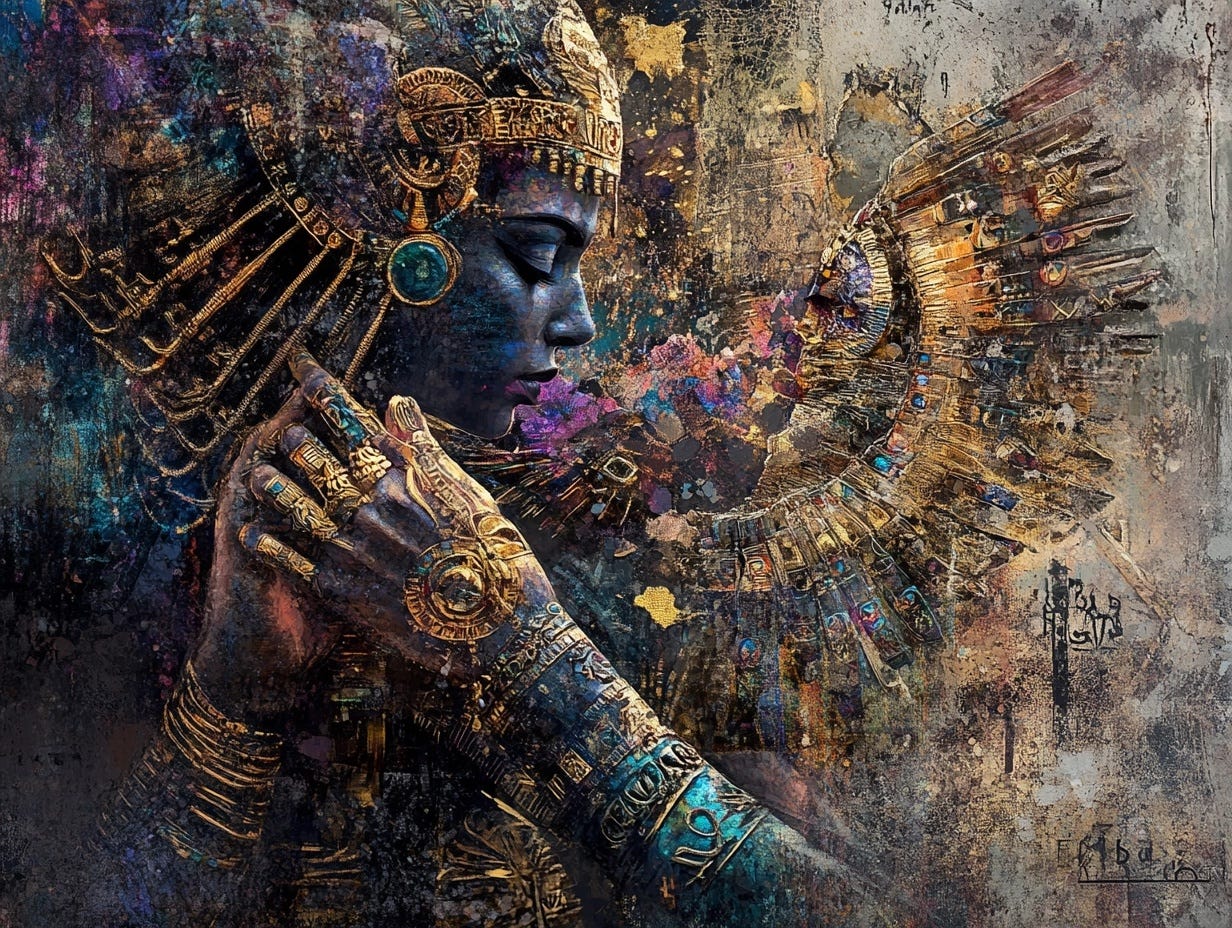
About the Sacred Wound in Myths
In the myths and stories that have guided humanity for millennia, I started to see reflections of my own wounded and aching heart. I realized I am far from alone in this experience. In fact, the idea of a wound that defines one’s destiny is ancient. It appears in our oldest tales and reverberates through our spiritual and psychological wisdom. My personal story is just one account of countless others who have carried a similar sacred wound. To explore this further, I want to step beyond my story and into the wider mythic landscape - into the stories of lovers, heroes, poets, and seekers who, like me, were marked by a grief that became a sacred part of their psyches and stories, and hearts - forever.
The sacred wound has many faces in myth. It is Chiron’s incurable injury, received from a poisoned arrow, suffered in silence even as he teaches gods and heroes. It is the grief of Orpheus, who turned back too soon and lost his love forever to the underworld. It is the wound of Isis, who wandered the earth gathering the scattered body of Osiris, forever remaking him in fragments. It is the exile of Psyche, who betrays love in a moment of fear, and must walk the gauntlet of divine trials to reclaim her soul’s union.
In these stories, the wound is not only something to endure but something to become. It initiates us into a new life. And this is not mere metaphor: it is the lived reality of countless artists, mystics, and seekers across time, who have borne some deep tragic incident, often through love lost, abandonment, failure, or death, and emerged altered, hallowed, and in some way… more whole.
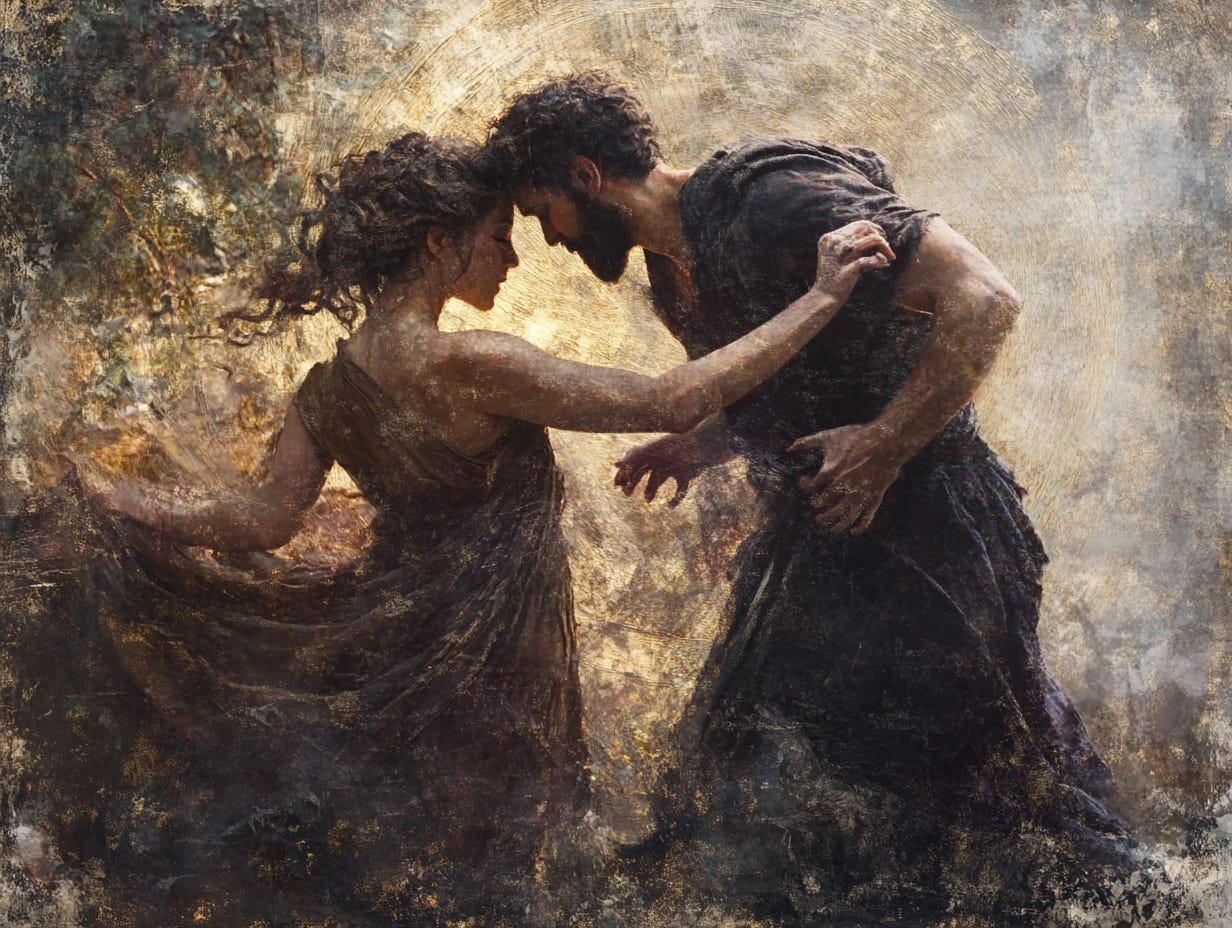
Our ancestors knew about the sacred wound. They told stories of heroes and lovers whose lives were shaped, and sometimes shattered, by loss. One of the most poignant is the Greek myth of Orpheus and Eurydice. Orpheus was the greatest musician that ever lived, and when his beloved wife Eurydice died suddenly, his grief was immeasurable. He descended into the underworld itself to retrieve her, enchanting the dead with his lyre and song of sorrow. The gods of the underworld granted Orpheus a chance to lead Eurydice back to life on one condition: he must not look back at her until they both reached the upper world. With Eurydice following, Orpheus climbed toward the light. But in his anxiety and longing, he did look back too soon, and in that moment Eurydice vanished, lost to him forever. Orpheus’s ultimate heartbreak was thus to lose his love twice. He emerged from Hades with an even deeper wound, one that never healed. He wandered the earth singing his grief, pouring the inconsolable longing into music. In this myth, we see that Orpheus’s wound became his creative destiny: his sorrow turned him into the archetypal poet, the singer of lamentations. The story suggests that some losses initiate a kind of lifelong descent; Orpheus himself never “got over” Eurydice’s death. Instead, his love and pain lived on through his art. He became the patron spirit of all artists who create beauty from suffering.
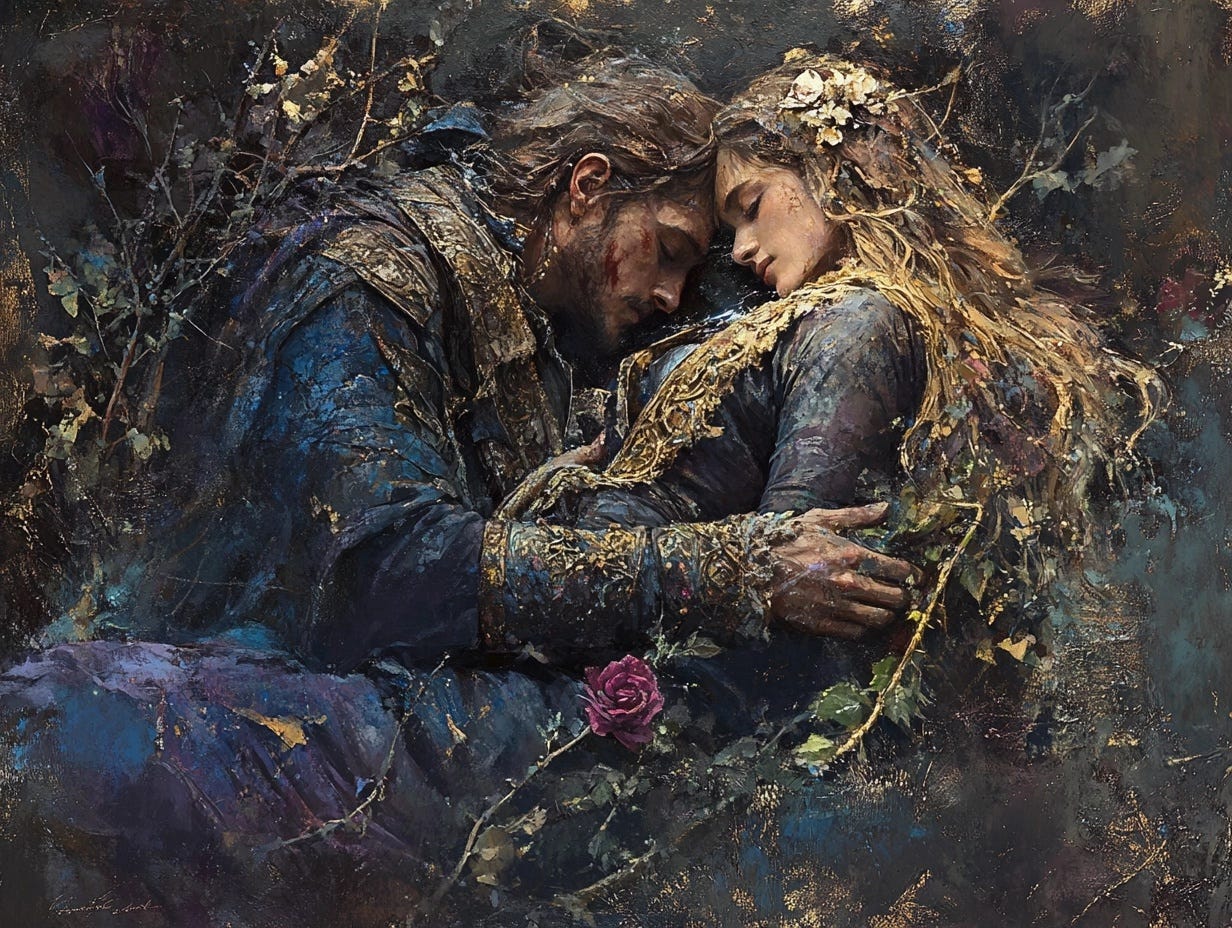
Another legend of a wound that defines a destiny is the medieval romance of Tristan and Isolde. Tristan, a noble knight, and Isolde, an Irish princess, fall helplessly in love due to drinking a magic potion. But their love is forbidden, Isolde is betrothed to Tristan’s king. The two experience a soaring, blissful union in secret, knowing it cannot last. Ultimately, their love leads to tragedy: in many tellings, Tristan is gravely wounded in battle and sends for Isolde, believing only her healing touch can save him. But by cruel fate, she arrives too late; Tristan dies of his wound, and Isolde, finding him dead, dies of grief beside him. They are buried together, a briar and a rose growing entwined from their graves. In death they are united, but in life their love remained agonizingly unresolved. This myth cemented the Western idea that profound love is often intertwined with sorrow and death. As analyst Robert A. Johnson observes in his book “We”, the story of Tristan and Isolde shows how romantic love in the Western psyche rides a razor’s edge between ecstasy and destruction. Denis de Rougemont famously noted that our notion of romantic love is “inextricably linked with death” —an idea Johnson echoed in his Jungian study of Tristan and Isolde. In other words, Western culture’s archetypal love story is inherently wound up with tragedy. The passion of Tristan and Isolde becomes sacred in our imagination because it was never fulfilled in ordinary life. Their wound, an eternally unfulfilled longing frustrated by the circumstances of their lives, gave their love a kind of immortal meaning. We retell their story not because of a happy ending (there is none), but because of the beautiful ache of love that remains even unto death.\
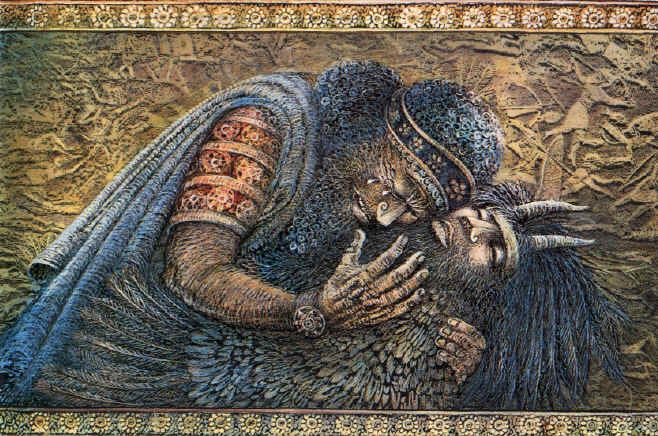
Even older than Orpheus or Tristan is the epic of Gilgamesh, etched on Sumerian clay thousands of years ago. Gilgamesh is a proud king who befriends the wild man Enkidu, and through that friendship discovers love and kinship. When Enkidu tragically dies, Gilgamesh is devastated. He cannot bear the fact that his beloved friend is gone forever; the reality of death seizes Gilgamesh’s heart and will not let go. In grief and panic, the king abandons his throne and wanders the earth in search of a cure for mortality itself. He travels to the ends of the world, to the realm of the flood survivor Utnapishtim, seeking the secret of eternal life so that he will never have to lose someone like Enkidu again. Gilgamesh’s journey fails to make Enkidu alive again, and he never does find immortality. But through his futile quest he gains something else: wisdom. He comes to understand the inevitability of death and the importance of living fully in the here and now. Gilgamesh returns to his city a changed man, a wiser king who understands the value of compassion and community. He memorializes Enkidu’s story on a stone tablet (the very epic we read). In effect, Gilgamesh’s wound becomes his teacher. The death of his friend forces him through the dark night of the soul, stripping away his arrogance and opening his heart. He emerges with a new purpose: not to avoid death at all costs, but to live so meaningfully that the love he has known will echo for ages. The epic of Gilgamesh shows that a great loss can catalyze a profound transformation. The hero’s grief becomes the engine of his destiny, driving him onto a spiritual quest and ultimately turning him into a wiser, more compassionate human being.
In all these myths, those of Orpheus, Tristan, and Gilgamesh, we see the outline of the Sacred Wound. A beloved is lost; a heart is broken; life is forever changed. The wound does not vanish. Orpheus never got Eurydice back. Tristan and Isolde never lived happily ever after in this world. Gilgamesh never defeated death. And yet, these figures continue, shaped by their wound into something larger than they were. Their suffering leads them (or those who remember them) toward deeper truths. Orpheus finds immortal song. Tristan and Isolde become symbols of love that lives beyond the grave. Gilgamesh gains wisdom and writes an enduring story. These myths carry a paradoxical truth: there is a tragic beauty in a wound that never heals. The very impossibility of closure becomes a path, an initiation into a fuller experience of life and spirit.
About the Sacred Wound in the Lifes of Artists
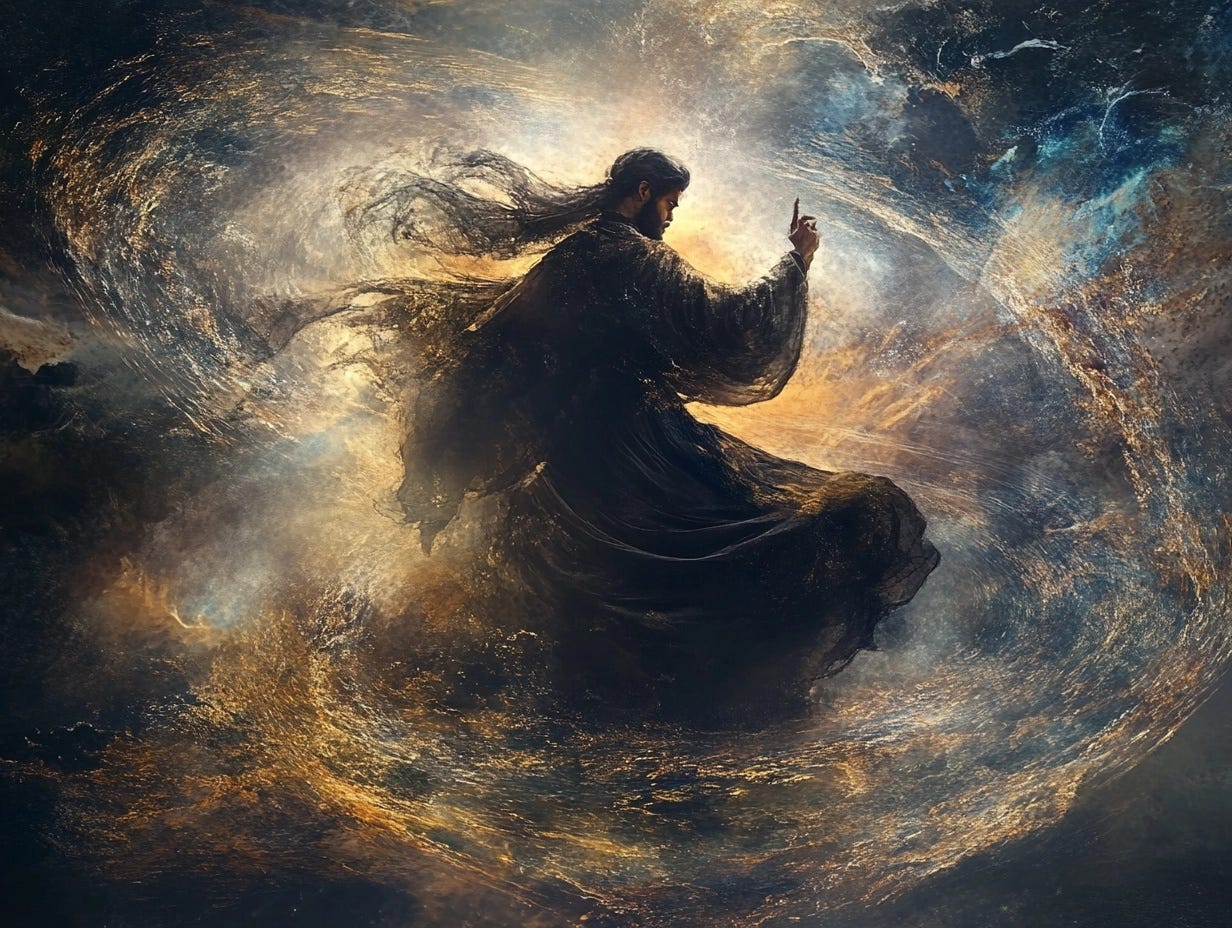
Not only in myth, but in real human history, we find examples of grief transfigured into spiritual insight and art. One of the most famous is the 13th-century Persian poet and mystic Jalaluddin Rumi. Rumi was a respected scholar and teacher when he met Shams of Tabriz, an wandering dervish. The two formed an instant and deep soul-friendship - variously described as that of master and disciple, or two intimate friends, or even lovers of the spirit. Shams awakened in Rumi a wild, divine love; under Shams’s influence, the sober scholar became an ecstatic poet. But this bliss was short-lived. One day Shams vanished. Some say he was killed by disciples jealous of Rumi’s devotion to him; others say Shams simply left, a wandering mystic moving on. Either way, Rumi was heartbroken. He searched for Shams everywhere, to no avail. The absence of his dear friend and spiritual companion became an unbearable wound in Rumi’s heart.
Yet from that gaping wound poured forth poetry unlike anything the world had seen. Rumi began speaking poems spontaneously in his grief and longing- verses of rapture, despair, and profound spiritual realization. He would whirl and dance and cry out for Shams, and thousands of verses would tumble from his lips. These became the The Works of Shams of Tabriz and later the epic Masnavi. Rumi’s longing for Shams transformed into a longing for the Divine. His human love opened into an infinite love for God, for the Beloved presence in all of existence. He understood that Shams had been a doorway to the Divine for him- and that door, now seemingly closed, in fact led Rumi to find the Beloved everywhere.
Rumi did not “get over” Shams. Until his dying day, he wrote love poems addressed to Shams, or to the Divine that took Shams from him. He even took on the name of Shams in some poems, signifying their ultimate union. Rumi considered this his wound holy. In one famous line, he says: “The wound is the place where the Light enters you.” This startling wisdom, that our pain is an opening to the light of God, could only come from someone who lived with a sacred wound. Rumi also wrote, “Don’t turn away. Keep your gaze on the bandaged place. That’s where the light enters you.” He understood that by staying with our sorrow, by holding the gaze on our wound instead of denying it, we invite a transformative light into our lives. His poetry overflows with this theme: that heartbreak, if fully embraced, becomes a gateway to the Infinite. In Rumi’s case, the disappearance of Shams cracked his heart open so wide that divine love flooded in, inspiring verses that continue to illuminate readers to this day.
Mystics across cultures have echoed this idea. The Sufi tradition to which Rumi belonged often uses the language of longing as the engine of spiritual growth. The pain of separation from the Beloved (whether a person or God) is seen as what drives the soul to seek union with the Divine. It’s as if the wound of love creates an inner emptiness that God’s love then fills. “Die before you die,” the Prophet Muhammad said, meaning to experience the ego-death of complete love and loss to taste the truth of eternity. The sacred wound in this context is the loss of self into love, often brought about by a great grief or longing. Rumi’s mentor Shams had taught him about the annihilation of the self in love; losing Shams gave Rumi the real experience of that annihilation, which he transmuted into poetry and teaching.
We see a similar pattern in other mystics and artists. The poet Rainer Maria Rilke, deeply influenced by mysticism, wrote in one of his letters that “love and death are the great gifts that are given to us; mostly they are passed on unopened.” In other words, love and loss are sacred offerings of life, but few of us truly open them up to see what’s inside. Rilke’s own life was marked by a kind of existential sorrow and longing; rather than flee it, he mined it for insight and beautiful verse. He even wrote an entire cycle of poems (the Sonnets to Orpheus and the Duino Elegies) that wrestle with the coexistence of joy and sorrow, life and death. Rilke came to view grief as an integral part of being human, something that deepens our capacity to love and to live. He advised a young poet to “live the questions now” and to embrace solitude and sadness, trusting that these experiences would eventually ripen into meaning. Indeed, Rumi and Rilke both show that longing itself can be a form of prayer, a painful grace that keeps our hearts connected to what is most sacred.
Initiation Through Suffering: Psychological Insights on the Wound
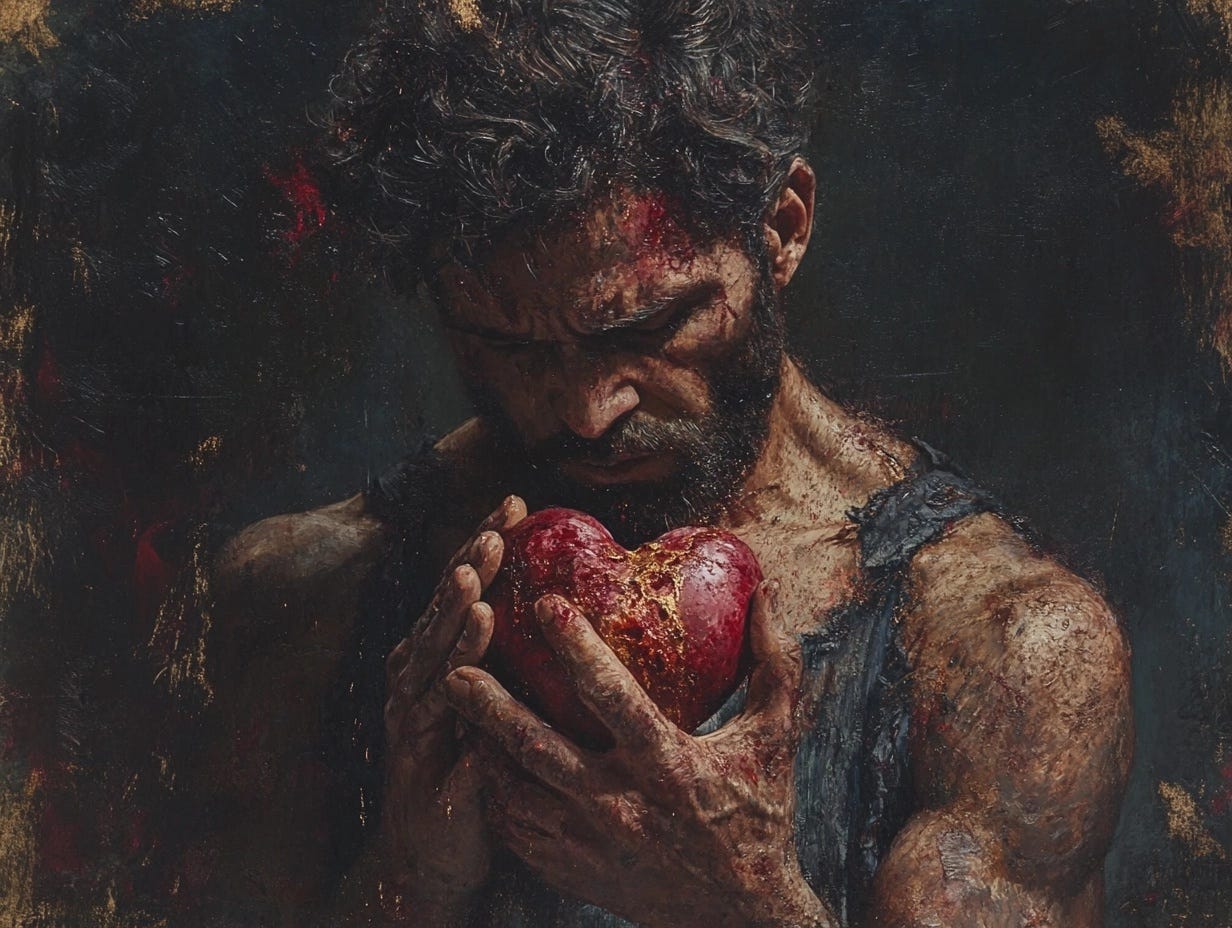
Why would a wound like grief be sacred? Modern psychology, especially Jungian depth psychology, offers some profound answers. The psychologist Carl Jung observed that suffering is often the catalyst for growth and individuation. “Seldom, or perhaps never, does a marriage develop into an individual relationship smoothly and without crises; there is no coming to consciousness without pain,” Jung wrote. In other words, without the trials and breakdowns of life, we don’t wake up. Pain forces us to expand our awareness. In Jung’s view, the psyche seeks wholeness, and often it is through wounds, through the conflicts, losses, and troubles we’d never choose, that the psyche pushes us to go deeper. Jung even formulated the archetype of the Wounded Healer, using the myth of Chiron (the wise centaur who was wounded incurably) as a model. He famously said, “Only the wounded physician heals.” The idea is that one’s own affliction can become a source of healing ability and empathy. Extrapolating broadly: our emotional wounds, if we tend them and learn from them, grant us a kind of gravitas and wisdom that can not only heal ourselves but also help heal others. The wound teaches us humility, compassion, and the limitations of being human, lessons that are essential in any soul work.
The Jungian writer Robert A. Johnson, who studied romantic love through myths like Tristan and Isolde, suggested that modern people often seek a spiritual experience through romantic passion. We “fall in love” and experience ecstasy, but when that high inevitably crashes, through loss or betrayal or simply the passage of time, we are left with a huge wound. Johnson noted that Western culture doesn’t prepare us to handle this well; we lack true rituals of grief or transformation for lost love. But if one approaches it consciously, the heartbreak can become a rite of passage. In the Tristan myth, for example, the destructive passion (when not integrated) leads to literal death; but symbolically, that “death” can be the death of our naive self, out of which a wiser self is born. The French alchemist’s dictum “solve et coagula” (dissolve and coagulate) applies here: love dissolves us, and grief then allows us to coagulate into a new form. Johnson wrote that it’s possible to let the ideals of love move to a spiritual plane, to recognize that the beloved awoke something divine in us that ultimately cannot be lost, because it didn’t solely belong to the human partner. In essence, heartbreak can initiate us into a larger love, if we let it. It’s a harsh initiation, no doubt, a kind of emotional death and rebirth.
Another Jungian thinker, James Hillman, went even further in emphasizing the value of enduring wounds. Hillman believed that our pathologies and pain are not merely things to cure; they are the soul itself working upon us, deepening us. He wrote that wounding “opens” us to the archetypal dimension – it forces us to see life not just in literal, personal terms but in mythic terms. In one essay, Hillman says that a deep wound magnifies our consciousness and makes us an “open wound” through which the realities of existence (including limitation, mortality, vulnerability) can be deeply felt. The wound reveals our mortality and humanity: “The wound is one’s mortality… its opening into humanity through a vulnerable and excruciatingly painful spot,” Hillman writes, invoking the image of Achilles’ heel and other mythic vulnerabilities. This idea resonates: our wounds make us human. They humble us, stripping away the illusion that we are invincible or separate from others. In the presence of great pain, we realize how connected we are to all who suffer.
Hillman also said our wounds are like “openings” to soul, and that we return to them again and again throughout life, each time learning a bit more. In the words of therapist Francis Weller, summarizing Hillman: “Consider how often we are brought back to the cave of our wounds… as a way of remaining close to something essential in the making of soul. It is through the ongoing entanglement with our suffering, that flavor and shape are delivered into our lives.” Hillman put it succinctly: our wounds and traumas are “salt mines from which we gain a precious essence and without which the soul cannot live.” What a stunning reversal of our normal attitude! The very thing we think is “ruining” us (our wound) contains the salt, the flavor of our soul. Without that salt, our life would be bland, shallow, insubstantial. With it, we have depth and savor. If we consider my own story of the loss of my ex-partner: our love and my loss of her is a salt that has flavored my soul. It has given me a depth and a compassion I lacked before, and a keen awareness of life’s preciousness. It has driven me to study myths and psychology to make sense of my pain, studies I might never have pursued otherwise. In short, it gave my life shape and direction. Hillman would say that in tending our wound, “we return again and again to tend what we love, and by so doing, we keep it alive”. My grief for her has indeed kept my love for her alive in my heart, and has kept me in touch with the tender core of myself.
Poet and author Robert Bly, a leading figure in the mythopoetic men’s movement, often spoke of the gifts carried by wounds. He noted that in many fairy tales and initiatory myths, the young hero is wounded or marked in some way, and this mark becomes a source of uniqueness or power. Bly once said, “Where a man’s wound is, that is where his genius will be.” This aligns with Jung’s wounded healer and Hillman’s salt mines. Our wound points to our genius, our particular aptitude for empathy, creativity, or understanding. Bly also remarked in his later years, “As I’ve gotten older, I find I am able to be nourished more by sorrow and to distinguish it from depression.” That’s an important distinction: sorrow (or grief) is a rich, soulful emotion that can nourish us, whereas clinical depression is static and depleting. Grief, when consciously engaged, keeps us connected to what (or whom) we love. It has movement; it flows like a river of feeling that eventually leads us to new places. Depression, by contrast, is like a swamp that stagnates. Bly implies that by honoring sorrow, letting it in, rather than fighting it, we can be fed by it. It can teach us how to feel more deeply and live more authentically.
All these insights suggest that the Sacred Wound is essentially an initiation: a trial by fire that can burn away our shallowness and self-centeredness, leaving behind a wiser, more soulful being. This initiation often feels like destruction, indeed, part of us is destroyed (the innocent part that believed life could be without great loss). But what is reborn is someone tempered by grief, with eyes that can see a deeper layer of reality. After my sudden and painful loss of my partner, for example, I found myself much more attuned to the sufferings of others. My wound has made me a more empathetic and caring friend and I can now speak from a deeper place, not just the surface. In mythic terms, I had descended to my own underworld and returned with a gift: in my case, the ability to articulate grief and to hold space for others in pain. This is why many spiritual traditions quietly honor the broken-hearted. In Christianity, the Sacred Heart of Jesus is depicted as a heart punctured and bleeding, ringed by thorns: divinity wounded. In Buddhism, the first Noble Truth tells us that life entails suffering; only by facing this truth do we begin the path of liberation. The archetype of the Sacred Wound appears in countless forms, all suggesting that our unbearable pain can paradoxically become the source of our greatest redemption.
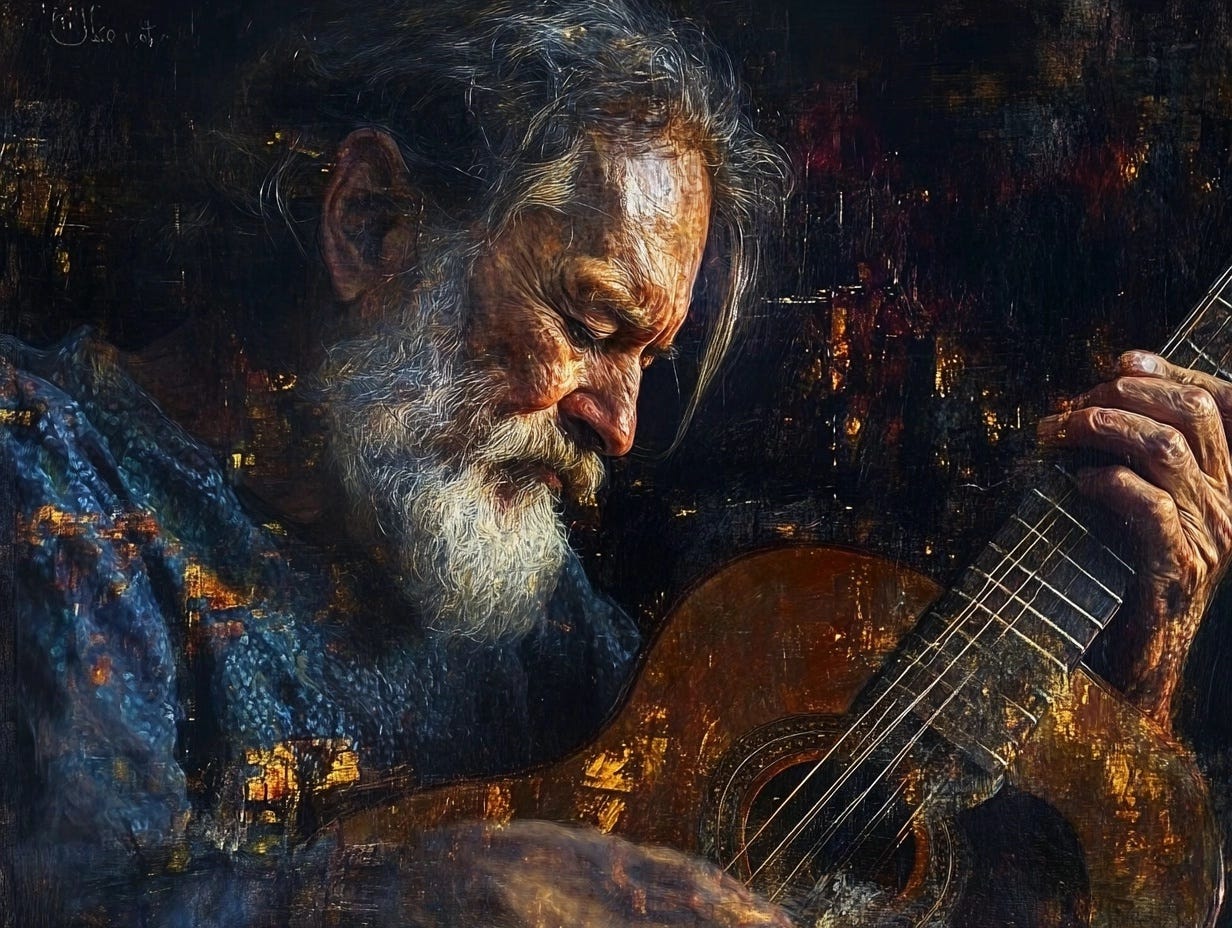
Art Born of Grief: The Wound as Creative Muse
When channeled with love and courage, the sacred wound often gives rise to art. So many of the world’s great artworks, poems, and songs are transmuted grief. We’ve already seen this in Rumi’s poetry, which flowed from the loss of Shams. Consider also the work of artists like Leonard Cohen and Nick Cave, who have openly lived with their wounds and made art from them.
Leonard Cohen, the Canadian singer-poet, struggled with depression and heartbreak throughout his life. He had a melancholy spirit and many romantic sorrows, which he distilled into songs and poems of haunting beauty. Rather than pretend to be happy or “fixed,” Cohen embraced his brokenness as part of his creative identity. In his song “Anthem,” he famously sings: “Ring the bells that still can ring / Forget your perfect offering / There is a crack, a crack in everything / That’s how the light gets in.” These lines have become almost proverbially famous because they capture the same truth Rumi spoke of: the idea that it’s through our cracks, our wounds, that the light of goodness or enlightenment shines through. Cohen, who spent years in a Zen monastery and wrestled with spiritual questions, knew that striving to be perfectly unbroken was an illusion. It’s the brokenness that makes us real and lets grace in. The crack in everything is universal: no life is without loss. But that’s exactly why no life is without hope, the light gets in through the cracks. Cohen’s body of work is essentially a testament to longing and resilience. Songs like “Hallelujah” carry a bittersweet mix of pain and praise. He once said that his sorrowful but hopeful songs were an answer to how he kept going despite depression. His wound became his muse, gifting the world some of the most healing songs of our time.
Nick Cave, the Australian musician and writer, provides a more contemporary example. In recent years, Cave endured the tragic death of his teenage son, a loss that could easily have destroyed him. In the aftermath, however, Nick Cave’s work underwent a profound transformation. His album “Skeleton Tree” and later “Ghosteen” grapple with grief head-on, with raw lyrics that read like letters from the underworld. Instead of shutting down, Cave became more open and tender in his art, even in his public persona. He began an online project (The Red Hand Files) where he responds to fans’ letters with disarming honesty and wisdom, many of them about grief. In one widely-circulated response to a grieving fan, Cave wrote: “It seems to me, that if we love, we grieve. That’s the deal. That’s the pact. Grief and love are forever intertwined. Grief is the terrible reminder of the depths of our love, and like love, grief is non-negotiable.” He went on to describe grief as an almost physical presence that “occupies the core of our being” and extends to the limits of the universe. Rather than something to overcome, grief to Nick Cave is something to be carried, something that bears witness to the love that gave it birth. He even speaks of experiencing his departed son’s presence as “precious gifts” in the form of visions and feelings, calling them “spirit guides that lead us out of the darkness”. Here is a man turning the absolute darkness of loss into a creative, life-affirming philosophy. Nick Cave’s concerts and talks after his son’s death became almost like communal healing rituals; he would speak openly about mourning, creating a space where others felt safe to acknowledge their own wounds. His art changed to accommodate tenderness and mercy in a new way. We might say his wound gave him new dimension as an artist and as a human being. Like Orpheus, he went down into Hell and emerged with songs that can console the broken-hearted.
Throughout history, many artists have walked this path. Spanish painter Pablo Picasso had his “Blue Period” of melancholy after a friend’s suicide, creating some of his most emotive work. Country musician Johnny Cash poured the pain of personal loss and regret into songs that millions resonate with. The poet Elizabeth Bishop, who lost her father as an infant and her mother to mental illness, wrote the famous line “The art of losing isn’t hard to master” and crafted poems of meticulous sorrow and beauty. Frida Kahlo, stricken by chronic pain and heartbreak, painted self-portraits that scream with color and wounded pride. It’s as if the wound, when embraced, confers authority to speak or create in a way that truly touches others. The audience can sense the authenticity, the “blood” in the work. When we see a painting or read a poem born from real suffering, it can reach that wounded place in ourselves and bring comfort or catharsis. This is perhaps one of the greatest gifts of the sacred wound: it enables us to create art or offerings that help others heal. Our personal wound, in becoming art, transforms into a communal balm.
Robert Bly’s insight rings true here: the place of our wound can be the source of our genius. A person who endures a great heartbreak might develop a “genius” for music that moves the soul, or a genius for compassion in caregiving, or simply the genius of presence, being someone who can sit with another’s pain without flinching. These are arts of life as much as painting or poetry. In my own modest way, I found that losing my partner has given me the urge to write, to play music, and to express the inexpressible. My journals of love and loss gradually have turned into this essay. And I hope eventually, by sharing this and other writings, that others feel less alone in their own grief. I’ve realized that by sharing from my wound, I am offering something like what the great artists who have touched me have offered me. This essay is my attempt to alchemize grief into something beautiful or at least something meaningful.
About the Archetypal Themes in our Personal Relationship Story
Let’s go back for a bit to talk about my story and the story of heartbreak.
For most of my life, I dreamed of finding a partner who reflected not only my heart’s longings but the sacred myth that lived beneath them, someone whose beauty, soul, and creative fire matched the image I had carried inwardly for decades. And then I met her.
Her name was Light. To me she was an archetype made flesh. Lilith embodied, radiant with defiance and allure. A wild muse from some forgotten pagan rite. A fallen angel burning with the ache of pain and exile. She mirrored my private longings back to me with uncanny precision, through music, myth, art, eros, and an unspoken recognition that seemed older than our bodies. She was not perfect, but she was real in the way dreams sometimes are.
And loving her was like walking into one of my own archetypal corners of my heart and soul. I found myself living inside the story I had always hoped was possible.
But love, when it takes such mythic form, always carries shadow. And ours arrived with the full spectrum of light and dark. Our bond was deep and real, but it was also intense, nuclear, passionate, and reactive. The deeper we loved, the more our traumas revealed themselves. My own tendencies to cling in anxiety and fear, to over-express, and to seek emotional reassurance collided with her instincts toward distance, protection, and sovereignty. My abandonment wound and her betrayal wound, two ancient wounds we’ve carried, began to steer the ship towards a painful and fated shipwreck.
Despite this, our love endured. We both tried. There were moments when our hearts met in such bliss and stillness that time seemed to vanish. But the equilibrium was fragile. My nervous system began to collapse under the weight of perceived rejection. Her nervous system began to shut down under the pressure of being seen too deeply, or needed too much. We fell out of regulation, out of repair. And in the end, she left.
Not with malice. Not with cruelty. But with finality. She left suddenly and without repair. She severed contact completely, without closure, without a final conversation, without space to mourn together. And perhaps that is what made the wound so unbearable. I have experienced breakups before. I have grieved loves that faded or fell apart. But I have never before been abandoned in the middle of love, while still in the dream, still devoted, still holding out my hands in longing to repair.
This grief has not been ordinary. It has felt mythic. I am not mourning the loss of a partner alone, I have been mourning the death of a dream I had wrapped my life around. It was the collapse of a temple I thought we were building together. It was the death of the fantasy, the dreams, the story we were weaving together. The end did not arrive with conflict or explosion. It came like a sudden storm, leaving me in the wake of the fallen Tower in silence and rubble.
This is the wound I now write from, not just the loss of my closest person, but the loss of the axis I had been weaving my story around. The silence of that ending has become a chasm. And yet, I sense it holds a kind of initiatory power. I suspect that if I stay in it, and walk into it fully, I may emerge changed.
From the very beginning, our relationship felt fated. We met like two magnets suddenly aware of each other’s polarity. It was more than attraction, it was familiarity, as if we had played this myth out before. And because it felt sacred, I ignored the signs that warned me otherwise. She told me early on about her trauma, about her struggles with commitment and nervous system overwhelm. Friends cautioned me to move slowly. But I was already in the spell.
And to be fair, so was she. We danced as twin flames often do, unavoidably drawn to each other like moths to fire, orbiting each other with hunger, tenderness, and sparks of fear. We dreamed of art, of public collaboration, of sacred union. But behind those dreams lurked unhealed traumas and fears. She needed her safety and freedom. I needed stability and comittment. And so the love that felt like prophecy became unsustainable in practice.
Eventually, the space between us has widened beyond repair. Her friends encouraged her to leave and enforce strict separateness, out of a desire to protect her. And my attempts to hold her, to reconnect, has only pushed her further away. I crossed boundaries in my desperation, sending long messages, seeking closure, reaching through the void. I called it devotion, but it was dysregulation. I know now that I made her feel unsafe. And for that, I grieve.
Our story ended not with betrayal, but with tragedy. Two people who loved each other, who wanted to heal, who dreamed of magic, but who couldn’t yet meet in wholeness. It wasn’t just our histories that tore us apart—it was our nervous systems, our traumas, our archetypes.
And yet, I will not say the love was wasted. It has shaped me. It has broke me open. It revealed what still lived unhealed within me. It has summoned a version of myself I now feel called to become. That, perhaps, is the strange grace of a sacred wound, it doesn’t just hurt, it initiates.
I now see her as a reflection of my inner Anima: the wild, erotic, dark, and magical feminine that I have long sought outside myself. She came to mirror me. And then she vanished so I could reclaim what I had projected. That work is ongoing. It is painful. But it is holy.
I do not know if this wound will live with me forever. It feels like it might. But I do know it is meaningful. And I am learning to honor it, not as a curse, but as a passage. A part of me suspects I will carry this grief as part of my story forever, though I will and have already let her go.
If nothing else, it has taught me that love, when it truly arrives, is not meant to complete us. It is meant to reveal us. To break open the crust of our old stories. To call forth the deeper myth waiting to be lived.
What I’ve come to learn, slowly, through grieving and ritual and writing, is that this wound is not a punishment but an intiation, an invitation. A threshold. A consecrated opening.
Because grief, in its purest form, is initiatory. It removes us from the ordinary world and casts us into a liminal space, a sacred desert, where we are stripped of everything but our essence. And in that space, something else arrives. Sometimes it is clarity. Sometimes it is madness. Often, it is both.
Robert Bly said, “Where a man’s wound is, that is where his genius will be.” This is not a poetic exaggeration. It is the architecture of transformation. The artist emerges from heartbreak not despite it, but because of it. The healer becomes so through what they could not heal in themselves. The mystic finds the divine not in perfection, but in despair.
There is a lineage of those who have turned their sacred wound into gold: Leonard Cohen, whose poetry echoed with the ache of holy longing; Rainer Maria Rilke, who transmuted isolation into verses that pierced through so many hearts; Chiron, whose wound became the source of his healing power. These are not stories of people who "got over it." They are stories of people whoentered it, whomarried their grief, who let the wound become an altar.
In my case, I have begun to understand that the woman I lost was not just a partner. She was a mirror of the unclaimed divine feminine within me, a projection of the Anima, radiant and untamed. Her departure has forced me to turn inward and reclaim what I had outsourced: the feral beauty, the chaos, the magic, the fire. What I worshipped in her must now be born in me.
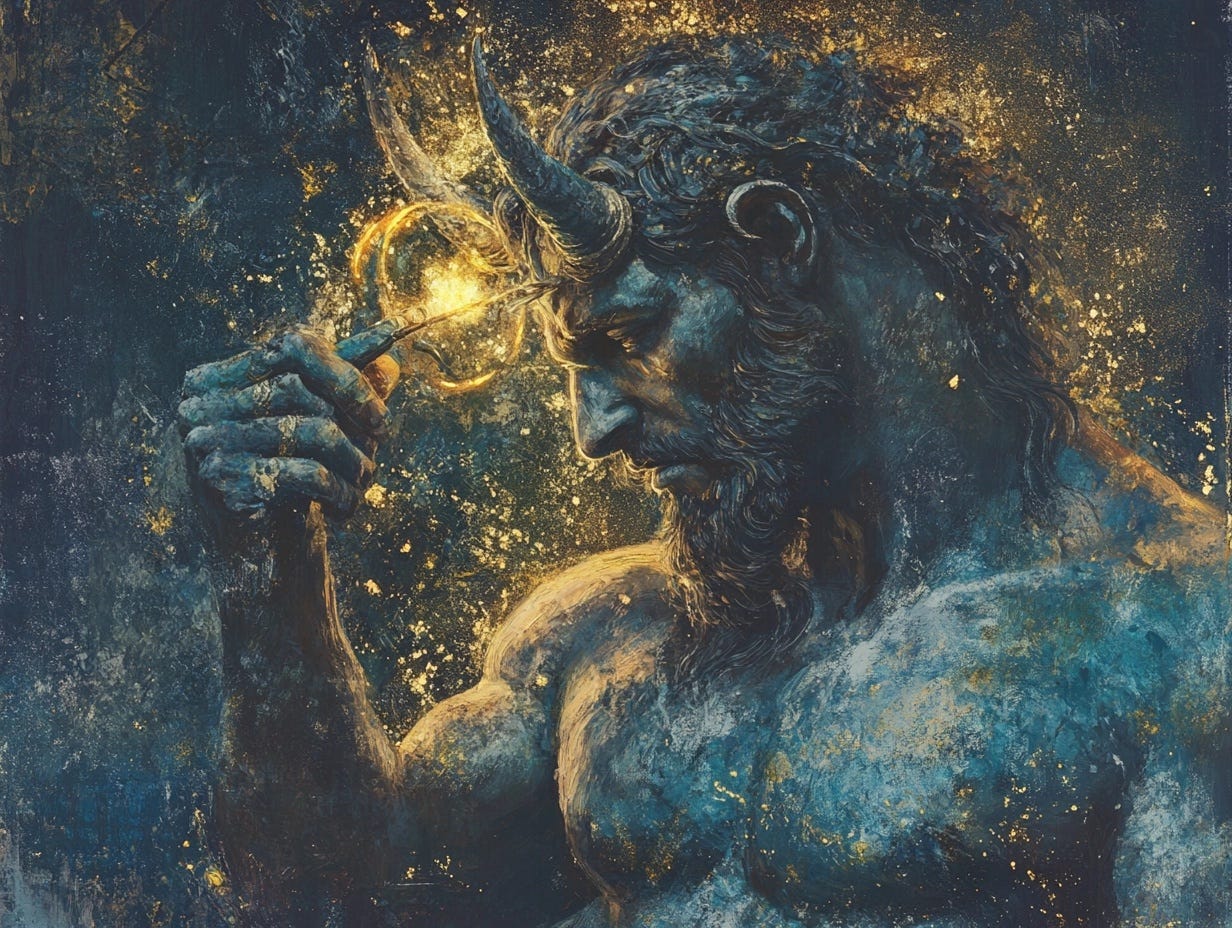
Chiron
In Greek mythology, Chiron was a wise centaur—renowned teacher of heroes—who was struck by a poisoned arrow that caused a wound even his healing powers could not cure. In pain and unable to die (for Chiron was immortal), he suffered greatly. Ultimately, Chiron found meaning in his suffering by using it to foster compassion and wisdom. He is said to have traded his immortality to be free of the pain, and Zeus placed him among the stars in honor of his sacrifice. Chiron’s tale has echoed through time as the archetype of the Wounded Healer: one who transforms their own pain into a source of healing for others.
I see my current journey reflected in Chiron’s story. I, too, carry an “incurable” wound of sorts – the loss of my beloved, which no remedy can apparently fix. I cannot simply undo the breakup or erase the love I still feel. Instead, I must learn to live with it, the way Chiron lived with his wound. And like Chiron, I suspect that this wound is here to teach me, to initiate me into a new role. There’s a concept in Jungian psychology (and echoed in astrology) that Chiron’s placement is where our deepest wound lies, but also where our gift of healing can emerge. In other words, “Chiron’s wisdom shows us how to transmute pain into a source of power.”
What might that look like for me? It’s still unfolding, but I can already see glimmers. For one, I have been writing more candidly and deeply than ever before. My journal has become a refuge where I converse with my pain and search for meaning in it. Songs are coming to me: new melodies and lyrics that pour out of the open wound in my chest. In some strange way, the beloved who broke my heart has also unlocked my heart, freeing a flood of creative energy. This creativity is raw and honest; it doesn’t shy away from darkness. It feels like tapping into an underground spring – perhaps the very “light” that Rumi spoke of entering through the wound.
I’m also finding that I am more empathetic than I was before. Suffering has a way of softening us if we let it. My own pain has humbled me and made me realize how universal heartbreak is. The particulars of my story may be unique – not everyone falls in love with a Lilith or Fallen Angel woman – but the core emotions are not rare at all. Many have loved and lost; many carry wounds that throb decades after the fact. I feel a kinship now with all wounded lovers, all who have had to let go of someone they adored because it just couldn’t work. In that kinship I sense the budding of the healer in me. I am not sure what form this healing gift will take, but I know that I want to eventually help others who walk this path. Even if it’s simply through sharing my story, or through the music and writing this experience inspires, I want my pain to serve a purpose beyond my own suffering.
All of this suggests that the very wound which hurts me so much now could become the source of my greatest contribution. This heartbreak might carve out a deeper capacity in me – perhaps to create art that speaks to the soul, or to show up for others in pain with real understanding. In mythological terms, the gods wounded me in the place I most loved, and in that wound lies a hidden treasure I have yet to fully uncover. The sacred wound may indeed become a portal to my genius, as Robert Bly intimates, if I have the courage to enter it and learn its lessons.
Walking the path of the wounded healer is not easy. I have to balance tending to my own hurt with the slow process of growth. I remind myself that healing is not a linear progression but a spiral. There are days I feel almost normal, hopeful that I’m moving on, and then a memory will pierce me. Chiron’s example tells me that it’s okay, healing can coexist with an enduring wound. One can carry pain and still radiate light. In fact, Chiron teaches that our vulnerability can become our strength. By remaining open – not shutting down or turning bitter – I keep the channel open for transformation. Yes, I am vulnerable now, profoundly so. My heart feels like an open wound at times. But I trust that remaining open is the only way the light gets in, and ultimately, the only way I can shine that light back out.
Carrying the Sacred Wound with Dignity and Love
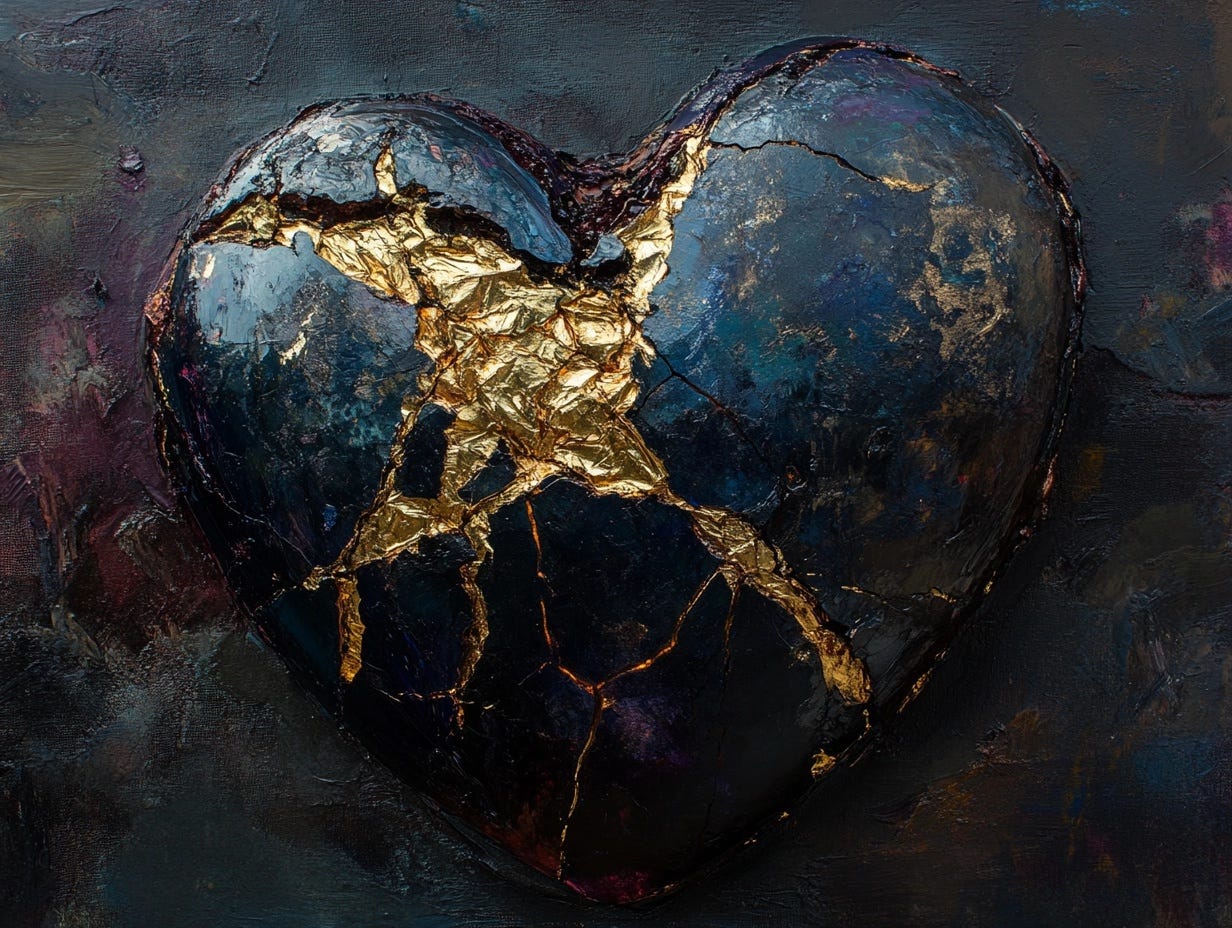
There is a certain tragic beauty in a life touched by a sacred wound. We often think the “goal” of healing is to erase the scar, to return to how things were before the injury. But what if the scar has its own story to tell, its own beauty? The Japanese have an art of mending broken pottery with gold (kintsugi), treating the crack as part of the object’s history to be honored, not hidden. Lives, too, can be mended with gold, if we treat our wounds as places to illuminate rather than shame.
To carry a sacred wound is to carry a reminder of how deeply we can love and how fragile everything truly is. It’s a burdensome honor. I will always carry the loss of my Luciferian Fire Goddess in my bones; it has become a part of me, a sacred scar. I carry it, however, not as an active bleeding injury (not as much anymore, at least), but as a enduring and important part of my story. It still aches on certain days. But I bow to that ache now. I see it as my link to something eternal, the love that gave it birth. And the universality of heartbreak. I do not want to “get over” it, because to get over it would be to forget the depth of love I was fortunate to taste. Instead, I strive to carry it with dignity and creativity, as so many before me have done.
Think of Orpheus walking out of the underworld, empty-handed yet filled with song; Gilgamesh returning to his people, chastened but wise; Tristan dying with Isolde’s name on his lips, their story inspiring lovers for centuries; Rumi whirling in grief and love until he becomes a conduit for the divine; Cohen and Cave standing on stage, vulnerable and authentic, turning pain into empathy among all who listen. None of these figures ever said, “I’m completely over it.” Quite the opposite, yet they integrated it. They let the wound remain, but they related to it consciously. They carried it in a way that added weight and gravity to their presence.
There is an initiation here for anyone who bears such a wound. The world around us often pressures us to “move on,” “find closure,” “be okay.” Those of us with sacred wounds eventually realize these well-meaning directives miss the point. We will move forward, yes, but we will carry our dead or our lost with us. As the psychologist Robert Neimeyer said, we don’t really get closure; instead we “relearn the world” after a loss. We learn a new way to live in a world that now lacks the presence of someone or something we loved. Part of that relearning is discovering how to keep that love present in a different form. I carry my lost beloved in me as inspiration, as memory, as motivation to live more fully. In that sense, I have a continuing relationship with my wound, it’s an ongoing dialogue, not a finished chapter.
To carry it with dignity means I do not use it as an excuse to collapse or to harm myself; I use it as a reason to be compassionate, to be creative, to serve something greater. Many who endure great loss eventually feel a calling to service, some channel their energy into causes (for example, parents who lose a child to an illness may start a foundation to help others). Some simply become the wise elder among their friends, the one who others turn to in times of trouble, because they know this person has been tempered by tragedy and will understand. In mythology, the wounded healer Chiron used his pain to become a mentor to the heroes of Greece. Each of us, in our own humble sphere, can do similarly. Our wound gives us a unique medicine to offer the world.
Let us also acknowledge: carrying a sacred wound is not easy. There are days it feels like a curse rather than a blessing. I still try bargaining with the Gods to undo this pain, that sometimes feels like a cursed mistake that it unfathomable and irredeemable. There are nights of loneliness, flashes of despair, moments when the unfairness and tragedy of loss hits like a punch in the gut. Dignity doesn’t mean suppressing those feelings; it means honoring them without being ruled by them. Creativity doesn’t mean we all must write songs or poems; it can simply mean we respond to our pain with imagination. Perhaps through ritual, lighting a candle for our beloved, speaking to them in prayer or journal, dedicating our actions to them. These are creative responses to loss that keep it dignified and sacred, rather than self-destructive.
In my journey, I have found solace in returning to myth and poetry whenever I feel alone in my wound. I have carved my words onto paper with blood from my heart. That is the magic of sharing our wounded stories. We find out that our personal wound is also a universal one. The names and details differ, but the core feelings are the same. We all either have or will have a great grief in our lifetime. It is part of the human condition. By speaking of it, by creating from it, we help each other carry it. In some sense, the “sacred wound” is a communal property as much as a personal one. In a genuine community (something our modern world often lacks, but which we can nurture in circles of friends or even online), people know how to be with each other’s pain. In the old days, villages had mourning rituals, and people wailed together at funerals, and there were designated times and places to let sorrow flow. Much of that has been lost in our fast-paced, progress-oriented culture. But I believe we are remembering the old ways, finding new expressions for them. A way of saying: we honor the wound, we will not look away. As James Hillman noted, in a world that idolizes constant growth and happiness, we must make room for the “soul values” of sorrow and remembrance.
My offering to you is this reflection born of my wound. If you carry one too, especially a romantic or soul-deep grief, I want to say: I see you. Your wound is painful, and it will change you, but it may also become your treasure. You might never get over it entirely, and that’s okay. Some loves are so profound we are not meant to simply move on as if nothing happened. Instead, we integrate the experience and let it shape our art, our work, our very way of being. We become, in a sense, initiated by the loss into a deeper love. A love that includes sorrow, a love that has tasted impermanence and therefore cherishes every fleeting drop of sweetness.
In carrying our sacred wounds, we join the ranks of Orpheus and Rumi, Tristan and Isolde, Gilgamesh and Enkidu, the wounded healers and the visionary artists. We carry the memory of what we lost as a living flame inside us. That flame can guide our destiny. It might light the way for others in darkness, too. This is the paradox: the grief that once made us feel broken and alone can become the very thing that connects us to humanity and to source. In the ache of missing someone, we come to know the preciousness of life and love more intimately than we ever did before.
I will likely forever miss my Cariad, my wife that will not be, the dragon who slept beside me. That is my sorrow, and it is my grace. It keeps me on my knees in reverence to life. It drives me to write, to seek meaning, to offer love to others, because I know how fragile it all is. My wound has, in a way, become my purpose. It is the well I draw from when I need empathy or inspiration. I have not “healed” it, but I have made a home for it. I carry it as part of my story, part of my strength. In the Celtic tradition, they talk of the “soul friend” (anam cara). I like to think that in some mysterious way, our lost beloveds become our soul friends on the other side. My lover in death has become my anam cara, guiding me invisibly. The wound of her absence is also the presence of her spirit in my life.
So to all who carry a sacred wound: I honor your burden. May you find the tragic beauty in it. May you allow it to shape you into a person of depth, empathy, and creativity. May your wound become a portal, opening onto the vast landscape of soul. And when the nights are hard, remember the old wisdom: “The wound is the place where the Light enters you.” Keep tending that place. One day, perhaps when you least expect it, something will shine through, an insight, a song, a connection, a moment of peace, and you will find meaning in your pain. Your grief, in its own way, will guide you to your destiny, and that destiny will be rich with the love you never let go of.
In the end, our sacred wound is a testament to having loved deeply. It is holy ground. We carry it with dignity and creativity so that, as Leonard Cohen put it, the light can enter through the crack. We carry it so that the love lives on, shaping a new story, a story of a life transformed by loss, a story that might inspire others when their time of loss comes. This essay is part of my story of carrying the sacred wound. We are all walking each other home, wounds and all, under the gaze of a million stars that have seen it all before. In that larger story, our personal sacred wounds become part of the collective story of humanity - of healing, art, and initiation that makes us fully human.
And so, I am weaving words for the ritual. I am painting and writing and invoking the parts of myself that I once exiled. I am creating a new mythology of self to transmute the grief and integrate it.
This is the task of the sacred wound. Not to forget. Not to repair. But to remember more deeply. To make meaning from the ruin. To write a new prayer from the ashes. To bleed and to write poetry as if it runs through us like sacred ink.
The sacred wound may never fully close. But in its ache, there is a secret. A blessing. A doorway.
And when we walk through it, trembling, we do not emerge broken. We emergereal.
I don’t know what the ending of this particular story will be. I don’t know if my beloved – my Fallen Angel – will remain a ghost to haunt my memory or if our paths will ever cross again in this lifetime. That chapter may likely be closed for good. And I may never see her or speak to her again. What I do know is that her impact on me will reverberate for years to come, perhaps forever in some form. And crucially, I have a say in how it reverberates. I can choose to let this wound fester into cynicism and despair, or I can choose to sanctify it, to treat it as sacred. I choose the latter. That is why I call this essay “The Sacred Wound.” Not because the pain is holy in itself (it hurts like hell, to be clear), but because I am deciding that it will be a source of meaning and positive transformation. I am consecrating my suffering so that it becomes fertilizer for something true and beautiful.
In practical terms, that means I will continue to grieve fully, giving myself permission to feel everything, while also slowly alchemizing the experience through reflection, creativity, and compassion. I will keep writing songs and poems and essays about her until the energy shifts from heartache to love and gratitude for what was. I will keep examining my own patterns, so that I can break the cycles of trauma that contributed to our downfall. Already I have sought therapy and dove deeper into my own psyche, determined not to let those old wounds run the show in future relationships. This is the kind of inner work that Robert A. Johnson might call “owning my own shadow,” taking responsibility for the pieces of me that were activated in our relationship. It’s painful work, but it is the work that creates wholeness.
I also find comfort in the universal nature of my ordeal. By framing my personal story in mythic archetypes, I tap into something collective. I know I’m not the first man to adore a woman who felt like a goddess and to be devastated by her loss. I know I’m not the only one whose trauma made it hard to love cleanly. When I say she was my Lilith or my Fallen Angel, a Dangerous Beauty who left me bereft, many intuitively know what I mean, even if the details of the story differ. These archetypes exist because countless others have lived some version of this story. Realizing this doesn’t diminish my experience, but rather ennobles it. It means my pain is part of the great human drama of love and loss. My task, then, is to turn my particular story into something golden that I can weave back into that overarching epic.
In closing, I offer a prayer of sorts – for myself, for my lost beloved, and for anyone who carries a sacred wound in their heart. May we find the strength of Chiron within us, the Wounded Healer who can hold pain in one hand and healing in the other. May our wounds indeed become places where the light enters, as Rumi promised. May we transform our heartbreak into insight, our suffering into service, and our pain into poetry. Someday, I believe I will look back and see how this wound has made me wiser, kinder, more alive and more human.
For now, I simply tend to it with reverence. This wound is a teacher. This wound is an altar. On it I lay the story of us – two souls who loved each other deeply but could not stay together. A tragic and fated love. I honor that story for all it gave and all it took. And as I step forward on this path, I carry the essence of my Fallen Angel muse in my heart, not as a crippling burden, but as a guiding light and a source of creation. This scar, when it forms, will be a reminder that I lived and loved deeply. It will remind me that I survived and that I transformed. In that way, The Sacred Wound will live on as a blessing – an intuition of forever that, in time, might just prove to be the birthplace of my own personal legend. A crucible and catalyst for necessary growth and change.
In magick, in myth, and in life,LVXmay crown the brow with light, but it is inNOXwhere the soul is carved—where the wound becomes the womb of wisdom, and darkness mothers the flame.
— Jake Kobrin, Ubud, Bali, April 2025
Read more of my writing and subscribe on Substack: jakekobrin.substack.com.
