The Pointed Finger
Originally published on my Substack, Writings From The Edge of the Known, where I write regularly. Subscribe there for new essays.
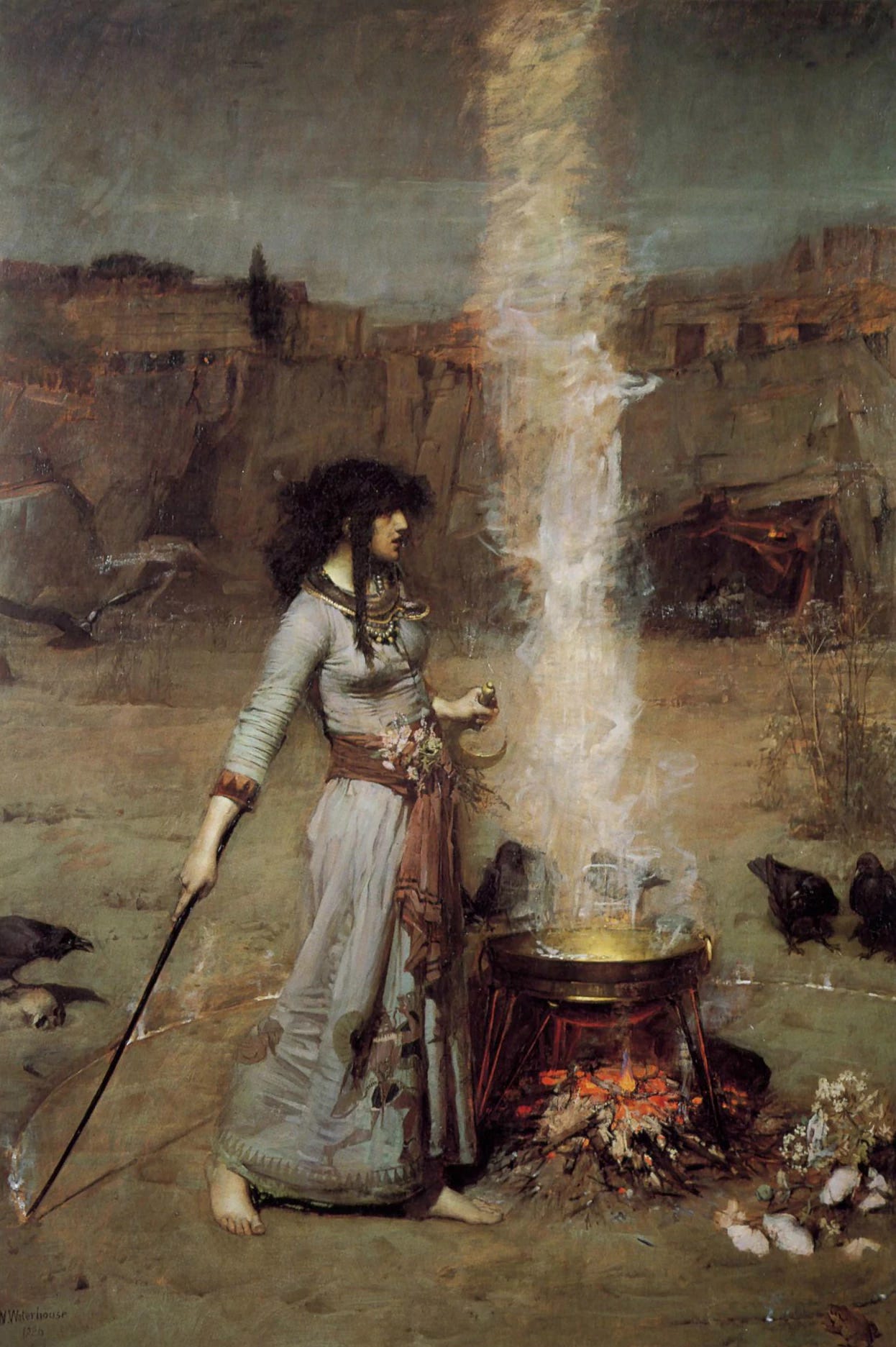
The Magic Circle - John William Waterhouse, 1886
Peter Grey, whose Apocalyptic Witchcraft stands as one of the defining works of contemporary witchcraft, writes that the tradition was born in the torture chambers of the Inquisition. That sentence is worth sitting with.
Modern practitioners who came to the Craft through romantic or nature-spirituality traditions sometimes prefer witchcraft as primarily a heritage of wisdom, herbalism, midwifery, communion with the wild. All of that is real. The torture chamber is also real. The witch as a category did not emerge from a community gathering knowledge in the forest. It was constructed, elaborately and violently, by people who needed a target.
That is the inheritance.
In Bali, where I lived for several years, rumours spread through the Western expatriate community that I was a Satanist. That my practices were harmful. That I was dangerous. This was not a vague social atmosphere I sensed from a distance. A retreat centre I called to ask about hosting a retreat had asked me to defend myself. We heard you’re a Satanist, they said, and I had to explain what I actually practised to people who had already decided and never asked. A friend told me later that before she met me, several people warned her away from me, that I was crazy, unsafe to be around. I was banned from a music venue where I had been a resident DJ, after someone told management I had hosted a Satanic ritual on the premises. I had actually merely DJed a dark bass music set with some Kenneth Anger visuals. The distinction did not survive the telephone game of a small expatriate scene where rumour functions as social currency. Where the language of spirituality provides a vocabulary precise enough to name threats and broad enough to be unfalsifiable.
I have been excluded like this my entire life. The profile that invites it is consistent. The unusual interests, the dark aesthetics, the refusal to perform required normalcy, the willingness to work with forces and ideas that make comfortable people uncomfortable. What happened in Bali was not new in kind. What was new was the realisation, arriving slowly as I assembled the evidence, that this pattern has a history. That I had predecessors. That the wound of misunderstanding and exclusion that I had carried since childhood is not personal misfortune but a structural inheritance, one that the tradition I practice has always carried, and that the tradition asks me to understand rather than merely survive.
What happened to me in Bali is not the same as being hanged in Salem. The scales are not equivalent and I will not pretend they are. But the mechanism that produced both events is the same mechanism, and understanding it is what this essay is for.
The Making of the Enemy
The construction of the witch as a category happened over centuries and for specific material reasons, and those reasons were overwhelmingly gendered. The historian Silvia Federici, in Caliban and the Witch: Women, the Body and Primitive Accumulation, documents the mechanics with rigour. The witch persecutions in Europe, concentrated roughly between 1450 and 1750, coincided with the enclosure of common lands, the suppression of peasant revolts, the consolidation of early modern state power, and the reorganisation of family structure to serve emerging capitalist economies. Women who controlled knowledge, women who managed reproduction, women whose authority in their communities predated the new order, and these women became the symbolic figure onto which the anxieties of transformation were displaced. The witch was the scapegoat that allowed feudal society to become something else while externalising the cost of that transition onto those least able to resist.
The persecution was an attack on women. This must be stated plainly and repeatedly, because it is still underplayed. There are male witches, Peter Grey among them, and I count myself one. But the witch trials were prosecuted primarily against women because the forces driving them were primarily misogynist. Women’s bodies, women’s knowledge, women’s autonomy, women’s authority in their communities, and these were what the emerging order needed to suppress. The witch as a figure was the instrument of that suppression. As Federici documents, the decriminalisation of rape against peasant and working-class women in France during this period was part of the same project. The systematic dismantling of women’s standing prepared the ground for the witch hunt, and the witch hunt completed what the rape laws began. The two were not separate developments but phases of a single assault.
Between 40,000 and 60,000 people were executed as witches across Europe during this period, by the most reliable current estimates. The overwhelming majority were women. The Malleus Maleficarum, published in 1487 by the Dominican inquisitors Heinrich Kramer and Jacob Sprenger, is the document that systematised the persecution. It is a text of extraordinary malice dressed in theological precision. It explains why women are more susceptible to diabolical influence than men, locating the cause in their weak intellect, their insatiable carnal appetite, their deficiency in faith, their greater gullibility. The document is wrong about everything. It was enormously influential for two centuries.
What made the witch hunt function was its social efficiency. Accusation required almost no evidence. The testimony of children was admissible. Torture extracted confessions that confirmed whatever the interrogator needed confirmed. Crucially, accusation was self-confirming. The woman who denied being a witch was hiding something, and the woman who confessed under torture had proven the system’s premise. There was no exit from the logic once you were inside it. The pointed finger was a sealed circuit. Once applied, it held.
Grey maps this political anatomy across centuries in Apocalyptic Witchcraft. In the 1200s the enemy was the Cathars, who threatened the Catholic Church by espousing poverty. In the 1300s it was heresy embodied in the destruction of the Templars. In the 1400s it became the figure of the Witch, which then blossomed into an international satanic conspiracy. The enemy is always required. The mechanism does not stop when a particular target is exhausted. It finds another. We have always been available.
The witch does not choose to be the figure of fear and transgression. The figure is assigned from outside, by those who require an outside in order to constitute their inside. The witch is what the community cannot integrate about itself, given a face and a body to burn. That is the inheritance Grey is naming when he insists the tradition must never forget its enemy. The enemy is the mechanism. The mechanism is very old. And it has been practised on our kind without interruption.
The wound of it is equally old. Every generation of the excluded has carried it, the specific grief of being seen as dangerous when you are trying to see clearly, of being cast out precisely because you will not perform the blindness the community requires. This is not a wound that heals. It is a wound that becomes wisdom, and a source of power, if you are willing to understand what made it.
The Scapegoat Mechanism
The philosopher René Girard spent most of his intellectual life developing a theory of the scapegoat. His argument, set out in Violence and the Sacred (1972) and expanded across several subsequent works, is that human communities manage their internal violence through a ritual displacement. When tensions reach a critical point, the group selects a victim, attributes its accumulated disorder to that victim, and expels or destroys them. The expulsion temporarily restores social peace. The victim is the mechanism by which the community absorbs its own violence without examining it.
The victim is typically someone already marked as marginal. An outsider by origin, by behaviour, by unusual ability, by conspicuous difference. The qualities that made them vulnerable to selection are often the same qualities that gave them specific power or knowledge. The midwife who knew too much about the body. The healer who worked with plants outside the sanctioned medical hierarchy. The woman who had no husband’s authority above her. The foreigner in the village. The person who saw things others preferred not to see.
What makes the mechanism so durable is that it feels, from inside the community performing it, like truth-telling. The finger that points at the witch does not feel arbitrary to the person pointing it. It feels like recognition. Like finally naming something real. The persecution feels like purification. This is the genius of the mechanism, converting the community’s self-loathing into moral certainty, and aims that certainty at someone who cannot defend themselves against the consensus.
Girard argues that the victim is usually innocent. That is the point. The guilt is constructed and attributed, because what the community actually needs is not the guilty party but the ritual of expulsion itself. The specific person is secondary to the function they serve.
The mechanism has a modern vocabulary in the spaces where I have encountered it. The expatriate spiritual community in Bali is not a Balinese community. It has no relationship to Balinese cosmology, religion, or culture beyond the superficial borrowing that characterises Western spiritual tourism. It is a colonial enclave, largely white, largely wealthy, practising a consumer spirituality assembled from decontextualised fragments of traditions it has not earned. In this community, as in others of its kind, the accusations arrive in the language of energy. Your energy is too heavy, too dark, you disturb the space. In a trauma-informed healing circle, the register shifts to safety. Being around you doesn’t feel safe. In a new-age community with loosely borrowed indigenous frameworks, it it becomes something else. you are out of alignment, you are disrupting the medicine. Same structure. The accusation is non-falsifiable. The accused becomes proof of the crime by virtue of the accusation itself.
The Inquisition could not have improved on this.
What I carry from these encounters is not only anger. It is the accumulated weight of being fundamentally misread, year after year, community after community. The wound of being the person whose presence is categorised as dangerous when you are in fact the person who refuses to pretend that everything is fine. That wound is part of the witchcraft inheritance. The tradition is made of people who bear this same mark.
The Satanic Panic and Its Children
The Satanic Panic of the 1980s and early 1990s is the most recent large-scale witch hunt in American history, and it deserves examination because it demonstrates that the mechanism does not require the Middle Ages, illiteracy, or a theocratic state. It requires only fear, a plausible enemy narrative, and communities willing to believe.
The panic began in 1983 with accusations at the McMartin Preschool in Manhattan Beach, California. Children were alleged to have been subjected to Satanic ritual abuse by their teachers. The case escalated into the longest and most expensive criminal trial in American history to that point. No convictions resulted. The physical evidence promised never materialised. The children’s testimonies, carefully examined in retrospect, showed the characteristic signatures of suggestion, overzealous investigators using leading questions with young children who were trying to give the adults what the adults seemed to want.
The McMartin case was not an anomaly. Hundreds of similar cases swept through the United States, Canada, the United Kingdom, Australia, and New Zealand across the same decade. Preschool workers, teachers, parents, community members were accused of elaborate Satanic rituals involving tunnels, secret rooms, animal sacrifice, and the systematic abuse of children. FBI investigator Kenneth Lanning spent years examining these claims and concluded that there was no credible evidence for a coordinated Satanic conspiracy, and that the cases showed consistent patterns of false accusation driven by moral panic.
Damien Echols was eighteen years old when he was arrested in West Memphis, Arkansas, in 1993, for the murders of three eight-year-old boys. He was convicted and sentenced to death. The prosecution’s case rested almost entirely on the claim that the murders were a Satanic ritual, and the evidence for Echols’ involvement rested almost entirely on the fact that he wore black, listened to heavy metal, and had expressed interest in Wicca and occult literature. He was, in the vocabulary of his rural Arkansas community, the witch. The person whose difference made him the available target.
Echols spent eighteen years on death row. In 2011, he and his co-defendants were released through an Alford plea, which allowed them to assert their innocence while acknowledging the state had evidence that could convict them. The actual killer was never charged. The forensic evidence the original investigation dismissed pointed away from Echols. The case against him was, from the beginning, about what he represented in the community’s imagination rather than what he had done.
Echols understood this from inside it. In his memoir Life After Death, he describes with lucidity the process by which a community constructs its monster. He understood that he was serving a function. He understood that the fear was real even when the specific accusations were not. He understood, as the tradition understands, that the witch is always partly a mirror. What the community cannot bear in itself it projects outward and then prosecutes.
The particular cruelty of Echols’s situation is also this. He spent his most formative years, from eighteen to thirty-six, on death row, carrying the weight of a community’s fabricated evil while the actual violence that had been done, to the murdered boys, to himself, to his family, remained unresolved. The designated witch absorbs the community’s disorder and disappears. The disorder remains. The wound does not.
The New Age Inquisition
The community that decided I was a Satanist was a loose network of Western expatriates in Bali, practitioners of yoga and bodywork and plant medicine, people who described themselves as conscious, who used the language of healing and high vibration and alignment, who had come to the island looking for something more real than what they had left behind. I had lived among them for years. I had considered them my community.
The accusation, as I reconstructed it, was this. I practised ceremonial magick, wore black, listened to metal, and had read widely in Western esoteric traditions. Someone had decided that combination amounted to Satanism. The word spread. I was not approached directly. I became aware of it through the social weather, conversations that stopped when I arrived, invitations that ceased, the careful management of proximity that precedes formal exclusion. And then more concretely. A retreat centre called me in to defend myself, and I had to explain the nature of my practice to people whose faces told me they had already made up their minds. A close friend told me later that before we met, multiple people warned her away from me. I was banned from a music venue where I had been a resident DJ, after someone reported that I had hosted a Satanic ritual.
What I did when I became aware of the broader situation tells you something about how the mechanism works on the person inside it. I wrote a public statement. I explained that my practice was oriented toward ego dissolution and contact with what the tradition calls the Holy Guardian Angel. I drew comparisons to Buddhist and Yogic practice. I said, with measured care, that I had never knowingly caused harm to anyone in the community. I was performing the required contrition, submitting my inner life to community audit, trying to prove a negative to people who had already decided. The inquisitors also asked their accused to explain themselves. The form of the question was never interested in the answer.
I grew up being excluded for the same profile. This is not a Bali problem. It is a lifelong condition. The unusual interests, the wrong aesthetic, the refusal to perform required normalcy, the willingness to take seriously things the majority treats as dangerous or embarrassing, and these have marked me as suspect in every social context I have inhabited since childhood. The spiritual communities of Bali applied the same social technology as the schoolyard. The vocabulary was more sophisticated. The mechanism was identical. And the sophistication made it worse, because adults who call themselves healers and who speak the language of consciousness are harder to challenge than children who simply exclude you, because their exclusion comes wrapped in the authority of spiritual discernment.
The language of energy incompatibility, followed carefully, is the language of projection. The person whose presence is classified as dark has typically surfaced, by their mere existence, something the accusing community prefers not to examine. They are too direct where the community prizes performed harmony. They ask real questions where the community prefers affirmations. They are visibly struggling where the community needs everyone to be visibly thriving. They represent an alternative the community cannot comfortably contain. They become the witch.
The people doing the excluding believed they were acting from their highest values. They were performing protection, not cruelty. They had concluded that I represented something incompatible with the community’s wellbeing, and they were managing the incompatibility out of it. This is what makes the experience strange to articulate. The Inquisition believed something similar. Good people can perform this mechanism with complete sincerity. The sincerity does not change the structure. And it does not make the wound smaller.
What the Pointed Finger Actually Points At
The person at whom the finger points is rarely the actual source of the problem the community is trying to solve. They are the available surface onto which the problem can be projected.
In the European witch trials, the actual sources of crisis were ecological and economic. Crop failures, plague, the violence of enclosure, the dissolution of community structures that had sustained rural populations for generations. The witch was the explanation that allowed these crises to remain external and identifiable rather than systemic and complex. If the harvest failed because of a witch’s curse, the community does not have to examine the land management practices that exhausted the soil. If the child died because of a witch’s malevolence, the community does not have to examine the fever that the midwife had no medicine for. The witch converts structural suffering into personal agency. That conversion is psychologically easier to manage even though it produces injustice, and even though the person destroyed by it has done nothing except be available.
In the new-age communities where I have been designated the problem, the actual sources of unease are almost invariably the things the community refuses to examine directly, the unacknowledged power dynamics, the unprocessed grief that the spiritual practice is being used to bypass, the gap between the community’s stated values and its actual behaviour, the ways in which the promise of spiritual development has been used to justify material extraction, sexual exploitation, or plain old social cruelty. These are the things that make communities sick. The witch is the person who, by existing in the way they exist, keeps the real conversation almost visible.
The finger that points outward is pointing away from something inward. This is the witch’s knowledge, and it is knowledge won at cost, because arriving at it requires sitting inside the experience of being the designated problem long enough to see past the accusation to the function. It requires, if you accept it, that you stop experiencing the exclusion as primarily about you and start experiencing it as information about the community doing the excluding. That shift is not easy when the exclusion is happening to your body, in real time, in a place where you were trying to belong.
Grey writes that the witch is the one at whom the finger of blame is pointed. The sentence is deceptively simple. What it encodes is an entire history of social function. The witch is defined by the pointing. The intrinsic qualities, the differentness, the knowledge, the refusal to perform expected submissiveness, are what make a person available to be pointed at. The pointing itself is what constitutes the category. The witch is not made by what she is. The witch is made by the need others have for someone to be the witch.
And that need is ancient and stubborn and shows no signs of exhaustion. Every community that has ever existed has carried it. Every era has found its vocabulary for it. The only thing that changes is the word they use for the person they are pointing at.
The Inheritance
By lineage I mean this. The social technology of scapegoating has been continuously operative throughout human history, and it consistently selects for the same profile. The person with unusual perception, unusual knowledge, unusual refusal to perform the community’s required fictions. Witches, heretics, sorcerers, troublemakers, toxic, problematic, low-vibration, energetically incompatible. The vocabulary shifts with the century. The selection criterion holds.
The continuity is structural. The seventeenth-century witch trial runs on the same mechanism as the suppression of the Cathars in the thirteenth century and the persecution of the early Christian communities before that, which reaches back into every human settlement that has ever needed an outside to define its inside. Hopkins would have recognised the social dynamics of a Balinese expat community immediately. The faces change. The need does not.
To identify with the witch is to claim an ancestry of the excluded. It is to say that I recognise my place in this pattern. I know the shape of the pointing finger because the finger has found me repeatedly, and I understand now what it is pointing away from.
The wound of that recognition is real. It is the specific grief of being seen as dangerous when you are trying to see clearly, of being expelled from community after community for the qualities that make genuine work possible. It is the grief of the child who was too strange for the other children, the teenager whose interests were read as threats, the adult whose practice is mistaken for malevolence by people who have never tried to understand it. This wound is the witch’s hereditary condition. It is passed down not through blood but through the repeating structure of how communities manage what they cannot integrate.
This recognition can go badly. It goes badly when the wound becomes an identity, when the experience of exclusion becomes the primary source of self-definition, when the outsider status hardens into performance. The wound as permanent residence. That is not initiation. That is arrest.
It goes well when it becomes orientation. When understanding the mechanism frees you from the delusion that the problem was you.
Damien Echols, after his release from death row, became a serious practitioner of ceremonial magick. He has said in interviews that his magickal practice sustained him through eighteen years on a capital case. The tradition he found was not incidental to his experience of persecution. It was a way of placing it in a larger frame. Of finding in the history of the designated other a lineage that gave meaning to what had been done to him. He did not become less wounded. He became more oriented. There is a difference, and it is the whole difference.
The tradition offers something clear. Not immunity from the pointing, not the removal of the pain, but the understanding that this particular pain has a shape, a history, a social function, and that you are in a position to see it more clearly than the people performing it. You are not the one who needs the scapegoat. That knowledge is worth the cost of acquiring it.
What Survives
Grey writes that the witch must never forget the enemy. The enemy is the structural force that requires an outside, that needs a designated evil, that must have the bonfire to prove the threat was real. It is the mechanism itself, which is ancient, patient, and does not stop because it has been understood.
Understanding it does not dissolve it. The Satanic Panic produced documented wrongful convictions. The Western expat spiritual community in Bali continues to operate. The social technology of exclusion through spiritual language is in deployment, right now, in communities all over the world that believe they are doing something entirely different. Clarity is not comfort. But it is preferable to the confusion that keeps you inside the mechanism’s own terms, defending yourself against accusations that were never about you.
The profile that makes you available to be pointed at does not go away because you understand its function. The directness, the refusal of performance, the uncomfortable perceptions, the capacity to surface what the community prefers submerged, these are the source of the practice, not liabilities to be managed. Understanding them makes you better at what you are. It does not make you safer from the consequences.
The wound does not go away either. I do not think it is supposed to. The grief of being chronically misread, of arriving in community after community and being received as a threat when you came in good faith, of having your actual practice mistaken for its opposite by people who never asked what it was. This grief is part of the inheritance. It is not proof that something is wrong with you. It is evidence that you are carrying something the tradition has always carried, and that the tradition has always required the people who carry it to carry it consciously.
The tradition offers the knowledge that this shape has been inhabited before. By women who knew too much about plants. By men whose desire was wrong by the standards of their moment. By children whose difference was read as contamination. By every person who ever stood at the edge of a community and understood something that community could not afford to know. Most of them are gone. Some left records. Those records are partial, mediated by the institutions that persecuted their subjects, filtered through the very mechanisms of accusation that produced the persecution. But the traces are there. In the testimonies extracted under torture at the witch trials, beneath the theological overlay, glimpses of actual lives persist, practices, relationships, ways of knowing the land and the body and the dead that the trial process was designed to erase. The erasure was not complete.
In West Memphis, Damien Echols survived. He lives now in New Orleans, and is writing, practising, speaking about what was done to him with a directness that the experience could easily have destroyed.
I am writing this essay. That is also something the experiences taught me to do.
The witch is the end of the pointed finger. The phrase means that the pointing arrives, and the witch is what stands at the receiving end of it. It also means that the witch is where the pointing terminates, where it finally meets something that does not dissolve, does not flee, does not perform the expected contrition. The community exhausts the mechanism. The witch is what is left standing.
The wound is real.
The strength and resilience, the defiance against prejudice, is also real.
Both belong to the inheritance.
— Jake Kobrin
Petaluma, CA
May 2026
Writings From The Edge of the Known is a reader-supported publication. To receive new posts and support my work, consider becoming a free or paid subscriber.
Sources
Peter Grey, Apocalyptic Witchcraft (Scarlet Imprint, 2013).
Peter Grey and Alkistis Dimech, The Brazen Vessel (Scarlet Imprint, 2019).
Silvia Federici, Caliban and the Witch: Women, the Body and Primitive Accumulation (Autonomedia, 2004).
René Girard, Violence and the Sacred, translated by Patrick Gregory (Johns Hopkins University Press, 1977).
Damien Echols, Life After Death (Plume, 2013).
Heinrich Kramer and Jacob Sprenger, Malleus Maleficarum (1487). Christopher Mackay translation, Cambridge University Press, 2009.
Kenneth Lanning, Investigator’s Guide to Allegations of “Ritual” Child Abuse (FBI Behavioral Science Unit, 1992).
Read more of my writing and subscribe on Substack: jakekobrin.substack.com.
