The Only Game in Town
Originally published on my Substack, Writings From The Edge of the Known, where I write regularly. Subscribe there for new essays.
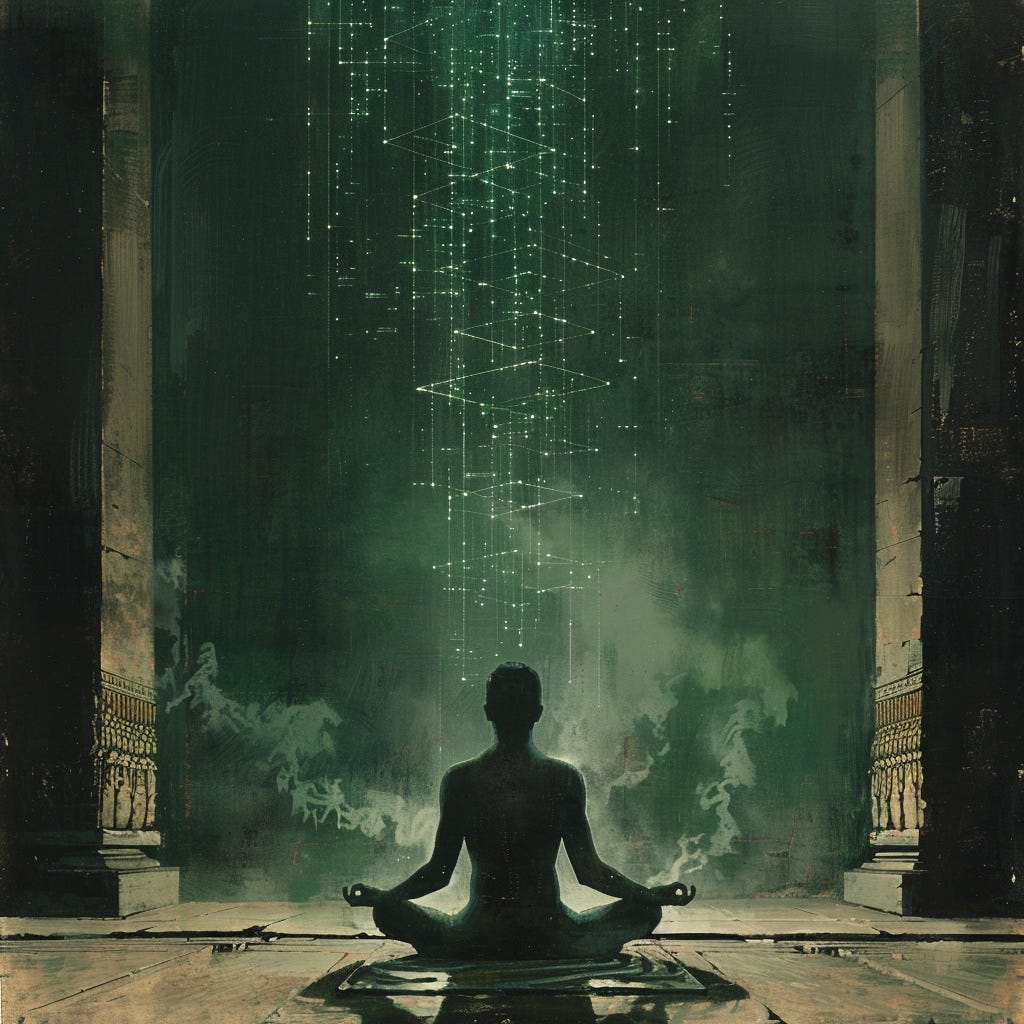
The Only Game in Town
Waking Up from the Matrix: Dharma and the Strange Convergence of Magick and Meditation
I want to tell you about the most boring thing that ever changed my life: meditation.
In January I finished my fifth ten-day Vipassana meditation retreat. It’s basically doing nothing in total silence for ten days. No phone, no writing, no eye contact, no speaking, no music, no substances, nothing to use as an escape at all. Just you and your mind in a room, sitting cross-legged on the floor, from 4 a.m. to 9 p.m., for ten days straight.
Now, this is the part where I’d love to tell you that while I was meditating, a beam of light came through the ceiling and I levitated and an angel kissed me on the forehead and I was never the same again.
But nothing like that happened. In fact, nothing cinematic or mystical happened at all.
And I think that’s actually the point.
What actually happened was slow. Tedious. Confusing. At times, a bit maddening.
Because what you start to notice, when you strip away all the external stimulation and all the stories you tell yourself about who you are and what you’re doing, is that your mind is at war with itself. Constantly. You’ll have a really convincing thought or realization, something that feels absolutely true, and then later your mind produces its exact counterpoint with the same conviction. And then it refutes that too. And you realize: Oh shit. This mind is not a truth-generating machine. It’s more like a debate team that argues every side, and nobody ever wins.
Or you’ve been sitting for hours and your knee starts screaming like it’s auditioning for a horror movie. But eventually you notice that the pain isn’t one solid brick called “pain.” It’s a flicker of multiple sensations: heat, pressure, tightness, pulsing. Like a swarm. Like weather. And then you notice something even weirder: the part of you that says “this is my pain” is also flickering. It shows up as a sensation pattern, a thought pattern, a story pattern. The “me” isn’t the owner of the pain. It’s just another event in the field of arising and passing experience.
And that’s closer to what Vipassana meditation actually is. Vipassana, which means “insight meditation,” originates from the Theravada school of Buddhism, an orthodox branch that claims to preserve what the Buddha actually taught. It’s not a peak experience. It’s more like a slow, persistent, sometimes boring excavation of your own mind and the nature of reality. You sit there and watch the machinery of your own experience, and you start to see how the whole thing is constructed: moment by moment, thought by thought, sensation by sensation.
What begins to be understood, not as philosophy but as lived, embodied understanding, is that a lot of what you call “me” and “my life” and “my reality” is being assembled in real time, without much ground to it. And you never noticed because you were too busy living inside the story.
A lot of spirituality is elaborate theater, or ungrounded distortion and superstition. But the part that is real, the part that isn’t cosplaying divinity or dressing up complex coping mechanisms or rebranding self-improvement with more incense, boils down to one thing:
Learning to see how your experience of reality is constructed and dissolved, moment by moment, and stopping the reflex of ascribing a story to that and taking it personally.
That’s it. That’s the only game in town.
And let me be precise before we go any further. I’m not asking you to believe in some new metaphysics. I’m not here to convince you that reality is a literal simulation, or that you’re trapped on a prison planet, or that there’s some astral manager reading your daily aura report.
I’m inviting you into an experiment you can run right here, right now.
Because I think the deepest thing The Matrix got right isn’t that the world is fake. It’s that the trap is confusing appearances for something solid, permanent, and real.
And the red pill you need to take is the training of your attention and awareness.
The Myth of The Matrix
Let’s talk about The Matrix. It’s basically the modern scripture for an entire generation of seekers. The parable we inherited instead of the ones prescribed by the church. Most of us grew up in a culture where the old religious metaphysics had collapsed, in a world that defied clean or coherent moral sense, and The Matrix stepped in as a genuine cultural myth.
It worked because it showed us something we all felt but couldn’t fully articulate: that something is off. That the person you perform as all day isn’t quite you. That the world is vivid but also feels... fake. That the whole thing feels scripted.
And sometimes it is scripted, in obvious ways: capitalism, social media, trauma, family systems. All the invisible contracts you never consciously signed. But there’s a deeper script that predates all of that, and this is where it gets spicy. It’s the way consciousness itself stitches the world together and calls it “reality.”
So here’s where The Matrix is helpful: it points to the fact that what you experience is mediated, interpreted, and rendered. You’re not seeing the raw universe. You’re seeing your brain’s best guess at the universe.
But here’s where The Matrix is misleading, and this is really important: it suggests that you can wake up into a more real world. Like there’s some ultimate base layer that’s finally true. Neo takes the pill, wakes up in the pod, and now he’s in the real world. Movie over. Well, not really, but you get the point.
This is not the Dharma. The Dharma says something more radical: you don’t wake up into a truer world. You wake up to the worlding process itself. You wake up to how experience happens. How sensation becomes perception, how perception becomes meaning, how meaning becomes identity, and how identity becomes suffering.
Now, all of this sounds abstract. And you’re right. You’re not going to think your way to liberation. So let’s make this painfully concrete.
Right now, as you listen to this, there are sounds. There are sensations on your body: an itch, a pressure where you touch the chair, where your feet meet the ground. There are thoughts, maybe images, maybe emotions. These are all sense objects. Objects in experience. Things known.
And then there is, behind all of that, the knowing of them. Awareness. Consciousness. Perception. Whatever word you want to use.
The entire world you live in, the world you fight for, the world you fear, the world you crave, hate, and love, is always manifested through this pairing: objects and knowing. And then the mind does something sneaky: it takes that stream and collapses it into a story called “me in a world.” And it spends your entire life defending that story.
The only game in town, what every spiritual practice and path worth its salt actually aims toward, is seeing through this self-and-world-rendering mechanism. Not destroying it. Not escaping it. Seeing it clearly enough that it loses its grip.
What the Buddha Actually Taught
There’s a lot of confusion around what the Buddha actually taught. And part of that is because “the Buddha” is a title, not a name. His name was, in fact, Siddhartha Goutama, and the word Buddha means “awakened”. But more importantly, in the West, Buddhism tends to get flattened into one of two things: either it’s a kind of self-care aesthetic, you know, the little Buddha statue next to your candle and your journal, or it’s a nihilistic philosophy for depressed smart people who read too much Camus and existentialism in college. Which, honestly, describes most of my friends.
But it’s neither of those things. And in some ways it’s more punk rock than either of them. The Buddha himself described the Dharma as “going against the stream.” Which goes a lot deeper than sticking it to the man.
The Buddha’s teaching, in its most stripped-down, non-mystical form, comes down to what are called the Four Noble Truths.
One. There is suffering. The Pali word for it is dukkha. I’ll use both interchangeably.
Two. Dukkha has a cause.
Three. There is a way to end suffering entirely.
Four. There is a path of training and practice that gets you there.
Now, people sometimes distort this by saying Buddhism teaches that “life is suffering.” But that’s not quite right. Dukkha is more like a chronic unsatisfactoriness that’s built into the nature of life itself, because we keep clinging to things that are always moving and changing.
It’s the fact that even when you get what you want, it doesn’t hold. Pleasure fades. Identities shift. Your mood changes hour to hour. Bodies age, get sick, and die. Relationships transform. And we resist all of that. Our minds keep trying to control what cannot be controlled.
Dukkha isn’t a pessimistic statement about existence. It’s a diagnostic one. It’s the doctor saying, “Here’s what’s actually happening.” And the point of naming it is not to be a downer. It’s because there’s a cure.
The Buddha then laid out the causes of suffering: craving, clinging, and ignorance. The reflex to either grab at things or push them away. And underneath all of it, the illusion of a solid, stable Self that stands apart from experience, observing it all from somewhere safe.
But then comes the good news. The cessation of suffering is actually possible. Not because you finally achieve a perfect life where everything goes your way, but because you learn to stop fighting with reality. You stop demanding that the ever-changing river of life hold still so you can find some firm ground to stand on.
And then there’s the path itself. A practical, cause-and-effect set of behaviors and trainings that moves you out of suffering. It involves ethical conduct, concentration, and wisdom. And it’s surprisingly scientific about it. You train, and the suffering loosens.
Now, Buddhism has a lot of lists. But at the core, underneath everything, are what are called the Three Marks of Existence.
The first is Anicca. Impermanence. Everything that arises, passes. Your best day, your worst day. Your breath, your heartbeat. Your joys and your despairs. All of it is moving. Always.
The second is Dukkha, which we’ve already talked about. Clinging to the arising of experiences is inherently unstable. You can’t hold running water in your fists. And the tighter you grip, the harder it gets.
The third is Anatta. Not-self. There is no fixed Self.
Now, this is where people get dramatic and start saying “nothing is real.” Which is true, to an extent, but it’s also sloppy. A more precise way to say it is that things are real as experiences, but empty of independent essence. They appear, and they feel real, but they don’t stand alone. And there is no permanent core you can locate and hold onto.
This is what the word “emptiness” is pointing at in later Buddhist language. It is not nothingness. It’s not the void. Emptiness is interdependent arising. It’s the recognition that everything is relational, everything is leaning on everything else. Like a house of cards, except the house of cards is also you.
Emptiness is not nihilism. Emptiness is the end of the fantasy that anything has a self-subsisting nature.
What Actually Happens on a Vipassana Retreat
I could sit here all day and talk about the nature of reality. But if you don’t actually practice, you’re just collecting ideas.
So let me tell you what actually happens on a Vipassana retreat.
It’s not particularly magical, mystical, or ceremonial. You wake up around 4 or 5 in the morning. You sit and meditate in silence for about 11 hours a day, for 10 days straight, without breaking the continuity of practice.
And it’s not really about “being calm.” If you go in expecting to feel calm all the time, you’re going to have a rough time. Because that’s not what Vipassana actually is.
What Vipassana actually is, is looking. Observing systematically, repeatedly, and without flinching.
And it is brutal. Not in the “I saw God and my ego got annihilated” kind of way that something like iboga can be brutal. It’s brutal in a quieter, more personal way. You see yourself. You see how addicted you are to stimulation. You see how quickly you manufacture stories. You see how your mind narrates everything, constantly, without stopping. You see how the “self” has been running your whole life, without your consent, for as long as you can remember.
The first few days are mostly withdrawal. Your brain is detoxing from stimulation. It throws thoughts at you like little grenades. Something important you could be doing. A business you could be building. Art you can be making (it’s how I got the impulse and idea to write this, for example.) Ways you could be optimizing, fixing, improving, becoming.
And if you’re not careful, the ego will find a way to colonize even that. It will turn meditation into a new project. A new identity. I’m the kind of person who meditates. That probably makes me better than other people. Or you’ll start judging the person across the room who keeps fidgeting, or who brought an unreasonable number of cushions. (Seriously it was kind of hilarious to watch people build their fortress of pillows by the end of the week in attempt to escape the body aches. Yup, just one more will do the trick, buddy.) You’ll start keeping score of who’s more enlightened.
This is the trap. The ego doesn’t die. It just changes costumes. Because the ego, like everything else, is impermanent. It’s always shifting, always adapting, always finding a new way to be in charge. Whether you’re wearing robes or a three-piece suit, it’s the same little dictator running the show.
Vipassana helps you see through this. Slowly, like adjusting your eyes in a dark room, you stop relating to your thoughts as commandments. You start seeing them as events. Transient, impersonal, like sounds passing through a space. Like weather changing.
You notice how a thought arises, lingers for a moment, and then fades. And then another thought arises. Sometimes you get caught in a loop. But even then, even the loop eventually shifts and changes and passes. And the thing that can really crack you open, in the best possible way, is realizing that you’re not the one authoring these thoughts. Not in the way you always assumed. The mind produces thoughts the same way the mouth produces saliva. Involuntarily. Automatically. It’s just doing its thing.
So if thoughts are arising on their own, and sensations are arising on their own, and emotions are arising on their own, then where exactly is the “I” that’s supposedly in control of all of this?
And here’s the thing. That question is not horrifying to sit with. It’s actually a relief.
Because the “self” is exhausting. You know exactly what I mean. The whole melodrama of your predicament. The constant pressure of who you are and who you think you’re supposed to be. When that grip loosens, even a little, the world becomes oddly intimate. Because it’s no longer being filtered through the lens of personal ownership and attachment.
This doesn’t mean you’ll become permanently enlightened. It doesn’t mean you’ll be exempt from human life, or granted some kind of special status. What it means is that things begin to shift in small ways, through your own direct experience. As you observe, you accumulate evidence, in your own body, that the self is not what you thought it was.
And once you see that, you can’t unsee it.
It’s not a permanent state. The clarity can become obscured. Life will do what life does. But it’s like a crack in the wall. And once that crack is there, the light comes through whether you want it to or not.
—---
Magick and the Dharma
I am not trying to recruit you into Buddhism like it is the only path up the mountain. There are other lineages that have been doing this work for thousands of years.
Ceremonial magick, real initiatory magick, actual serious practice, has always been about gnosis, meaning direct knowing, transformation, and contact with something deeper than the social self.
If you have done any work with ritual magick, which I would anticipate many of you have, you will recognize the basic shape of it: you create a container, you work with symbol, you refine attention, you invoke, you encounter, and you get rearranged.
And in the higher magical maps, the whole point is not to become a better spell-caster. The point is the Great Work. It is a shift in being, a crossing of thresholds where the ego’s authority collapses. So in a way, gnosis is the aim in both ceremonial magick and Buddhism.
The methods, however, differ in their relationship to construction. Vipassana is, in essence, subtractive. It is not trying to build something. It is not trying to create something. It says: just look, see what is already happening, strip it all the way down until you see the bare architecture of experience itself.
Magick is often constructive on purpose. It builds a symbolic machine and runs consciousness through it until consciousness reveals itself. The magician builds a temple out of names and symbols and correspondences, and then consciousness walks through that temple and realizes: it was all Me the whole time.
The magician builds a temple to discover it was always mind. The meditator discovers mind and realizes it was always a temple.
That distinction matters because it shapes the characteristic failures of each path. Magick can inflate the ego, inflate the individual will, inflate the sense of specialness. Vipassana, on the other hand, can become dissociation. It can become an avoidance of relational life dressed up in the language of emptiness. You know the type: the person who uses non-attachment as an excuse to never show up for anyone.
Both paths have shadows. The question is whether you are honest enough to see yours.
The point is not that Buddhism is better. The point is that they converge on a similar insight while training different muscles. Magick trains the muscle of meaning, symbol, and intention. Magick says you can change the world. Vipassana reveals that the world was never actually being changed by anyone.
Magick taught me that reality is editable. Dharma taught me that the editor was never real.
—--
Getting the Glimpse Through Psychedelics
Let’s talk about psychedelics, because our generation has a very complicated relationship with them.
Psychedelics can absolutely show you impermanence and not-self. They can dissolve the boundaries of identity. They can reveal that perception is constructed. They can deliver experiences that feel like genuine spiritual truth.
But there are real problems with psychedelics as a path, and to understand them you need to know a concept from Buddhism that matters enormously. The concept is this: states are not liberation.
A state is an experience. And what do we know about experiences? They arise and they pass. That is the whole teaching. Anicca. Impermanence. And it applies equally to your shitty Tuesday and your ego death on mushrooms. Both of those are transient. Both of those are impermanent. Neither one of them is you, and neither one of them lasts.
So if you take psychedelics and have a nondual moment, a moment where the self dissolves and you see that perception is constructed and everything is one, you might glimpse something genuinely profound. And that is beautiful. I am not dismissing it.
But then you come down. And your nervous system is running the same patterns it always has. You still crave. You still fear. You still react. All of the deep conditioning of your mind is still sitting there, completely intact, waiting for you.
And here is where these insights can become a trap. They become a story you tell about yourself. “I know now. I have seen it. I am awake.” And that story becomes a new identity. And an identity is the exact opposite of liberation. You have traded one cage for a fancier cage. The new cage smells like frankincense and has thangka paintings on the walls, but it is still a cage.
This is what the great Buddhist teacher Chogyam Trungpa Rinpoche called spiritual materialism. Collecting peak experiences like trophies. Building a highlight reel of your own awakening. And the entire time, the ego is sitting in the director’s chair going, “Yes. This is an excellent story about how I transcended the ego.”
Vipassana does not let you do that as easily, and the reason is simple. It is aggressively unsexy. It is boring repetition. It is tedious, humbling, unglamorous training. It is sitting with your breath for ten hours a day and watching your mind throw tantrums like a toddler who didn’t get the snack they wanted.
And I think that is exactly why it works.
Because it is not giving the ego what it wants.
It is giving you what reality actually is.
—---
The Only Game in Town
So what do I mean by “the only game in town”?
I mean something very simple.
You can distract yourself, optimize yourself, and decorate your ego indefinitely. You can build the most exquisite metaphysical worldview and live inside it like a luxury apartment with a great view and really nice furniture. But none of that stops impermanence. None of that stops loss. None of that stops the basic fact that everything you love is changing, including you.
So sooner or later, and for some of us it is sooner because life has a way of kicking us in the gut when we are being particularly stubborn, you meet the real curriculum. You meet the fact that your craving does not deliver safety. You meet the fact that identity does not deliver stability. You meet the fact that control does not deliver peace.
And then you have a choice.
You can keep playing the default game of acquisition and control. You can tighten your grip, increase your strategies, escalate the certainty, build the walls higher. Or you can play the only game that actually ends dukkha.
You can let go.
You can learn to see reality for what it is, a construction of the mind, and stop mistaking it for a fixed and permanent self.
Now, this will not automatically make you passive. This is not about becoming some kind of dead-eyed monk who has opted out of life. If anything, seeing the truth makes you more alive, because it stops you from living trapped inside your own hallucinated narrative.
It makes you more responsive and less reactive. It makes you more ethical, not because you are following a rule, but because you can feel cause and effect more clearly. When you see that your mind is an ecosystem, you stop pouring poison into it. And when you see that other people are ecosystems too, you stop treating them like pieces to move around on your chessboard.
Dharma is a metaphysics. It is a philosophy. But it is not only that. It is also training. It is the slow, unglamorous, irreversible work of learning to see.
_____
The Experiment
Rather than just tell you this is real, here’s something you can verify yourself. Do it for seven days, ten minutes a day. Tonight, tomorrow morning, your lunch break, wherever.
Sit down, set a timer, and do one thing: notice what arises and label it lightly.
“Hearing.” “Thinking.” “Warmth.” “Pressure.” “Planning.” “Itching.” “Worry.” “Imagining.” “Remembering.”
Not fixing, not changing, not optimizing. This is not a self-improvement project. Just notice: arising, passing, arising, passing.
Here’s the difference between this and spacing out: when the sense of “me” shows up, notice that too. “I am doing this.” “I am bored.” “I am failing.” “I am succeeding.” Label it the same way you’d label an itch.
At first it might feel mechanical or fake. That’s fine. It means the machinery is becoming visible, which is sort of the whole point. What you call “me” is largely a set of automatic processes repeating. A loop. And you’ve been living inside it your whole life thinking you were the one running it.
Keep going and something quietly revolutionary starts to happen:
You don’t have to believe a thought for it to arise. You don’t have to obey an emotion for it to pass. You don’t have to be in the story.
You can be the knowing.
Just don’t let “The Witness” become your new ego identity. That’s the trap.
The Re-Enchantment Project
If you take the Dharma seriously, it doesn’t kill magick. It clarifies it.
Strip away the aesthetics and the cosplay and what is magick at its root? The disciplined use of attention, symbol, and intention to shape experience. And the Dharma agrees: experience is shapeable, it’s conditioned, it can be worked with. Nothing about that is negated. What the Dharma adds is this: the shaper is also conditioned. The inner magician is not standing outside the system pulling levers. It’s part of the system too.
You can still do rituals. You can still work with symbols, maintain a devotional relationship to mystery, stand in a circle and call upon forces in the four quarters and feel the hair rise on the back of your neck. You can still encounter something your rational mind cannot fully explain. But you do it now without the desperation. Without the grasping. Without using the Work to feed the ego’s hunger for power and specialness, because you’ve seen through the ego that was hungry.
That’s what Dharma does to magick: it makes it less neurotic.
And magick does something for Dharma in return. It brings the juice back. The meaning, the beauty, the living encounter with Mystery. It stops you from using emptiness as a reason to feel nothing, from turning liberation into a kind of spiritual numbness. This isn’t a new synthesis either. The Vajrayana and Tantric lineages of Tibetan Buddhism have always known that symbol, ritual, and direct encounter with the numinous are not obstacles to awakening. They’re vehicles.
Western magick and Tibetan Buddhism are not the same thing. But they are mutually corrective. At their root both are concerned with gnosis, a transformation of your fundamental interpretation of reality, a confrontation with what is actually true. The wisdom traditions of the world are extraordinarily diverse on the surface. But underneath, they keep pointing at the same thing: see through the illusion, return to the mystery.
That’s why it’s the only game in town.
The Invitation
The Dharma has survived for over two thousand years not because it’s a great philosophy or because it wins arguments. It survives because it works. It’s practical, operational, and it shows you something you cannot unsee: the world you are suffering inside of, the story and context of your life, is being manufactured moment by moment by your senses and the narratives you layer on top of them. The solid, separate, enduring self at the center of that story is not what it appears to be. It’s a construction. And this practice lets you see that directly, not as a concept but as experience.
When you really see it, something shifts. Not all at once, not permanently at first, but the grip loosens.
You’ll still feel pain. You’ll still grieve, get tired, have bad days and strange moods and moments where you want to quit. That’s not what ends. What loosens is the extra layer: the resistance, the identity defense, the constant low-grade demand that reality be different than it is. That loosening is freedom. Not freedom from being human, but freedom from the obligation to perform being human in a specific way, according to a story you didn’t consciously choose.
If you’re here because you’re tired of being owned by your own mind, tired of being pushed around by moods, cravings, identities, and the fear of change, then welcome.
There’s nothing to win. Nothing to lose. Only the clinging to release, and the pushing away to put down, and this moment, exactly as it is, to rest in.
— Jake Kobrin
Mill Valley, CA
April, 2026
Thanks for reading Jake’s Substack! Subscribe for free to receive new posts and support my work.
Read more of my writing and subscribe on Substack: jakekobrin.substack.com.
