The Frequency of Longing
Originally published on my Substack, Writings From The Edge of the Known, where I write regularly. Subscribe there for new essays.
Note: Reading this pairs well with this (*really fucking good/intense*) music - click on the image link:

Before reading, subscribe for free to receive new posts and support my work.
The Frequency of Longing:
Notes on Male Loneliness, Music, and Cultural Collapse
by Jake Kobrin
My date looked around the venue and leaned close to my ear. “I notice there’s like 95 percent men here,” she said. It wasn’t a judgment, just an observation, but it hung in the air between us. She was right. Under the stage lights at theSwansconcert this week in Berlin, you could see the faces clearly, a sea of men who’d come to experience something most people would find unpalatable. Swans lead-creative Michael Gira stood at the center, conducting waves of sound that built and crashed with relentless intensity, the kind of music that doesn’t comfort or entertain but demands something from you, asks you to stand disciplined and present in the middle of overwhelming force.
Later, as we talked about what we’d witnessed and experienced, she tried to articulate what she’d felt in the music itself. The resonant frequency of it, she said, was longing. She’d noticed the demographic, overwhelmingly male, and made the connection: this music resonates most powerfully withmale loneliness. There was something in that observation that felt both obvious and profound.
She was right. And here’s what I’ve come to understand: even though I have connection in my life now, even though I’ve had relationships and communities and friendships throughout my life, that frequency still resonates with me. That longing, that sense of being fundamentally outside, it hasn’t gone away. Maybe it’s not even about sex or romantic partnership. Maybe it’s about being truly seen, understood at a level that transcends surface connection. And even when I’ve experienced that recognition, some part of the frequency remains buried deep within me. A part of me forever attuned to that particular wavelength of isolation and yearning.
Maybe it’s something beyond personal history. Not just about individual wounds but about an atmospheric undercurrent running through our entire contemporary moment. The breakdown of love and tribe and social values. Men increasingly isolated and retreating. Women continuously cautious and overburdened. Both sides suffering in different ways from systems that seem designed to keep us apart.

I should say that I know several women who totally love Swans, who are drawn to noise and industrial and experimental music, who find themselves at home in darker artistic spaces. The goth and industrial scenes, including many of the residents of Berlin, and in certain corners of fashion and art, have always included women who resonate with intensity and shadow. But the demographic reality that night was undeniable, and it pointed to something larger worth understanding.
I fell in love with Swans when I was fat and unwanted and invisible in all the ways that teenage boys can be invisible. Not the romantic invisibility of the misunderstood artist, but the concrete social fact of being excluded, bullied, unseen. Of watching other people be invited and pair off while you existed in some parallel universe where the basic grammar of human connection seemed written in a language you’d never been taught. Swans and other similar musical artists gave that feeling a form. Not a solution, not even comfort, but recognition. The music said: yes, these depths exist. Yes, this intensity is real. Yes, you can stand in the middle of overwhelming force and let it move through you without breaking.
I found other music that spoke this language too. One of my favorites wasGodspeed You! Black Emperor, the Canadian post-rock collective whose sprawling instrumental pieces build apocalyptic soundscapes.Godspeedopen their song “Dead Flag Blues” with a bleak monologue:“The car’s on fire and there’s no driver at the wheel... We’re trapped in the belly of this horrible machine and the machine is bleeding to death.”And there wasJoy Division,early Nine Inch Nails, and countless others from the entire tradition of music that doesn’t offer comfort but does offer witness. These became the soundtrack to understanding what I was feeling, giving it dignity and form.
Now, decades later, standing in that crowd with someone I feel connected to and care for, I understood we were experiencing something beyond just artistic and musical taste. The longing she’d identified in the music, that abandoned quality of masculine energy, was everywhere in that room. And it’s everywhere in the broader culture, just beneath the surface, shaping how men and women relate to each other and fail to relate to each other in ways that are quietly devastating.
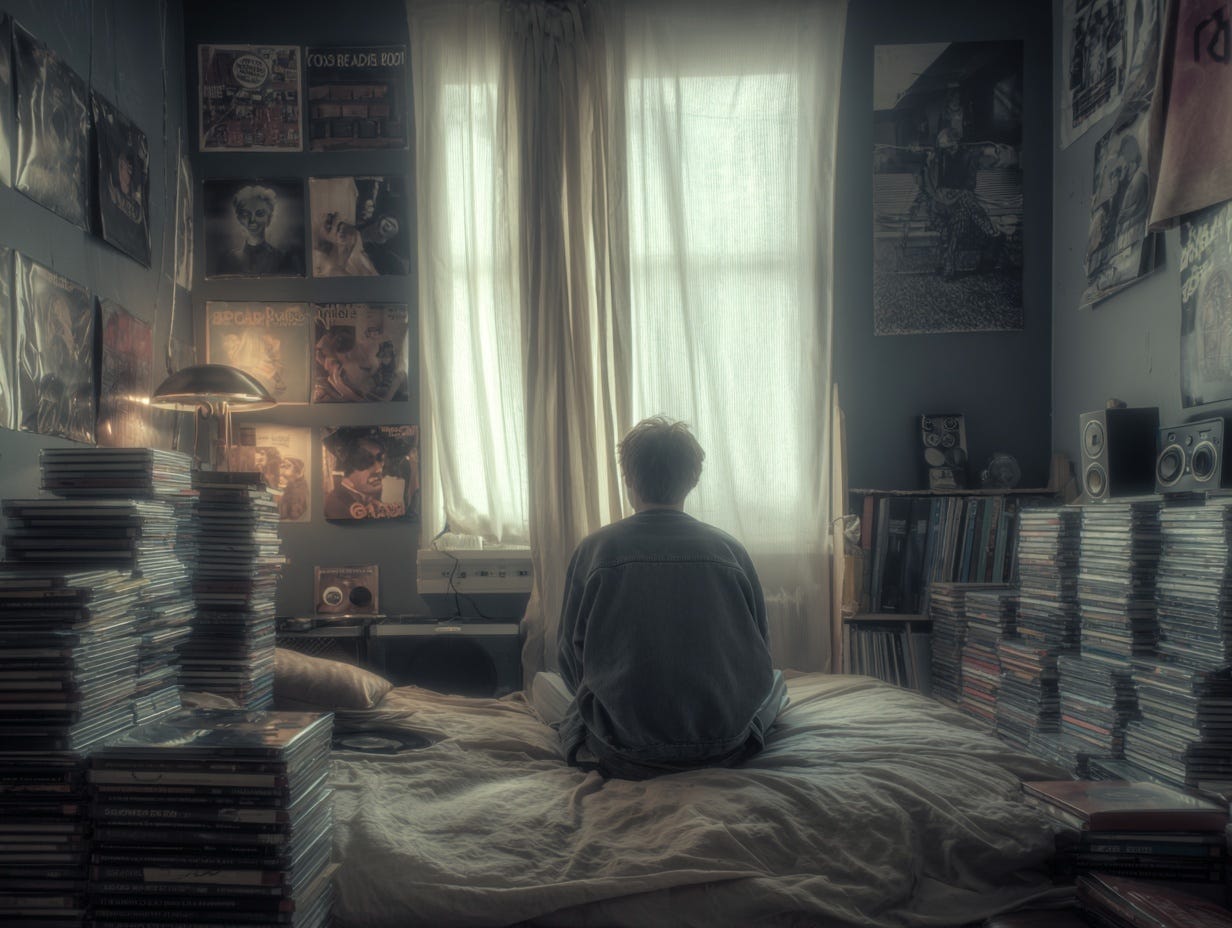
The statistics on male loneliness paint a stark picture. Fifteen percent of American men now report having no close friends whatsoever. In 1990, that number was three percent(American Institute for Boys and Men, 2023).In a single generation, complete friendlessness among men has quintupled. Twenty-five percent of young men under 35 say they feel lonely “a lot” on any given day, a rate significantly higher than young women and higher than in most other wealthy nations(Vigers, 2025).The United States is an outlier here, something uniquely broken in how American men connect with each other and the world.
Around 45 percent of men aged 25 to 40 say they don’t have a close male friend they can confide in about personal problems(American Institute for Boys and Men, 2023).This “friendship recession” has happened alongside other shifts: rising rates of young men who are single not by choice, increases in what researchers call NEET status (not in education, employment, or training), and a dramatic rise in sexual inactivity. Nearly thirty percent of men aged 18 to 24 reported no sexual contact in the past year in recent surveys, almost triple the rate from a decade earlier(Ingraham, 2019).
Dating apps, which skew roughly 62 percent male(Pew Research Center, 2023), create winner-take-all dynamics where a small fraction of men receive the majority of attention while many others experience near-total invisibility. Women, facing an overwhelming number of options and prioritizing safety and compatibility, exercise selectivity that leaves many men feeling rejected before they’ve even had a chance to be seen.
The consequences ripple outward. Men die by suicide at roughly four times the rate of women(Nock, 2006). Male overdose deaths from opioids and stimulants run two to three times higher than women’s. The term “deaths of despair” has emerged to describe the surge in suicide and substance abuse among men who feel they have no place in the social or economic order(Reeves, 2022).
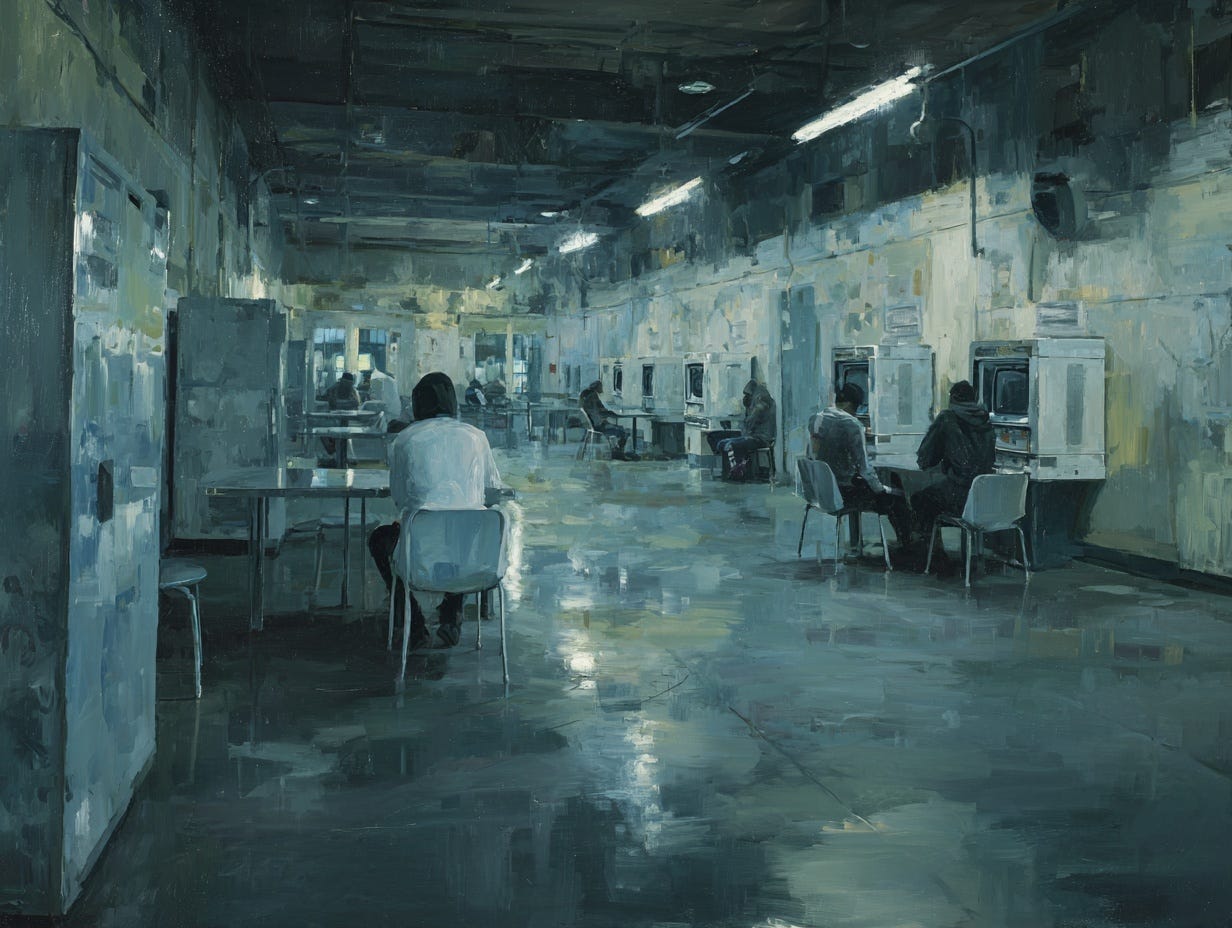
The men at the Swans concert probably aren’t the same men drowning in incel forums or retreating into compulsive pornography consumption for days at a time. They’re not posting on 4chan about killing or raping women. They’re not building elaborate “gooncaves” lined with monitors playing synchronized pornography, disappearing into what one recent Harper’s Magazine report called a “pornography-obsessed subculture” of endless masturbatory sessions(Kolitz, 2025).
The men who come to experience Swans generally seem to have found a different outlet for their intensity. They’re engaging with their darkness through art rather than letting it consume them. But this isn’t about moral superiority or cultural sophistication. The difference is simply in where the loneliness gets channeled. Some men find art that transforms their pain. Others retreat into spaces that amplify it.
Both groups often emerge from similar roots. The same sense of being excluded from something essential. The same yearning for connection, recognition, belonging. What diverges is the response, the path taken from that initial wound. And those paths are shaped by countless factors: luck, privelage, geography, access, the people who happen to cross your path at vulnerable moments, the communities you stumble into.
The incel phenomenon represents one of the darkest manifestations. A recent study of 561 self-identified incels found that 48 percent reported maximum levels of clinical loneliness, and 37 percent experienced suicidal thoughts daily(Swansea University & Archives of Sexual Behavior, 2025).These are men in profound pain who’ve found a community that validates their suffering while offering no path out of it. The ideology they’ve built says their loneliness is permanent, genetically determined, someone else’s fault.
The violence that has emerged from some corners of this community (mass shootings in Isla Vista, Toronto, Plymouth) represents an infinitesimal fraction of lonely men. But it has cast a shadow over the entire conversation. Elliot Rodger, the 22-year-old who perpetrated the Isla Vista attack in 2014, left behind a manifesto that used the word “lonely” or “alone” nearly 100 times. He blamed women for denying him affection, blamed successful men for outcompeting him, and sought revenge on a world that failed to give him what he felt entitled to.
This is where the conversation becomes impossible. To acknowledge male suffering risks seeming to justify male rage. But we have to be able to hold both truths: loneliness is real and devastating, and it never justifies harming others. A woman’s refusal to date someone is always her right, and the cumulative weight of rejection can still be genuinely painful for the person experiencing it.
From an evolutionary perspective, female selectivity in mate choice is an adaptive strategy shaped by the higher biological costs of reproduction. Throughout human history, women who were choosier about partners generally had better outcomes for themselves and their offspring. This shows up across cultures: women tend to place higher value on potential partners’ resources, ambition, and stability, while men place relatively higher value on youth and physical attractiveness(Buss, 1989).
The genetic evidence suggests that throughout most of human history, significantly fewer men than women successfully reproduced. Perhaps only 40 percent of men versus 80 percent of women passed on their genes. Male reproductive success has always been more variable, more subject to competition and hierarchy.
Various cultural systems evolved to manage this reality. Monogamous pair-bonding norms, enforced socially rather than legally, distributed mating opportunities more evenly and reduced male competition that could erupt into violence. Research suggests that societies with strong monogamous norms show lower rates of violent crime compared to more polygamous ones, and that married men commit less violence than single men(Henrich, Boyd, & Richerson, 2012).
Jordan Peterson created significant controversy by arguing for a return to “socially enforced monogamy” to address rising male violence linked to sexual exclusion (Peterson, 2018). I need to be clear: I don’t support Peterson’s framing or proposed solutions. The idea that women should be encouraged or pressured into relationships to manage male aggression is ethically troubling and practically unworkable. It places the burden of men’s violence on women’s choices rather than on men themselves(Freeman, 2018; Southey, 2018).
But we do have to be honest about what happens when large numbers of men feel excluded from basic human goods like intimacy, partnership, family. Not to excuse violence or entitlement, but to understand the social dynamics at play. Aristotle wrote about the isolated man becoming “tribeless, lawless, hearthless,” someone with no stake in peace because he has no bonds tying him to social order(Aristotle).
The question isn’t whether women should lower their standards or sacrifice their autonomy. They shouldn’t. The question is what we do collectively to address a situation where increasing numbers of men are failing to develop the skills, emotional capacity, and social integration necessary to be the kind of partners women actually want(Matos, 2022).
Meanwhile, women are exhausted. Seventy-two percent of single women report being tired of “emotionally mentoring” the men they date(Stanford Gender Studies / Relationship Wellness Institute, 2025).Because so many men lack close friendships, their romantic partners become their therapist, social planner, and sole confidant, roles that are unsustainable for one person to fill(NDTV, 2025).

Many women are choosing solitude over taking on another person as a project. Sixty-two percent of single women say they’re not looking to date at all, compared to only 37 percent of single men(Pew Research Center, 2023). This creates a painful feedback loop. Men, becoming lonelier, lean even harder on romantic relationships as their only source of connection, which makes them less attractive as partners, which makes women withdraw further.
Women are also navigating a landscape where they must constantly be on guard. About 71 percent of women in the U.S. have experienced some form of street harassment in their lifetime, and roughly one-third report worrying about being sexually assaulted at least occasionally(Stop Street Harassment, 2018). My estimation based on personal conversations is that the percentage may be even larger than reported. When a large subset of men are socially inexperienced, sexually frustrated, and possibly consuming toxic online content, their interactions with women can be clumsy at best and threatening at worst. The tragedy is that the men who most need human warmth often present in ways that repel it, creating another vicious cycle of rejection and withdrawal.
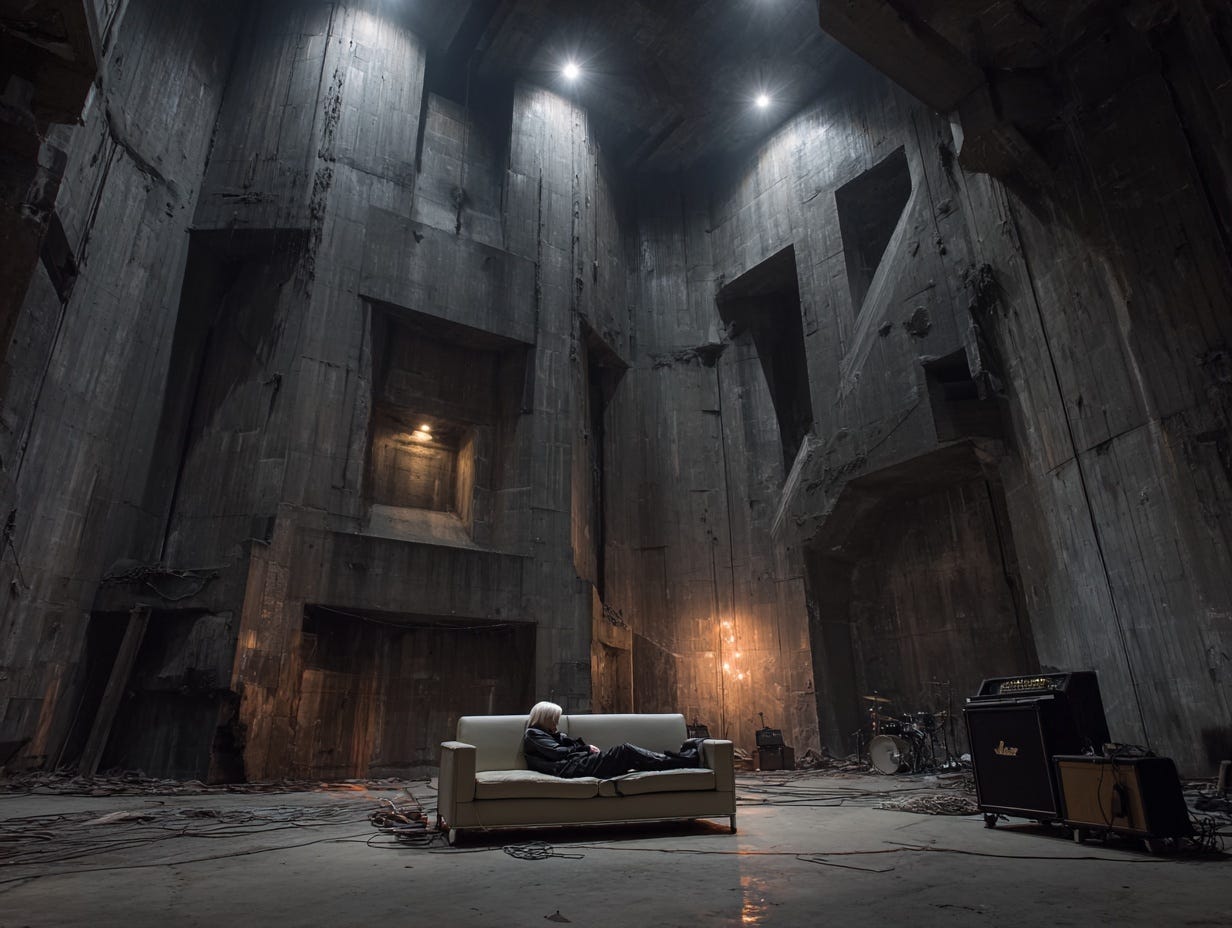
What I’m trying to articulate is something about the atmosphere of our current moment. An undercurrent that runs beneath everything. You can feel it in dating app statistics and friendship recession data. You can hear it in certain kinds of music or see it in art, media, movies, video games. You can see it in rising male suicide rates and the opioid epidemic. There’s a breakdown happening. Of love, of tribe, of social values and structures that once provided men with identity, purpose, place, and community.
A lot of the music that resonates with people who carry this yearning has a specific character. It tends toward extremity, toward volumes and intensities that match the interior experience. It’s goth, industrial, underground, noise, harsh, electronic, sparse and abrasive. Swans builds monuments of sound that feel both crushing and transcendent, that honor the full weight of longing without offering easy resolution. Apocalyptic soundscapes that seem to soundtrack the collapse itself. This music doesn’t offer comfort. At its best, it offers moments of transcendence and transformation. It takes overwhelming internal states and gives them form, gives them beauty, gives them a kind of terrible dignity.
For people (ahem, men) who’ve been taught that feelings are weakness, who’ve learned to associate vulnerability with humiliation, this music creates space where interior experience can exist at full volume without apology. It doesn’t solve anything, but it does witness. And sometimes, being witnessed is what allows you to keep going.
What my companion heard in that music, the resonant frequency of longing, the way it connected to something about abandoned masculine energy, this is real. Not because women don’t feel longing or abandonment, but because there’s a particular quality to how some men carry these feelings when they have nowhere else to put them, when they’ve been taught their entire lives that emotional need is shameful, that dependence is weakness, that asking for help is failure.
The men who find their way to music like this have discovered that suffering can be given form without destroying yourself or others. But the men who never find these outlets, who never discover that their pain can be transformed or at least witnessed, they’re the ones most at risk. Some retreat into the worst corners of the internet, into ideologies that justify their bitterness(Jacobin, 2020).Others simply suffer in silence, their despair turned inward, contributing to those staggering suicide statistics.

I don’t have the answers. The solutions must require work and renovation at every level. Men need to take responsibility for developing emotional skills and building friendships that don’t rely entirely on female partners(Reeves, 2022).Communities need to create spaces where men can gather around something other than competition or resentment and can share about their inner experience without stigma. We need economic policies that offer young men pathways toward stable, dignified work. We need cultural narratives about masculinity that include vulnerability without shame.
But we also need to extend basic empathy to people who are struggling. Loneliness isn’t a moral failing. The World Health Organization now recognizes loneliness as a global public health concern, with health effects “as bad as smoking 15 cigarettes a day”(The Guardian, 2023).It’s a form of suffering that, left unaddressed, can metastasize into something darker. The difference between paths often comes down to whether someone finds recognition for their experience. Not justification or validation of bitterness or entitlement, but acknowledgment that the suffering is real, that loneliness is a legitimate form of pain, that the yearning for connection is fundamentally human rather than fundamentally flawed.
What we’re witnessing is a moment of profound social restructuring. The old systems that provided men with identity and community have largely collapsed. The new structures we’re building haven’t yet found ways to include everyone. Some people are getting hurt in the transition. That’s not an excuse for violence or hatred. But it is a reality that deserves more than dismissal or contempt.
Hannah Arendt observed that totalitarian and violent movements often prey on deeply lonely individuals who seek belonging(Arendt, 1951).People firmly anchored in communities are less susceptible to extremist appeals. The goal, then, is to integrate young men into society in positive ways, giving them reasons to invest in the social fabric rather than rage against it.
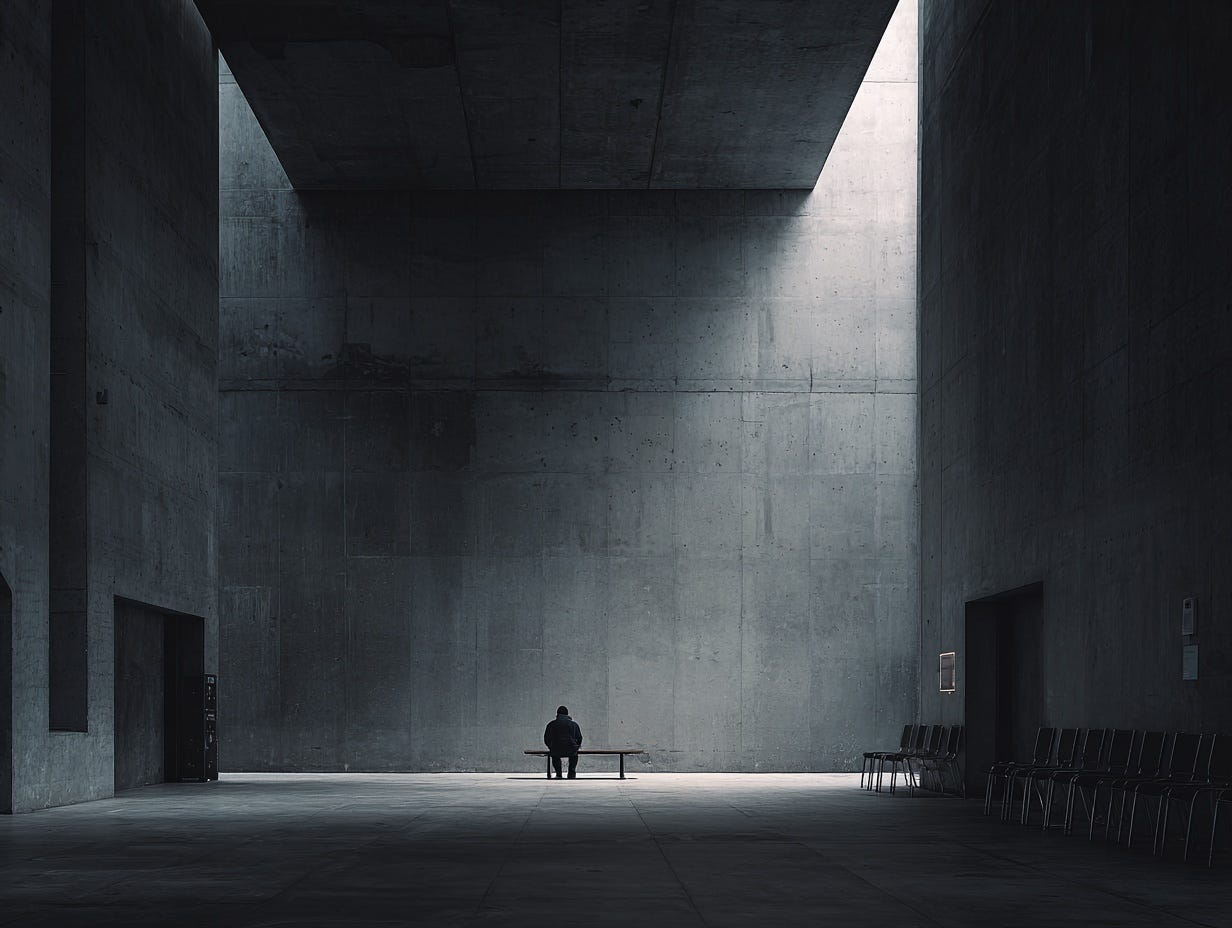
At the Swans concert, in the middle of that extraordinary and intense music, I felt grateful to have my companion by my side. Her observation, simple as it was, opened something. The recognition that this longing, this particular wavelength of masculine yearning and isolation, it’s not just my personal history. It’s woven into the fabric of our contemporary moment in ways that shape all of us.
The men in that audience were all different - some came with partners or friends, some came alone. What united us was an appreciation for music that takes emotional extremity seriously, that doesn’t shy away from intensity. The music gave us permission to feel at volumes most of the world considers inappropriate or uncomfortable. For a few hours, that yearning had a home.
The longing remains. The frequency persists. But there are ways to live with it that don’t require destroying yourself or others. There are ways to transform it into art, into understanding, into compassion for everyone else who carries similar wounds. The question facing our culture is whether we can create more pathways toward transformation and fewer dead ends that lead to rage or despair.
We’re all trying to find our way through this. The machine may be bleeding to death, but we’re still here. We’re still breathing, still feeling, still capable of creating and appreciating art that takes our complex emotions and suffering seriously. Still capable of witnessing each other’s pain, of naming the frequencies we’re living in, of meeting loneliness with something other than dismissal or fear.
Art has always been the medicine, and music is part of this. The music says: yes, this is real. Yes, it’s this big. Yes, you can stand in the middle of it without breaking. And for some of us, that recognition is the beginning of finding a way through, of discovering that the intensity we carry can become a source of depth and creativity rather than just isolation and pain. That even in the belly of this horrible machine, even as it bleeds, we can still reach for each other across the distances that seem designed to keep us apart.
— Jake Kobrin
Berlin, Germany
November 28, 2025
References:
American Institute for Boys and Men. (2023).Male loneliness and isolation: What the data shows. AIBM Report.
Arendt, H. (1951).The Origins of Totalitarianism. Harcourt.
Aristotle. (1984).The Politics(C. Lord, Trans.). University of Chicago Press. (Original work 4th century BCE).
Buss, D. M. (1989). Sex differences in human mate preferences: Evolutionary hypotheses tested in 37 cultures.Behavioral and Brain Sciences, 12(1), 1–49.
Freeman, H. (2018, May). Jordan Peterson believes women can cure violent men.The Guardian.
Henrich, J., Boyd, R., & Richerson, P. J. (2012). The puzzle of monogamous marriage.Philosophical Transactions of the Royal Society B, 367(1589), 657–669.
Ingraham, C. (2019, March). Americans not having sex reaches record high.The Washington Post.
Jacobin. (2020). A portrait of the breakdown of hope and meaning in America.Jacobin Magazine.
Kolitz, D. (2025, April). The Goon Squad.Harper’s Magazine.
Matos, G. (2022). The rise of single men and changing relationship expectations.Psychology Today.
NDTV. (2025, March). Why women are tired of mankeeping.NDTV Features.
Nock, S. L. (2006). Marriage as a public issue.The Future of Children, 16(2), 13–32.
Peterson, J. B. (2018). Public lectures, interviews, and writings on monogamy, social order, and evolutionary dynamics of mating.
Pew Research Center. (2023).The state of dating and relationships in 2023. Pew Social Trends Report.
Reeves, R. (2022).Of Boys and Men: Why the Modern Male Is Struggling, Why It Matters, and What to Do About It. Brookings Institution Press.
Southey, T. (2018, May 18). Jordan Peterson’s wrong-headed view of “enforced monogamy.”The Globe and Mail.
Stanford Gender Studies / Relationship Wellness Institute. (2025). Survey on emotional labor and “mankeeping” among young women.
Stop Street Harassment. (2018).National sexual harassment survey. SSH Annual Report.
Swansea University & Archives of Sexual Behavior. (2025). Dr. MacKenzie et al. Profiling loneliness, suicidality, and mental health among incel community members.
The Guardian. (2023, November). WHO declares loneliness a global public health concern.
Vigers, B. (2025). Younger men in the U.S. among the loneliest in the West.Gallup News Report.
Thanks for reading Jake’s Substack! Subscribe for free to receive new posts and support my work.
Read more of my writing and subscribe on Substack: jakekobrin.substack.com.
