The Devil’s Work
Originally published on my Substack, Writings From The Edge of the Known, where I write regularly. Subscribe there for new essays.
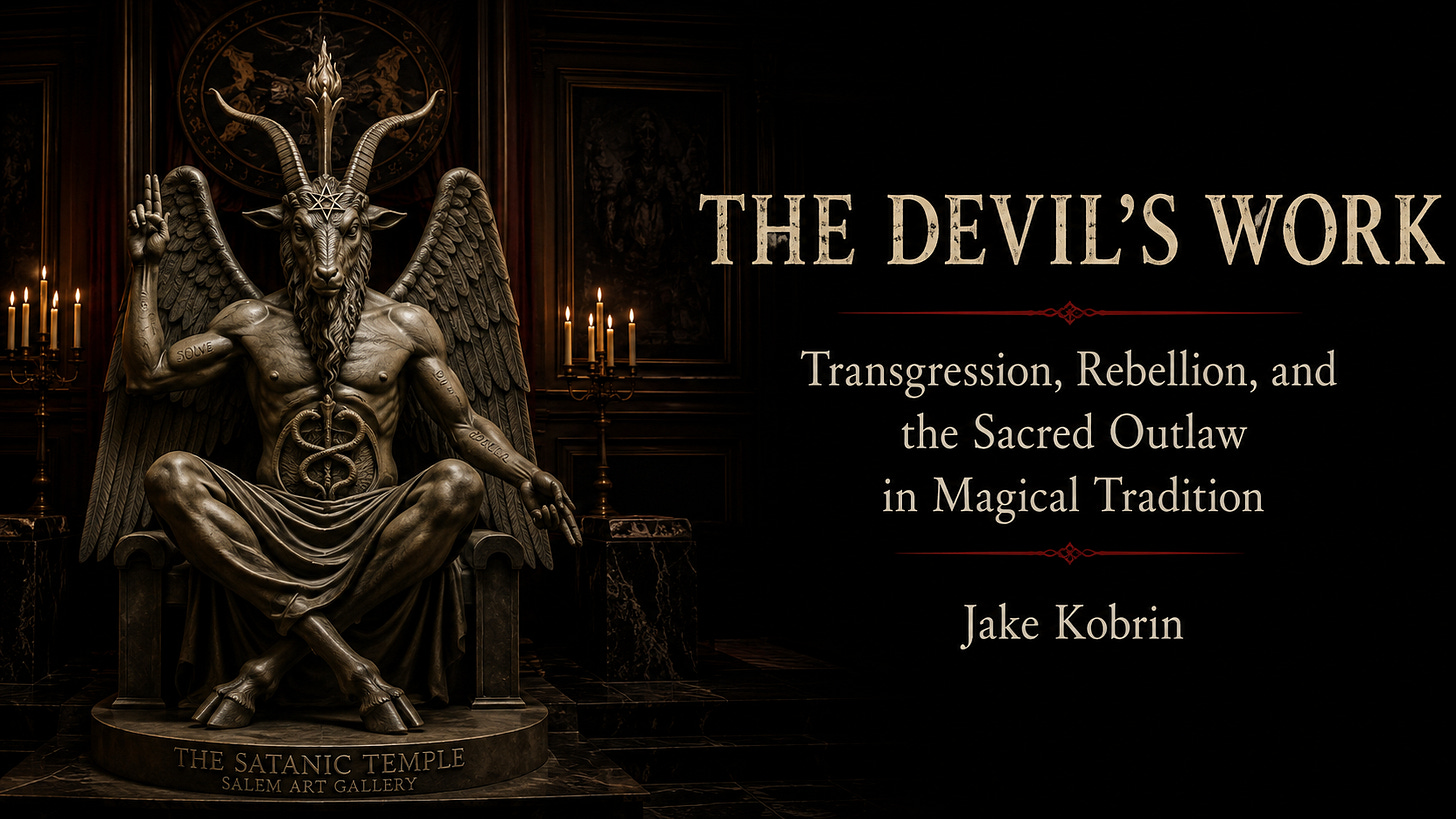
Edited from a live lecture at the Salem Art Gallery at the Satanic Temple in Salem.
Introduction
Satanism is a tradition of rebellion, but rebellion itself can become dogmatic. Transgression has spiritual value when it breaks identification, but very little value when it merely performs an established countercultural identity. For someone raised Catholic, Satanic imagery might carry enormous psychological charge. For someone else, it might be comfortable, familiar, even conventional.
The question becomes: what actually constitutes transgression for a particular person? What happens when rebellion becomes another form of obedience? Satanism is primarily a tradition of disobedience. It is a tradition of questioning authority and trusting yourself more than you trust religious or institutional dogma. But the risk is that Satanism itself can become yet another institution that people follow blindly.
It is important, as a Satanist, to question the institution of Satanism itself. That is why I am willing to be a little heretical here and even talk about Jesus. The other main point I want to make is that taboo and transgression are both culturally specific and highly individual. I was not raised in a religious household. My mother grew up in a Catholic family and my father was Jewish. Both of them were traumatized by having religion forced upon them.
Neither of them wanted to impose religion on their children. You could say that the religion I was raised in was essentially American capitalism, which is probably the dominant religion of our supposedly secular world. For me, wearing an inverted pentagram, blaring black metal, or putting on a Behemoth shirt is not taboo. I have been doing those things since I was a teenager. Although I love them because I respect Satanism and love black metal, they do not create that charge for me.
The charge is what we are looking for. The spiritual purpose of transgression is to loosen the boundaries of identification, to discover where the identity we have constructed has begun to confine us. Transgression can happen in both large and small ways. The extreme examples, the cremation grounds and the corpses, come later. But there are also little things.
There are harmless ideas we build around what kind of person we are, and those can become little prisons. They strengthen the constructed ego-self and can obscure what we might call the true will. Transcending that self-identification can happen in completely ordinary ways, simply by deliberately violating one of those harmless ideas about who you are. The Satanic impulse, as I understand it, is the impulse to question them and to disobey when disobedience is necessary.
It is the impulse to refuse inherited authority when that authority has not earned our allegiance and, perhaps most importantly, to remain willing to turn that same questioning impulse back upon Satanism itself. Transgression is not automatically liberation. Someone can violate a taboo and become less free, less conscious, more compulsive, or more identified. A teenager rebelling against his parents can still be completely controlled by them if his entire identity consists of doing the opposite of whatever they want. The moment rebellion becomes another form of obedience, something essential has been lost.
The Ground Beneath Us
The ground beneath this argument is literal. The Salem Art Gallery occupies a former funeral parlor, an 1882 Victorian building on Bridge Street. About a mile away, at the foot of Gallows Hill, there is a shelf of rock called Proctor’s Ledge. In 2016, a team of historians confirmed it as the execution site of the Salem witch trials.
For nearly 325 years, we were not entirely sure where the killings took place. Nineteen people were hanged there in 1692. Giles Corey was pressed to death under stones in a nearby field because he refused to enter a plea. At least five more died in custody, and somewhere between 150 and 200 people were accused. But there is a crucial detail.
The people who confessed to witchcraft in the way orchestrated by the accusers largely survived. Tituba, the first person accused, confessed and lived. The people who were hanged were those who would not violate their own sense of integrity or speak falsehoods about themselves. This is the machinery of persecution in its purest form. A community is under pressure.
That pressure produces an accusation, and the accusation is constructed so that if you deny it, you confirm it. The only exit is to admit your guilt. In this case, integrity becomes a capital offense. A mile from Proctor’s Ledge, the Salem Art Gallery contains an eight-and-a-half-foot bronze Baphomet, a permanent exhibit on witch hunts and moral panics, an art collection, and a library. I want to trace something specific: the deliberate use of transgression as a spiritual technique, as distinct from persecution inflicted on you or theater performed for an audience.
This essay is about a violation committed on purpose against a law that you, and you alone, take seriously in order to transcend your own boundaries and arrive somewhere you could not otherwise reach. The path runs through Gnostic antinomianism, the left-hand currents of Eastern Tantra, the invention of the witch, the assembly of the devil out of scattered biblical parts, Aleister Crowley, Austin Osman Spare, Chaos Magick, Genesis P-Orridge, and the strange late flowering of Satanic transgression as constitutional law. The question at the end is whether this pattern still works and whether it still serves a function.
Rebellion is now one of the default aesthetics of consumer capitalism, and it exists mostly to sell us things. If the transgressive gesture has been absorbed by advertising, then the sacred outlaw has a problem. We should look at that directly rather than continuing to perform a rebellion that the marketplace has already co-opted to sell us new, edgy black clothes.
I want to hold two things at once: respect for the people who paid for these traditions, sometimes with their lives, and fidelity to the historical record as much as possible.
What Transgression Is
What, then, is transgression? Transgression requires a law. In the context of this essay, it requires a law that you personally hold as sacred, something you genuinely believe or feel bound by. A person who believes that the Eucharist is only a cracker does not commit sacrilege by stepping on it.
This is why a child raised without religion who buys an inverted cross is only purchasing jewelry. But the ex-seminarian who does the same thing is performing deep psychic surgery on himself. The Black Mass only works on a Catholic. The philosopher Georges Bataille put it more eloquently in 1957: taboo and its violation complete each other. Transgression suspends the prohibition without abolishing it, and the prohibition remains the force underneath.
This is what generates the charge. You need the law and you need the prohibition. If you remove them, the transgression evaporates. This is the difference between truly participating in a forbidden thing and treating it as a hobby. Mary Douglas, the British anthropologist best known for her 1966 bookPurity and Danger, gave us the other half of this equation with the famous observation that dirt is matter out of place.
Every culture builds an order by deciding what belongs where, and the things that fall between categories become both polluting and powerful: the corpse, the menstruating woman, thresholds and crossroads, the person who is neither man nor woman, the person who is neither inside nor outside a culture. This is why the Greeks gave witchcraft to Hecate, the goddess of the crossroads.
She holds the keys and the torches. She stands at thresholds, the exact places where categories fail, with the dogs and the dead. The Greeks left her offerings at crossroads at the dark of the moon and walked away without looking back. Her ground was the ground that no one else wanted.
The operative logic is this. The self you experience as yourself, your skin-encapsulated ego, is largely a set of internalized prohibitions close to what Freud called the superego. It is made of everything you were taught to find disgusting, shameful, unthinkable, or beneath you. Those boundaries may feel identical to who you really are, to your true nature, but they are, for the most part, your conditioning and your training. Deliberate transgression is a method for finding the edges of that training by pushing at the place where you begin to feel fear.
You flinch and hesitate when you violate a prohibition that you truly hold. You usually get a very specific experience: a spike of terror, nausea, or exhilaration. On the far side, there is a moment when your sense of the world is briefly reorganized. The gap between your map of the world and what the world could be is the entire point of every antinomian tradition. Victor Turner, the anthropologist best known for his work on ritual and initiation, called that state on the far side liminality.
He noticed that societies built it into their initiations on purpose. An initiation follows the formula inscribed on Baphomet’s arms: solve et coagula, which is at the heart of the alchemical and magickal traditions. You strip the initiate of names, status, clothing, and category, hold them in that liminal state, and return them changed. You see the same structure in the military and in every magickal order.
Transgression is a way of manufacturing liminality, and four things are important to hold in mind. First, transgression is a method, and methods have aims. That is what distinguishes an initiatory act from habitual violation or aimless disobedience. Second, there is a difference between violating a taboo that you hold and violating a person. One of the core tenets of The Satanic Temple, and one I believe all ethical magickal traditions should share, is that you do not violate somebody else’s body, consent, or life.
No amount of sacred vocabulary can convert that into an initiation, and a great deal of abuse in occult communities exists because of that confusion. Third, the charge is finite. The prohibition has to survive the violation; it has to remain alive for the violation to keep working. When you burn through a taboo completely, you start to shoot blanks and need a larger taboo to push past. Fourth, the taboo has to be yours.
It has to be something personal, vital, and costly to you, because risk is a major component in any true act of rebellion or transgression. Otherwise, you are participating in pageantry, performing the gestures of a rebellion that has already lost its charge.
Gnostic Reversal
The first sustained antinomian argument in the Western record comes out of the second century. If you take Genesis 3 and read it as evidence about the character of the God described in it, it tells a very interesting story. A being places two people in a garden, forbids them the fruit of knowledge, and threatens them with death if they eat. A serpent then tells them that they will not die, that their eyes will be opened, and that they will become as gods, knowing good and evil. They eat, they do not die, and their eyes open.
Then God expels them explicitly to prevent them from reaching the tree of life. If you read the story as testimony, the serpent told the truth and God lied. That interpretation is preserved in several texts from the Nag Hammadi Library, thirteen leather-bound codices found in Upper Egypt in 1945. Before those texts were discovered, nearly everything we knew about the Gnostic currents came from the people who were trying to destroy them.
Irenaeus, Hippolytus, Epiphanius: these men were writing prosecution briefs. The Nag Hammadi Library changed that.The Hypostasis of the Archonspresents the serpent as the instructor sent to awaken the sleeping humans, and Eve as the spiritual principle rather than an accessory.
The Testimony of Truthasks flatly what sort of God invites human beings to knowledge, then hides in the garden, watches them, and asks where they are.The Thunder, Perfect Mind, in my opinion the most profound of the Gnostic texts, is spoken by a female voice who names herself as both the whore and the holy woman, the barren one and the mother, the honored and the scorned. It unfolds as a sequence of self-contradictions designed to break the listener’s categories apart. The sexually libertine Gnostics of legend, with their orgies and sex magick, are unfortunately largely a hostile construction.
The Carpocratians, who supposedly held that the soul must exhaust every sin before it can escape the cycle, and the Cainites, who allegedly venerated every villain in the Hebrew Bible, are known to us almost entirely through their prosecutors. Scholars such as Michael Williams and Karen King have spent decades arguing persuasively that most of the people we call Gnostics were actually severe ascetics, and that accusations of orgiastic libertinism were standard slander applied to heretical groups people wanted destroyed. The Romans leveled the same charge at the early Christians. It is the oldest smear in the book.
What survives historically is the interpretive move: the discovery that a sacred text can be read against the grain of the authority that transmitted it, and that the reversal can produce higher knowledge.
The accuser might in fact be the jailer; the tempter might be the teacher; and the arrangement described as your salvation might be a description of your captivity written by the captor. Every antinomian current in the West since then is a variation on that reading. The Cathars, Blake, and Crowley all have their versions of it. The people who founded The Satanic Temple have theirs, in which Baphomet is depicted with children looking up at the figure with reverence and affection rather than terror. The serpent’s gift is a literacy of a particular kind.
Once you read a text against its institution, you have an orientation that you can apply to every institution you have ever belonged to, including this one and including your own practice.
The Left-Hand Currents of Tantra
The Eastern traditions require care because Western occultism has historically taken great liberties with material it did not fully understand. Tantra is not one thing. It is an incredibly varied assortment of spiritual traditions and practices.
The word can be translated roughly as ‘weaving.’ Nowadays, in the New Age, it is mostly associated with Californian sex parties, MDMA, and hot-tub Tantra: spiritual sexy times rather than the serious Tantric traditions of the East. Within Tantra, there is a broad distinction between Dakshinachara, the right-hand current, and Vamachara, the left-hand current. The left-hand practices are those that ritually and deliberately use substances and acts forbidden by Brahmanical purity law.
The best-known formulation is the Panchamakara, the five M’s: madya, wine; mamsa, meat; matsya, fish; mudra, parched grain; and maithuna, sexual union. None of those things would shock most Western people, but in a culture organized around caste purity, dietary law, and the ritual danger of pollution, consuming them in a consecrated setting systematically dismantles the practitioner’s most deeply trained reflexes of disgust. The Kapalikas, the skull-bearers, went further, taking the cremation ground as their temple and the human skull as their bowl, living in permanent, deliberate ritual impurity. The Aghori of Varanasi continue a version of this today.
Some Aghori practices involve consuming the charred remains of human flesh within a broader understanding of karma, death, impurity, and non-duality, and also as an act of extreme transgression against the deepest taboo there is. I am not prescribing this.
If one of us imitated such a practice outside its initiatory context, it would accomplish very little. The logic of the practice is consistent throughout: the divine is not partial. If the divine is everything, then it is also the decaying corpse. It is the ash. It is the excrement.
It is the thing you are disgusted by and fear to look at. A consciousness that flinches from any part of the world has not accepted the world as truly divine. These practices are designed to burn out that underlying aversion. It is important to understand, though, that this is a living initiatory tradition with lineages, gurus, oaths, preparations, and long apprenticeships in interpretation. The traditions themselves treated these questions as serious and dangerous, and argued for centuries about when the rites were to be performed literally and when they were meant to be performed internally. Lifting the rituals out of that structure and performing them in your apartment in Berlin or Salem with a group you met online strips the rites of their true mechanism.
It is also worth noting that the term left-hand path arrived in Western occultism largely through Helena Blavatsky, who used it as a straightforward insult meaning black magick. When a Western practitioner says it, they usually mean self-deification and a refusal of submission. When a Kaula practitioner says Vamachara, they mean consecrated rites inside a devotional system that involves enormous submission to a guru. These are two very different things that happen to share a name. The initiation is important.
You can read every book on the Aghori traditions ever printed and you will not be an Aghori. What a Western practitioner can legitimately take home is the principle: your disgust and your aversion are maps of your conditioning. Whatever you fear to look at, whatever you are avoiding, is holding a door shut. You do not need someone else’s tradition to discover where you flinch.
You already know where that is, and you’ve probably been steering around it your whole life.
The Invention of the Witch
Returning to Salem and to the people whose corpses the city is essentially built upon, Exodus 22:18 says, ‘Thou shalt not suffer a witch to live.’ The question, then, is what a witch is. The witch, as the early modern period understood her, was substantially manufactured, assembled out of older folk material largely by men to address a specific institutional problem. The Canon Episcopi, a legal text circulating around 906, was clear that women who believed they flew at night with the goddess Diana were suffering from a delusion, and that the correct pastoral response was to correct the belief. That position made large-scale prosecution impossible.
You cannot execute someone for a hallucination. The reversal of that position over the fourteenth and fifteenth centuries is the single most important doctrinal event in the history of the witch trials. Once these women are truly flying with Diana, once the pact with the devil is real, the crime becomes treason against God, and that treason permits torture and execution. The most famous document of the witch hunts is Heinrich Kramer’sMalleus Maleficarum, printed in 1487.
This was the industrial expression of that shift. The Malleus was essentially a procedural manual, and the man who wrote it had already been thrown out of Innsbruck after the local bishop rejected his conduct in a witch trial. The Malleus is the work of a discredited zealot, and it went on to shape European witch-hunting for the next two hundred years. Carlo Ginzburg, the Italian historian of early modern witchcraft and the Inquisition, gave us one of the clearest views of this process in operation through Inquisition records from Friuli in northeastern Italy.
Beginning in 1575, he found the Benandanti, peasants who claimed that on certain nights their spirits left their bodies to fight witches in ritual battles over the fertility of the crops. The Benandanti fought with stalks of fennel and the witches with sorghum. They understood themselves as the good ones, and they said so repeatedly. Over roughly fifty years of interrogation, the inquisitors slowly, patiently, and without much apparent malice taught them to describe themselves as witches. You can watch it happen across the transcripts. The peasants’ own vocabulary erodes and the inquisitorial vocabulary replaces it, until by the mid-seventeenth century the Benandanti are confessing to the witches’ Sabbath in terms supplied by their questioners.
They were gaslit into heresy by the people in charge of punishing them. Those records should be required reading for anyone who takes a confession at face value, including confessions taken by our own side. This still happens. My friend Damien Echols was imprisoned for eighteen years during the Satanic Panic for crimes he maintained he did not commit. To get out, he had to enter an Alford plea, which allowed him to maintain his innocence while formally pleading guilty.
Two things follow. First, the Murray thesis that the witch trials persecuted a surviving organized pagan religion does not hold. Second, the people killed in Europe and in this town were overwhelmingly not actually practicing anything. They were poor. They were disproportionately female. They were old, strange, or foreign.
They were sometimes caught in property disputes with neighbors. Ultimately, they were an inconvenience. This brings me to René Girard, the French philosopher who gave us the scapegoat mechanism, a remarkably succinct model for how this works. A community in crisis generates internal rivalry. That rivalry becomes contagious.
Distinctions collapse, and everyone begins to resemble everyone else in their antagonism. At the point of maximum instability, the violence converges, through a process that no one necessarily planned, on a single figure who can be blamed for all of it. I see this happen all the time, even in small groups and communities. The figure is chosen for marks of difference.
They are too poor, too foreign, too disabled, too sexual, too esoteric, too strange. The killing works because the community really does feel at peace afterward. Because peace follows the eradication of the victim, the victim often acquires a supernatural character. This is why, in Girard’s theory, so many sacrificial figures eventually become gods. The most famous Western example is Jesus himself. This is where I get to be a heretic in The Satanic Temple.
Read the Gospels as a police record rather than as Scripture and you find a sacred outlaw. He broke the Sabbath law in public and said the Sabbath was made for man. He ate with tax collectors and whores. He walked into the temple and turned over the money changers’ tables. He called the religious authorities of his own tradition a brood of vipers.
His own religious institution charged him with blasphemy, and the empire executed him by crucifixion, the death Rome reserved for slaves and rebels. That is a political charge. He died as a scapegoat, exactly to Girard’s specifications, and Girard built much of his later work around that execution. For the next three centuries, the people who followed him were the accused.
The Romans said Christians ate flesh and drank blood in secret, which is how the Eucharist appears from the outside. They said Christians committed incest because they called each other brother and sister. They called them atheists because they would not sacrifice to the state gods. Nero blamed them for the fire of Rome and burned them as torches in his gardens. This is the same predicament described throughout this essay, and the Christians were the first to occupy it.
Then Constantine made Christianity the religion of the Empire, and within roughly seventy years of Christianity becoming legal the inversion was nearly complete. A bishop named Priscillian was beheaded at Trier for heresy at the urging of other bishops, and the charge they used to kill him was sorcery. The persecuted church became the church that hunted witches.
The cross Rome used to kill an outlaw became the banner of the Crusades and the Inquisition. The Roman Catholic Church spent the next thousand years repeating many of the same actions that had killed its founder. That is the pattern of this essay. In one story, the scapegoat becomes a god. The god acquires an institution, and the institution needs a new scapegoat.
Peter Grey, whoseApocalyptic Witchcraftis one of the defining works of contemporary witchcraft, writes that the tradition was born in the torture chambers of the Inquisition. The heritage of herbalism, midwifery, and communion with the wild is real, but the torture chamber is also real. The category of the witch was constructed elaborately and violently by people who needed a target, and it did not come out of the forest. As Peter Grey put it, you will find the witch at the end of a pointed finger. That is our inheritance.
The tradition also has an ancestress. In theAlphabet of Ben Sira, a medieval Jewish text, Lilith is Adam’s first wife, made from the same earth as Adam. She refuses to lie beneath him. She speaks the secret name of God and flies out of Eden. When the angels are sent to drag her back, she does not go.
Before that, she was a Mesopotamian night demon, and she survives in Isaiah as a creature of the wasteland. The response to her refusal was to make her a monster, the killer of infants, the thing that comes for men in their sleep. A woman refuses the hierarchy, and the hierarchy answers by turning her into a demon. Every woman hanged on that ledge in Salem was made to stand in the same role Lilith inhabited first.
That is why witches have taken her back. The witch and the devil are the same object seen from two perspectives. The devil is the accusation given a face. The witch is the face given the accusation.
The sacred outlaw, the figure this essay is named after, is the person who walks up to that system and audits it, who looks at the place the community has prepared for the victim and steps into it on purpose, becoming a mirror that reveals the hypocrisy and falsehood of the system. Choosing the outsider role is a real spiritual operation, but it is also a privilege that the nineteen people executed at Proctor’s Ledge did not have.
The Assembly of the Devil
The devil was also assembled, and it is worth tracing how. Most of what people believe about him was welded onto the symbol later. In the Book of Job, the figure who proposes the test is called ha-satan.
The definite article matters. It means the accuser, and it is an office. The word describes a job. I have heard him compared to Oscar the Grouch because he is still part of God’s team. He is still on Sesame Street.
He’s a member of the Divine Court, a prosecutor, and he operates with permission. There’s no rebellion. There’s no hell. There’s no horns. He’s on the staff.
Isaiah 14 is a taunt song against the king of Babylon. The prophet mocks the fallen tyrant by comparing him to Helel ben Shachar, the shining one, son of the dawn, a figure with parallels in Canaanite mythology who tries to ascend above the divine stars and is cast down. This is where the Lucifer myth begins, as a poetic insult aimed at a fallen ruler. Jerome, translating the Bible into Latin around 400, rendered Helel as Lucifer, which was simply the ordinary Latin word for the morning star.
The morning star is the planet Venus, with a wealth of esoteric attributes. Related language is even applied to Christ. There was also a fourth-century bishop named Lucifer who was later venerated as a saint. Nobody thought the name was infernal until the identification of Isaiah’s taunt with the fall of Satan hardened in Christian exegesis. Once that association crystallized, it never came apart.
But look at what the name actually says. Lucifer means light-bringer. The morning star is the light that rises before the sun, first and alone. The name the church attached to its enemy is a name for the one who carries the light. That is why the antinomian current has always had a soft spot for him.
Then the Book of Enoch supplies the Watchers, the angels who taught humanity metallurgy, cosmetics, and sorcery and were punished for it. Revelation has the dragon, the beast, and the whore, and the Church Fathers weld the pieces together. As Peter Grey argues inLucifer: Princeps, the personification of evil was a theological solution to a theological problem, and the solution created a figure with far more life in him than his makers intended. By the medieval period, he has horns and a tail, taken from Pan and the satyrs, figures of veneration in the ancient Greek world. In 1307, he acquires a name that now stands in the Salem Art Gallery.
When Philip IV of France wanted the Templars’ money, he had them arrested and tortured. Under torture, some confessed to worshipping an idol called Baphomet. The name is most likely a mangled version of Muhammad, and the idol most likely never existed. Baphomet, too, was born in a torture chamber as an accusation. Then, in 1856, Éliphas Lévi drew the figure we now know: the goat’s head, the woman’s breasts, the wings, the torch of intelligence burning between the horns, the pentagram on the brow, one hand pointing up and the other down, and solve et coagula written on the arms.
Lévi took a confession extracted from tortured men and turned it into a symbol of the reconciliation of opposites: male and female, animal and human, above and below. That figure now stands in the Salem Art Gallery. The visual history runs forward to Lévi’s 1856 image, but the literary history had already shifted by 1667, when the devil acquired Milton’s voice. Milton’s Satan is so magnificent that Blake, reading him a century later, concluded that Milton was of the devil’s party without knowing it.
Milton, I believe, gave birth to what we would now call the modern Luciferian tradition. That was the hinge point. From Blake onward, the West performed a full inversion in public and in print. This is where much of the great Romantic literature, and later modern goth and Satanic culture, comes from. Shelley argued that Milton’s Satan was morally superior to Milton’s God because he persists in opposition despite certain defeat, while God extracts revenge from a position of total security.
Shelley went looking for an older version of the same figure and found Prometheus, the Titan who stole fire from the gods, gave it to humanity, and was chained to a rock for eternity with an eagle eating his liver. In the preface toPrometheus Unbound, published in 1820, he says outright that Prometheus is a better character than Satan because he has all of Satan’s courage and defiance with none of his ambition or revenge. Byron wrote his own Prometheus. Mary Shelley subtitledFrankenstein‘The Modern Prometheus.’
Serpent. Lucifer. Prometheus. It is all one figure: the one who carries forbidden light to humanity and ends up paying for it.
Byron’s Cain, published in 1821, has Lucifer as the honest one, the only figure in the story who does not lie to the protagonist. Carducci wrote a hymn to Satan in which Satan is reason, science, and the future. Huysmans wroteLà-Basin 1891 and gave the modern world its template for the Black Mass, mostly out of his imagination. Beginning in 1885, Leo Taxil spent twelve years fabricating an enormous conspiracy about Satanic Freemasonry, complete with an invented high priestess, which the Catholic press swallowed entirely.
In 1897, Taxil called a press conference and announced that he had made all of it up to embarrass them. The Church had spent a decade citing his fiction as evidence. That was almost ninety years before the McMartin preschool trial, the defining case of the Satanic Panic, which became one of the longest and most expensive trials in American history and produced no convictions. Moral panic is one of culture’s standing capacities, and it activates with great predictability. When we speak of the devil, we are speaking about a very specific function.
He is the one who is blamed, the one who is accused, the one who says the forbidden thing, the one whose existence permits the community to locate its own violence outside of itself. The Romantics grasped that the position was occupied by whoever the powerful needed to accuse, and they concluded that this place was therefore an honest place to stand.
Crowley, Babalon, and the Abyss
Then there is my pet occultist, whom I love to read and think about while everybody else wallows in fear of him: Aleister Crowley. Crowley’s mother called him the Beast, and she meant it as a diagnosis and an insult. He accepted it as a title and spent fifty years turning his mother’s insult into a spiritual office. He took the vocabulary of the accusation and wore it with pride.
The Beast 666. The Great Whore. The whole apparatus of Revelation, lifted out of its context and repurposed as spiritual identity. He grew up inside the Plymouth Brethren, which is to say he grew up inside a system where those words carried maximum charge. He was detonating his own taboo.
The Whore matters here as much as the Beast. Revelation gives us the Whore of Babylon as the worst thing its author could imagine: a woman on a scarlet beast holding a golden cup, drunk on the blood of saints, the mother of harlots and abominations. Crowley took that figure, made her the goddess Babalon, and put her at the very top of his system.
She is the sacred whore. The word is exact. The whore is the woman a culture fences off as impure, matter out of place, the body that has been touched by everyone.
Babalon is holy precisely for this reason: she refuses no one. She receives everything.The Thunder, Perfect Mindhad already said it seventeen centuries earlier.
‘I am the whore and the holy one.’ Peter Grey’sThe Red Goddessis probably the best book on Babalon. That brings us to Cairo in 1904, where over three days Crowley takes dictation ofLiber AL vel Legisfrom a voice he calls Aiwass. That text has been misread for more than a century by people who know only one sentence of it: ‘Do what thou wilt shall be the whole of the Law.’
That statement is not a license, and Crowley spent the rest of his life explaining that, largely in vain. True will, in his usage, is closer to the orbit of the planets than to appetite. A star does not choose its path by preference. The doctrine claims that you have such a path, that you almost certainly do not know what it is, and that finding it requires dismantling the person you currently think you are. That is what the Abyss and Thelemic magick are for.
In 1909, in the Algerian desert, Crowley and his lover and magickal partner Victor Neuburg worked the Enochian Aethyrs of John Dee. In the tenth Aethyr, Crowley invoked Choronzon, the demon of dispersion, into the triangle while Neuburg remained within the protective circle, an inversion of what is considered safe in traditional magickal evocation. The account is chaotic and undignified. It includes a naked wrestling match in the sand.
What matters is the doctrine it produced. To cross the Abyss, you must empty yourself into the cup of Babalon: every last drop of what you have accumulated, every achievement, identity, and spiritual attainment, retaining none of it.
The thing that stands between the aspirant and that emptying is the demon of dispersion, who can only be defeated by having nothing left. This is why Babalon is the sacred whore. She is the one you give everything to, and she takes it. That is a transgression against the self, and it is one of the most severe in the Western canon. Crowley was not a saint.
He was frequently cruel. His treatment of the women he called Scarlet Women was often contemptuous. His daughter died in Rangoon in 1906, in circumstances to which his own negligence contributed. Leah Hirsig, his most serious love and magickal partner, was used and discarded. I was recently reading his love poetry to her in theTunisian Diaries.
His racial language is repellent, even by the standards of his class and period. He died broke in a boarding house in Hastings. I raise this because the failure mode of this entire argument is the person who looks at transgressive material and concludes that cruelty is a sign of magickal attainment. There is a place for consensual sadism, and I will defend that. Crowley’s magick was serious, but his conduct was frequently indefensible. Both statements are true, and occult communities need to learn to hold them together.
Then there is Jack Parsons, who is both a hero and a tragedy. He was a rocket scientist, a co-founder of what became the Jet Propulsion Laboratory, and Crowley’s most gifted American student. In 1946, he performed the Babalon Working in the Mojave Desert with L. Ron Hubbard, who later founded Scientology. Parsons was attempting to incarnate Babalon on Earth, and he produced a text that has been considered a fourth chapter ofThe Book of the Law.
Crowley’s response from England was withering. Peter Grey observes that heresy is always the unforeseeable crime of the devout and not the apostate, and Parsons is the illustration. He was rejected for doing exactly what he had been taught to do. He died six years later, at thirty-seven, in an explosion in his home laboratory, a few years after taking the Oath of the Abyss. Be careful of your oaths.
The revolutionary who founds an order discovers that the order now requires orthodoxy, and the next devout student to hear a voice becomes a problem to be managed. Every transgressive tradition ossifies.
Austin Osman Spare
The pattern continues with the artist Austin Osman Spare, who developed the Alphabet of Desire and the modern sigil technique. Spare’s transgression was against the technicalities and traditions of magick itself, and it is the one that has had the longest reach. Spare was a prodigy who exhibited at the Royal Academy at seventeen. He spent the next four decades systematically dismantling his own career, living in poverty in South London, selling drawings for shillings out of pub back rooms, and producing one of the most original bodies of art and magickal thought in the English language.
The Book of Pleasureappeared in 1913, and almost nobody read it. It is difficult, self-published, and illustrated with drawings that look as if they were made by somebody watching something spooky move through the room. It also contains the technique that half of modern practical magick is built upon. The problem Spare identified with ceremonial magick is elegant.
If desire operates most powerfully below the conscious mind, then conscious desire is an obstacle. Wanting a thing while consciously knowing that you want it reinforces the state of wanting, and wanting is a state of lack. You compress the desire into a written statement and collapse that statement into a glyph until no letter is legible.
Charge the glyph in a state where the ordinary mind drops out, most commonly through orgasm, and then forget it deliberately. The sigil works by being planted somewhere in your psyche that your conscious mind cannot reach. Around this he built a vocabulary entirely his own: Zos, the body that does the work; Kia, the unbounded consciousness without attribute.
Then there is the Death Posture, which is essentially acting as though you are dead until belief and self drop out. What makes Spare relevant here is what he refused. He refused the lodge.
He refused the grade system, the robes, the Hebrew, the Qabalah, the hierarchy, the initiatory certificates, the entire nineteenth-century ceremonial apparatus that Crowley had inherited from the Golden Dawn and spent his life elaborating. Crowley and Spare met briefly and badly, as most people did with Crowley, and Spare went his own way. Spare’s heresy was to say that the equipment was in the way.
A man with a pencil, a mirror, and the willingness to enter a state most people spend their lives avoiding has everything the tradition claims can only be obtained through elaborate temples, initiations, and systems. That heresy won. Sit in any room of working magicians under fifty and count how many are using Spare’s method versus how many are doing the full Golden Dawn ceremonial shtick. Spare died in 1956 in Brixton, essentially unknown, but much of contemporary sigil magick practice owes him a debt. There is a lesson in that about where innovation comes from, and it is not comfortable for institutions.
Chaos Magick and Belief
This brings us to Chaos Magick. The current that runs from Spare through the late 1970s produced the most radical transgression in this lineage because it went after belief itself. Peter Carroll and Ray Sherwin founded the Illuminates of Thanateros around 1978, andLiber Nullappeared the same year. The core proposition is simple: belief is a state that produces effects. Therefore, belief is a technique. You put on the belief that fits the operation, run the operation, and discard that belief afterward.
You can work with Goetia on Tuesday as a strict Solomonic literalist, do Tibetan Chod practices on Thursday as a Buddhist who holds that all appearances are empty, and work sigils on Saturday as an atheist who thinks the whole thing is a trick played on the nervous system. You can refuse to reconcile them. Feeding into this was Discordianism, a joke religion worshipping the Goddess of Chaos that turned out to be a delivery mechanism for serious epistemology.
Robert Anton Wilson’sIlluminatus!taught an entire generation model agnosticism: hold your certainties as tools rather than as things you have to believe in. The slogan attached to all of this is, of course, ‘Nothing is true. Everything is permitted.’
I am not going to tell you what entities are, because I do not know. Anyone who tells you that they know is probably selling something. However, I love this line from Lon Milo DuQuette: ‘It’s all in your head. You just don’t know how big your head is.’
I believe that is still within the spirit of Chaos Magick. I would offer this, heretically, in the spirit of the tradition: belief is a tool, but it still requires commitment. Keep the flexibility of your beliefs, but stop using that flexibility as an excuse to avoid ever committing to anything.
Genesis P-Orridge
Continuing along this lineage into the modern age brings us to Genesis P-Orridge. For Genesis, this material was not theoretical. The trajectory runs through COUM Transmissions, through Throbbing Gristle, which pioneered industrial music, through Psychic TV, and into Thee Temple ov Psychick Youth, founded in 1981. It took Spare’s sigil method and made it collective and postal. Members performed a sigil operation on the twenty-third of each month at 23:00, incorporating blood, hair, and other bodily fluids, and mailed the result to the temple.
There was no hierarchy or grade system, and it reached thousands of young people, many of whom had never read an occult book, giving them a functioning practice. Then, in February 1992, Channel 4 broadcast a Dispatches documentary about Satanic ritual abuse in Britain that used footage from a Psychic TV video, presenting an art film as evidence of ritual atrocity.
Scotland Yard raided Genesis’s home while they were in Nepal, seized the archive, and Genesis never returned to live in Britain. This is the same accusation-and-persecution process we have seen across the centuries, but this time in a country with a free press and within the lifetime of many practitioners. Girard’s structure ran exactly to specifications: a moral panic, an outsider marked by every sign of difference, an accusation that denial confirms, and a life dismantled.
No one was ever charged with anything. The panic passed, but Genesis remained exiled. Then there is the last work of Genesis P-Orridge, probably the one that matters most. With Lady Jaye Breyer P-Orridge, Genesis undertook the Pandrogeny Project. Two people who loved each other underwent parallel surgeries and bodily modifications with the aim of resembling each other, in order to produce a third being that was neither of them and was constituted by both.
It was, by any conventional measure, medically unnecessary and physically dangerous. Lady Jaye died in 2007. Genesis continued the project alone, described themselves in the plural for the rest of their life, and died in 2020. You can call it a work of art or a magickal operation. Notice the structural argument Genesis was making.
The cut-up was William Burroughs and Brion Gysin’s technique for breaking the control of language by physically severing text and reconstituting it. Genesis’s insight was that the body is also a text, written by genetics and by everything that shaped it, and that it too can be cut up. In a culture where the body is the last thing everyone agrees is naturally given, treating it as editable material is the deepest available transgression. The fact that it is now a live political battleground in this country ought to tell you that the taboo is still very much intact.
Whether or not the price of this operation was worth it is a question that only they could answer, but they always said it was.
Modern Satanism and The Satanic Temple
This brings us back to modern Satanism and to the Salem Art Gallery. Modern Satanic organizations represent a fascinating third act in this story. Anton LaVey, who was also an alumnus of Tamalpais High School, where I went to school near San Francisco, founded the Church of Satan in 1966 and publishedThe Satanic Biblein 1969. The theology, such as it is, is materialist and Nietzschean by way of a carnival barker. That is what LaVey was.
He was a carny. Satan is a symbol of the flesh, of the vital indulgence that Christianity spent two thousand years pathologizing, and ritual is psychodrama with no metaphysical claim attached. Significant portions ofThe Satanic Bibleare lifted from Ragnar Redbeard’sMight Is Right, a piece of social Darwinist ugliness, and the Enochian Keys come from John Dee via Crowley. LaVey was a showman and a synthesist, and his real innovation was the discovery that you could be a Satanist in public in America and survive.
Michael Aquino split off in 1975 and founded the Temple of Set on a theistic basis, holding that Set is real and a distinct intelligence and that the aim of the work is Xeper, the deliberate coming into being of the individual psyche. It is more philosophically serious and less culturally visible. Then, in 2013, Lucien Greaves and Malcolm Jarry founded something neither of them predicted: The Satanic Temple, which is non-theistic. Its Seven Tenets, read plainly, are a document of Enlightenment ethics: compassion, the struggle for justice, the inviolability of one’s own body, respect for the freedom of others including the freedom to offend, belief conforming to the best scientific understanding, the obligation to rectify one’s mistakes, and the principle that the spirit of compassion and wisdom outweighs any written word. You can read that list and ask: what is Satanic about that?
That is the point, because what The Satanic Temple discovered is that the First Amendment does not permit the state to decide which religions are real. If a Ten Commandments monument stands on the grounds of a state capitol, the site becomes a public forum, and a public forum cannot discriminate by viewpoint. The organization commissioned an eight-and-a-half-foot bronze Baphomet derived from Lévi’s drawing. The figure was modified with a male chest specifically to remove the obscenity objection and offered to Oklahoma. The Oklahoma Supreme Court then ordered the Ten Commandments removed, and the offer moved to Arkansas. The statue is currently housed at the Salem Art Gallery.
The same logic produced After School Satan Clubs. If one religious club may exist in a public school, why not another? This is transgression that has learned to operate inside the system. It uses constitutional law as a ritual instrument. The Baphomet here does what a talisman does.
It sits in a place and forces a decision that could otherwise be deferred indefinitely. It compels the state to say out loud whether it means what it claims. That is both a magickal working and a cultural operation, and it is more effective than any curse ever laid on a legislator. Traditional occultists sometimes complain that The Satanic Temple is atheism in an occult costume.
Political opponents complain that it is an illegal stunt. Both miss what the organization is actually doing: holding open the role of the accused on purpose, publicly, in the town where the accusation was most famously fatal. Whether that constitutes a spiritual practice is a question I cannot answer for you, but this building is a former funeral parlor a mile from the ledge and contains an exhibit on witch hunts. The scapegoat has returned to claim its place near the site of execution.
Why Heresy Recurs
Stepping back, why does this pattern recur across traditions that had no contact with each other? Here is my argument. Any tradition that survives has compressed itself. It has taken the vast and mystical discoveries of its founders and packed them into forms that can be transmitted to people who have not necessarily had that founding experience: liturgy, doctrine, rules, initiations, and hierarchies.
That compression is necessary. Without it, nothing survives past the next generation. But the process is lossy. Two or three generations later, you can have an institution where the forms are intact but the thing the forms were built around is long gone.
The heretic is the person who notices. Sometimes the heretic is simply wrong, and the tradition is right to expel them. But the heretic’s function is structural regardless of whether they are correct. A tradition with no live opposition loses the ability to tell the difference between what it believes and what it merely represents. The pressure of a serious heresy forces the orthodox to reconstruct the argument, and this is how a tradition finds out whether it still holds anything valuable.
This is why innovation comes from the edge. It came from Spare, from Parsons, and from Genesis. There is, however, a case against romanticizing this. The overwhelming majority of transgression probably produces nothing at all. We are looking at a survivorship sample. For every Austin Osman Spare, there may be ten thousand people who blaspheme spectacularly and get nothing from it but a hangover.
The heretic who gets it right is remembered as a visionary. The others are remembered by nobody. The tradition, meanwhile, is doing something the heretic cannot do: carrying material across centuries.
The people who copied out the grimoires preserved texts they did not fully understand, and they are the reason we have anything left to innovate from in the first place. The accurate picture is a relationship. The institution carries something forward, the heretic tests the boundaries, and both roles matter.
Where Transgression Goes Wrong
There are several warnings about where this can go wrong. The first is the antinomian trap, illustrated by Sabbatai Zevi, a seventeenth-century Ottoman Jewish mystic who became the center of the largest messianic movement in early modern Judaism in 1665. He was proclaimed the Messiah by Nathan of Gaza, and within a year a large portion of the Jewish world believed it.
In 1666, the Ottoman authorities gave Sabbatai a choice under threat of death, and he converted to Islam. The movement should have ended there. Instead, Nathan produced a theology to account for it. The Messiah must descend into impurity in order to redeem the divine sparks trapped there. His apostasy was therefore the deepest possible act of holiness precisely because it appeared to be a betrayal.
This is the doctrine Gershom Scholem, the great historian of Kabbalah, called redemption through sin. It is antinomianism in its most extreme form because it creates an unfalsifiable position. Even the most catastrophic violation of the tradition can be reinterpreted as evidence of a deeper sanctity.
Jacob Frank, whose name I share and with whom I have always felt a curious connection, took the logic further in the next century: the law must be violated in order to be fulfilled. That doctrine also carried a sexual antinomianism that, as far as we can tell from the record, functioned at least partly as a means of control over his followers. That is the trap.
Antinomianism with no accountability structure becomes an apparatus for the leader’s own appetites. Once the doctrine holds that apparent wrongdoing is evidence of hidden holiness, no behavior can be criticized, and the person who objects has merely failed to understand the mystery. Real transgressive practice should cost the practitioner something. It is uncomfortable, frightening, and costly to the person performing it. But when the transgression consistently diminishes the student and benefits the teacher through money, sex, labor, or obedience, you are looking at a fraud using mystical vocabulary.
That is not hypothetical. Every occult community has at least one such person, and they are often very charming. The second danger is escalation. Remember that the charge is finite. You burn through a taboo, your world gets a little wider, and then the taboo is gone.
The effect is that you need a larger one, and that can become an addiction to blasphemy with diminishing returns. The third danger is confusing destabilization with attainment. These practices are designed to loosen the structure of the self.
That is what they are for. But the self that comes apart has to come back together. Grandiosity, dysregulation, sleeplessness, or the conviction that you have been personally selected can be symptoms of mental disorder rather than spiritual attainment. Finally, as I argued at the start, violating a taboo that you hold is a spiritual operation, but violating another person is assault, and dressing it in ritual does not change that. We are permitted to inherit selectively, to audit the past, and to update our traditions, as every living tradition has always done.
What Is Forbidden Now?
What, then, is actually forbidden now? If transgression requires a live taboo, and if the culture has absorbed rebellion so completely that it is now used to sell things, where is the taboo? You can buy an inverted cross at any mall in this country. Baphomet is on T-shirts everywhere. Blasphemy is used by mainstream celebrities as marketing. Every brand in America wants to see itself as the rebel, the disruptor, the one that breaks the rules.
The aesthetics of transgression have been fully absorbed and are now the default idiom of commerce. A Satanic aesthetic in 2026 is a demographic. The sacred outlaw has to keep looking inward, as well as at the culture, for the actual edge. Based on my observations, sincerity itself has become taboo. Irony is a compulsory register of the culture.
To say plainly that you love something, that you serve something, that something matters to you without a protective layer of self-deprecation is still a vulnerable act. You can witness the discomfort when people drop the irony. There is still a taboo with some charge in it. Devotion is forbidden. Submission to something larger than yourself moves against the entire architecture of contemporary selfhood, which is built to protect itself. Yet most magickal traditions on Earth consider that only the beginning of the work.
This is a particularly sharp taboo in a left-hand-path context, where sovereignty is the organizing value, and I raise it deliberately. If the whole aim of your practice is to bow to nothing, then bowing is the thing you cannot do. That is your taboo. This is why I return to Babalon. The most sovereign magician of the twentieth century, the man who declared every man and woman a star, built his system so that the final step was to kneel and pour every drop of himself into the cup of a whore.
His own answer to the left-hand path’s taboo on devotion was sitting in the middle of the system the whole time. In our culture of ultra-short attention spans, sustained attention is forbidden. Sitting with a practice for a decade before it yields anything is almost incomprehensible. So is boredom.
The most systematically avoided state in the developed world has become a taboo. An hour of nothing, unfilmed, undocumented, unposted, is an act of resistance against an economy built on your inability to tolerate boredom. Not producing content about something is transgressive. The undocumented life is transgressive. Doing the work and not telling anybody is transgressive.
I am guilty of this myself, despite having plenty of rationalizations for it. Even as I write these words, I can feel how strong the pull is to keep posting. Staying is forbidden: the vow, the commitment that outlasts the feeling that produced it.
We are a culture organized around optionality, and we treat any sacrificed option, any closed door, as a failure. The traditions discussed here are nearly unanimous in insisting that nothing of consequence happens until you are committed. Believing in spirits is also forbidden within the broader culture. The aesthetic of belief is permitted, particularly where it can be monetized.
But organizing your life around the proposition that there are minds here that are not human, and saying so plainly among educated people, will still get you looks. I have experienced that many times. Whatever the truth of that proposition, the discomfort produced by saying it out loud tells us something. There is still a live taboo there.
My proposal is this: in a culture that has converted rebellion into something marketable, the last available blasphemy may be obedience to something that will never have any financial or brand value.
The Devil’s Work
This returns us to the central question. The devil is a role within the social order. He is the accused. He is the one who says the forbidden thing, the one whose existence permits a community to place its own violence, its own disowned shadow, outside itself.
He was assembled from a Canaanite morning star, the court prosecutor of God, a slander against a Babylonian king, a translator’s Latin word, and the confessions of tortured knights. Then he was given a face by people who needed somewhere to put their own shadows. The devil is the scapegoat. The witch plays the same role, but she is more than a symbol.
She is a body that can be hanged. The sacred outlaw is the person who looks at that role, understands exactly what it is, and steps into it deliberately. From that place, outside the consensus, the view is unobstructed. You can see the machinery that produced it. Every tradition discussed here is after the same thing by a different route: some way of getting free of that machinery. The Gnostic reader learned to read the sacred text against the authority of orthodoxy. The Kaula or Aghori practitioner ate what was forbidden until disgust stopped governing them.
The witch, insofar as she has existed, went out to the heath because the village had no room for what she knew. Jesus ate with the whores and got the cross for it. Crowley took the accusation of being a beast and wore it as his name. Spare threw away the temple. The chaos magickian threw away belief.
Genesis threw away the body’s given form and paid for it in exile and years of surgery. The people who run this building took the accusation into a courtroom and forced the state to defend itself. All of that is one gesture performed in different centuries by different practitioners in different ways. Satanism still unsettles many people.
But transgression is a method, and methods serve aims. A violation with no aim behind it is the only sin. It misses the mark, which is what the word sin originally means. The occult and witchcraft traditions are thick with people who never learned that distinction.
Find the thing that you personally flinch from, the one you have been orienting your whole life to avoid, and go stand in it. See who comes out the other side. Do this to change yourself so that when you return, something in you no longer works the way it did, and you have to live differently. If you are truly changed and you paid the cost for that change, then this is the devil’s work. Remember that nineteen people were hanged a mile from this place because they refused to speak falsehoods about themselves, while the ones who lied survived. That standard of integrity is the standard this building and this organization stand on.
Questions and Answers
AUDIENCE
In your own practice, how does this idea translate into practical magick?
JAKE
The things we have the most resistance to are exactly what this practice is about: the things we are afraid of. For example, I have done a great deal of ceremonial work with ayahuasca. Before a ceremony, I often feel as though I would rather do almost anything else. I can feel terrified and intensely nervous because the ceremony becomes a direct confrontation with everything I have been trying to avoid, including all the ways we distract ourselves or numb ourselves out.
Once you are there, you are simply in it, in the thick of it. Being willing to go there is the heart of this practice, and that requires courage. For me, it is fundamentally a relationship with fear and with knowing your own edge. That edge will be completely different for every person. For one person, simply walking into the Salem Art Gallery or entering a Satanic space might be the edge. For someone else, the edge might be committing to a silent meditation practice because the boredom itself produces resistance.
The point is not that everyone should do the most extreme thing available. The point is to notice where the aversion is, notice where the fear is, become curious about it, and develop enough courage to face it. That is where the practice lies for me.
AUDIENCE
How do you see things changing over the next ten or twenty years, especially with ChatGPT and other emerging technologies? You talked about how taboos fade and return. Do you think that pattern will stay the same, or do you think it will change?
JAKE
When it comes to traditions and currents of magick, we live in the age of everything. The internet will continue fracturing traditions into an almost infinite variety of forms, and those forms will continue to mutate. This is an age in which someone can practice medieval ceremonial techniques while also experimenting with the newest technologies. All of those things now exist beside one another.
There will absolutely be people who choose to experiment with AI and other emerging technologies and integrate those technologies into a witchcraft or occult framework. There will also be many people in direct opposition to that. Culturally, we are already seeing significant resistance to AI and emerging technologies, and I do not think that resistance is going away.
At the same time, there is a strong return to physical objects and older forms. I collect vinyl records, and vinyl is more popular than it has been since the 1980s. I am primarily a visual artist, so I also watched the entire NFT boom happen. It became a bubble that eventually popped. Now there is an enormous desire for physical things again: original paintings, prints, records, books, and objects you can actually hold.
During COVID, I also watched online communities, online covens, and practice groups proliferate because people had no other option. That was meaningful, and some of those communities became real communities. But I now see people moving more and more toward gathering in person again. Being in direct contact with other people matters, especially now. I expect tighter communities, deeper involvement, longer-term relationships, and actual physical practice with other human beings to become increasingly important.
The technological side and the traditional side will probably intensify each other. The more digital our lives become, the more valuable physical presence, handmade objects, embodied ritual, and direct human relationships may become. I do not think one side simply replaces the other.
AUDIENCE
Do you distinguish between a transgressive practice you already believe in, such as working with ayahuasca, and a practice that asks you to adopt a faith or belief you do not actually hold? How do you identify or approach that second category?
JAKE
This is a major part of Chaos Magick, because Chaos Magick views beliefs and perspectives as part of the machinery of magick. What we internalize, including the programs or scripts we are running, shapes what gets created and projected onto the outside world. There is therefore a prescription within Chaos Magick to deliberately adopt beliefs that are not your native beliefs.
You might decide to practice as a hardcore Christian for a week, for example. Or you might temporarily adopt the political or religious position most opposed to your own. The important part is that the practice is time-bounded and deliberate. You are not pretending that you permanently believe something you do not believe. You are practicing fluidity of belief as a method and a technique.
All of these traditions are predicated, in one way or another, on the understanding that whatever we project onto reality is not reality itself. The map is not the territory. Magick is partly about the way we co-create reality through our perception and interpretation of it. Chaos Magick takes that fact and turns it into an explicit technique.
Ram Dass also comes to mind. He kept political figures he disagreed with on his altar alongside his saints. The exercise was to move toward a form of non-dualism, seeing those forms as equally empty in the Buddhist sense, or learning to see the divine in all things. You can experiment with that yourself. Put a person or symbol that triggers you on an altar and practice seeing the sacred there as well. That is another way of working with the same principle.
AUDIENCE
An audience member said that much of the book resonated with them, particularly the feeling of existing somewhat outside of communities because they never fully identify with the single thing those communities organize themselves around. They asked where I came from, what led me to write the book, and how I arrived at this particular perspective.
JAKE
I am also an eternal misfit. I do not fit neatly into any particular community, and my friends tend to be anomalous misfits as well. Belonging to a group can require a certain sacrifice of authenticity or selfhood. I believe that every person is a unique soul, and that every person has a path that is ultimately their own.
I consider myself a Thelemite, and a major part of Thelema is recognizing the unique will, the unique orbit, of every person. That orbit is going to look different from everybody else’s, and I think it deserves to be respected. When people fall completely into the box of a scene or identity, they can end up destroying some part of themselves to fit into it.
I have friends who are musicians, including death-metal musicians who have been in that world since the 1990s, when the scene was still forming. At first, it was simply people experimenting and pushing the boundaries of music. Death metal was not yet an established thing with an agreed-upon aesthetic. Later, journalists gave it a label, conventions developed, and those conventions began to repeat. The thing that was originally strange and unprecedented eventually became recognizable.
To be original and genuinely yourself, you have to walk a path that has not been laid yet. You have to forge your own trail. You are not necessarily going to fit into something recognizable because, at first, you are not recognizable. You are something new. That has always been important to me.
As for my own background, I grew up in the Bay Area and have lived abroad a great deal. I lived for seven years in Bali, Indonesia, where I practiced largely as a solitary magician. I am primarily a visual artist and tattoo artist, as well as a writer and teacher of esoteric material.
During COVID, I was in Bali and spent a great deal of time living almost as a monk and practicing ceremonial magick. I am an initiated member of the A∴A∴, Crowley’s Hermetic organization and an offshoot of the Golden Dawn. You could say Crowley advanced the curriculum beyond where the Golden Dawn went. The A∴A∴ is highly practical and deeply interested in states of consciousness and the deliberate practices used to reach them.
I also have a background in Buddhist practice and Vipassana meditation. I have done many Vipassana retreats and a great deal of experimentation with plant medicines and psychedelics. I have come through many different doors, explored many different systems, and I am constantly discovering new tools. That is part of why I consider myself a chaos magickian: I can piece together and synthesize disparate traditions into something that feels true to my own path.
When it came to writing the book, my main intention was accessibility. I have read many occult and magickal books, and I find them fascinating, but they are often opaque and difficult to penetrate. The techniques and ideas can be genuinely transformative, but there has traditionally been a great deal of gatekeeping and hierarchy around them. Sometimes the writing itself becomes part of the gatekeeping.
I wanted to write a book that explained these things in simple English. I do not claim that everything in it is original. I created some of the practices and rituals, but I also borrow from existing traditions, including the Golden Dawn and related ceremonial systems. Every generation does some version of this. The underlying technologies do not always need to be reinvented, but they do need to be explained again in language people can understand.
AUDIENCE
They also asked whether part of the impulse to write the book came from recognizing my own sense of otherness. Was I, in some sense, writing something for people who might now be standing where I once stood?
JAKE
Absolutely. I tell a great deal of my own story in the book. I have undergone major internal and external transformations in my life. I struggled with severe depression when I was younger, and I started exploring magick and occultism during that period. That exploration helped me.
I wanted to write the book I wish I had found back then, because I think it would have held certain keys that I needed. Ceremonial magick can be self-help for goths or metalheads. That was the packaging I needed, and that kind of packaging resonates with many other people. It can show someone that there is a way to change, that they can create a better life for themselves, or at least a better state of mind to live in.
AUDIENCE
More of a comment: I appreciate that your philosophy resists being one-dimensional. I think you called it spiritual fluidity. In the modern era, we want to put people into boxes so we can understand them without really getting to know who they are. Your approach shows a lot of layers, and I appreciate that.
JAKE
Thank you. I admire many different traditions. There are gems in all of them. You can sometimes discover immense spiritual value in things that are not even ostensibly spiritual. Some of my deepest spiritual lessons have come from science fiction and fantasy books. I do not think wisdom has to arrive wearing an explicitly spiritual costume.
AUDIENCE
This is my first experience with all of this. I was born and raised Christian but left it many years ago. Is Satanism a faith? Is The Satanic Temple a tradition or a way of life focused on human life and self-understanding, rather than belief in a literal Satan? Christians and Jews believe in God, and some Christians believe in the devil as an actual being. How does that relate to what you have been explaining?
JAKE
The Satanic Temple is one branch of Satanism, and there is no single Satanism. The Temple of Set, for example, is more theistic. Its practitioners believe in a spiritual presence or intelligence identified with Set and connect with it through ritual. Anton LaVey founded the Church of Satan, which is also distinct from The Satanic Temple. Both the Church of Satan and The Satanic Temple are atheistic or non-theistic in nature.
Part of the gesture is a very deliberate ‘fuck you’ to the Christian Church: taking the most triggering symbol available within the dominant religion and using it to assert religious freedom. That matters especially in Salem, where people were murdered after being accused of forbidden beliefs and practices. We saw another version of the same process during the Satanic Panic in the 1980s and 1990s.
The Satanic Temple has been politically active on issues of religious freedom and bodily autonomy, including reproductive rights and LGBTQ rights. I am only a visitor here, so there are people within the organization who can speak with far more depth and authority about its work than I can. From my perspective, it is a highly social and politically engaged organization.
A great deal of this is also about seeing the ways Christian institutions have been used for power, control, coercion, and fear. I deeply respect esoteric Christianity, which is why I included Jesus in this essay. The institutional Church is very different from the heart of what Christ represents or what Jesus taught. The problem is not necessarily the spiritual symbol. The problem is what institutions can do with it.
Satanism, as I understand it, can therefore become a humanistic tradition in almost the Renaissance sense of humanism. Our sexuality, our bodies, and ordinary human desires do not need to be treated as shameful. They can be worked with, celebrated, and enjoyed without the constant fear of sin or the belief that normal biological desires make us dirty or bad.
The Satanic Temple also has a strong relationship with rationality, but there is another layer. It holds up a mirror to the way people project assumptions onto groups based on a name, an aesthetic, or a symbol without ever becoming curious about who those people actually are. Many people I have met who consider themselves Satanists have been compassionate and kind.
Yet someone steeped in certain religious programming may fear and judge them automatically. That is the same process that helped create witch hunts in the first place: fear divorced from rationality. Curiosity, inquiry, and a willingness to understand can dissolve some of that fear.
AUDIENCE
Satan originally comes from biblical stories. Does modern Satanism still carry some of that Christian and Jewish material with it, even if it severs the symbol from the institutions that used religion to control people?
JAKE
Yes. Arguably, if you are a theistic Satanist, you still belong to a broadly Christian symbolic world because Satan is a figure from that tradition. But the reason modern Satanism adopted him is precisely because Christianity, and the larger Abrahamic traditions, have been so culturally dominant. Satan becomes the most taboo symbol available within that culture.
Using that symbol can therefore become an assertion of self-authority and rebellion against the oppression of the dominant culture. To answer the original question more succinctly, people in The Satanic Temple do not literally worship Satan as the devil. Nobody here is making sacrifices to a supernatural devil.
The kind of magick I practice is not the same thing as what is taught or practiced by The Satanic Temple, because my own practice is not strictly atheistic. I do take seriously the power of sacred symbols and the possibility of deities, spirits, demons, and angels within ritual practice. But I am also a chaos magickian, so I do not insist on defining exactly what I am interacting with when I invoke or evoke something. I allow the experience to remain partly a matter of perception and partly a mystery.
AUDIENCE
How do these ideas around antinomianism play out in more structured, hierarchical, traditionally gatekept systems such as Thelema or the Golden Dawn?
JAKE
Thelema and the Golden Dawn are distinct traditions. In one sense, Thelema is a heretical development out of the Golden Dawn, an antinomian current emerging from that inheritance. Crowley was fiercely opposed to the culture of his time. But even the Golden Dawn was countercultural in Victorian England. Astrology, Tarot, ceremonial magick, and related practices could be genuinely shocking within a predominantly Christian society.
Thelema has much more to do with antinomian techniques and practices. Crowley also taught different people different things. At times, for example, he encouraged students to challenge deeply ingrained sexual identities as a way of breaking identification. I am not recommending that. He arguably pushed people too far, sometimes to the point of trauma. That is exactly why I keep emphasizing that you need to discover where your limits actually are rather than simply trying to destroy them.
Thelema also contains work with the Qliphoth, Goetic demons, and other material that the Golden Dawn often treated as too dangerous or taboo. Crowley also claimed direct authority through contact with the Secret Chiefs. The gesture was essentially: ‘They are talking to me now, and I am going to create my own tradition.’ That is itself a kind of antinomian break with institutional authority.
The Golden Dawn can look conservative, trite, or stuffy by today’s standards. It is a conservative magickal order relative to many contemporary occult currents. But in its own period, membership itself could be countercultural. Members often had ordinary professions and had to be extremely secretive. If it became known that a lawyer or other respectable professional belonged to an occult or quasi-pagan group in Victorian Christian society, there could be real social and professional consequences.
AUDIENCE
Let me rephrase the question. Does having a set initiatory structure, with students and teachers, ever create conflict with the individualistic or antinomian impulse?
JAKE
The premise of Thelema is highly individualistic. I am a member of the A∴A∴, and although I know people in the O.T.O. and attend Gnostic Mass, I am not deeply initiated in the O.T.O. As I understand it, the O.T.O. is much more group-oriented in the sense that there is a common series of initiations, whereas the A∴A∴ is much more individualistic.
The A∴A∴ works directly from teacher to student, almost as a form of discipleship. The teacher and student form a relationship, and the teacher suggests specific practices. There is a general structure of grades, themes, goals, tests, and initiations, but each student works through those grades differently depending on character, talents, and proclivities.
The teacher therefore suggests things that are specific to the student. That structure does not necessarily erase individuality. Ideally, it gives individuality a disciplined container. The charge of taboo we have been discussing is, in my view, a central energy within Thelema and is built into the system itself.
AUDIENCE
My own taboo is around anything that feels too institutional or too structured. From that perspective, what would you recommend if I wanted to learn more about these traditions?
JAKE
If you live nearby, the Knights Templar Oasis is an O.T.O. lodge. I am not personally associated with it, but you could visit and experience it directly. More broadly, you could deliberately work within a lineage and with a teacher, even if it were Zen Buddhism or another tradition rather than Thelema.
If institutions, lineages, and commitment are an edge for you, committing to one for a period could reveal something about that resistance. It might work directly on your resistance to commitment within traditions and lineages. If you already know that is an edge, there may be value in experimenting with it rather than simply organizing your life around avoiding it.
At the same time, it is important to remain critical. Crowley, in many ways, created a religion around himself, and some of the orders he created helped deify him. You can move through a tradition, take what is genuinely valuable or inspiring, and still refuse to follow it blindly. That is not only permitted; I think it is necessary.
AUDIENCE
Another audience member asked a question concerning the figure of the Devil. They explained that they had grown up with Protestant Christianity and had been deeply conditioned by ideas about God, sin, and the Devil from a very young age. Even after leaving Christianity and eventually finding their way into witchcraft, that fear remained.
They noticed that many of the witchcraft communities they encountered, particularly within Wicca, were also very careful to distance themselves from the Devil. There was often an insistence that witchcraft had nothing to do with Satan or the Devil. So although they had left Christianity and entered something that appeared transgressive, the original taboo remained intact.
Eventually, they realized that the Devil still occupied this forbidden psychological territory for them. Their response was to deliberately move toward the thing they had been taught to fear, to cross that internal boundary and examine the Devil directly rather than continuing to avoid it.
JAKE
When we are afraid of something, learning about it is always a good place to start. There is a great deal of serious scholarship about the devil. You can also go back to the literary classics: Milton, Dante, and the broader literary and historical tradition surrounding the figure. Learning where the image actually came from can strip away some of the inherited terror.
AUDIENCE
Their question was essentially: Do you think working directly with the figure of the Devil, whether psychologically, symbolically, or spiritually, can be a useful way of confronting and undoing that inherited fear?
JAKE
Absolutely. This is your neighborhood-friendly Satanic Temple. People here are kind and open. Simply having direct exposure to something you were taught to fear can help undo some of that programming, especially when the experience challenges the presumptions you carried into the room. You encounter actual people rather than the image your nervous system inherited. That can diminish the fear in a very concrete way.
—- Jake Kobrin
August, 2026
Salem,Massachusetts
Writings From The Edge of the Known is a reader-supported publication. To receive new posts and support my work, consider becoming a free or paid subscriber..
Read more of my writing and subscribe on Substack: jakekobrin.substack.com.
