The Death of the Guru: In Defense of Villainy
Originally published on my Substack, Writings From The Edge of the Known, where I write regularly. Subscribe there for new essays.
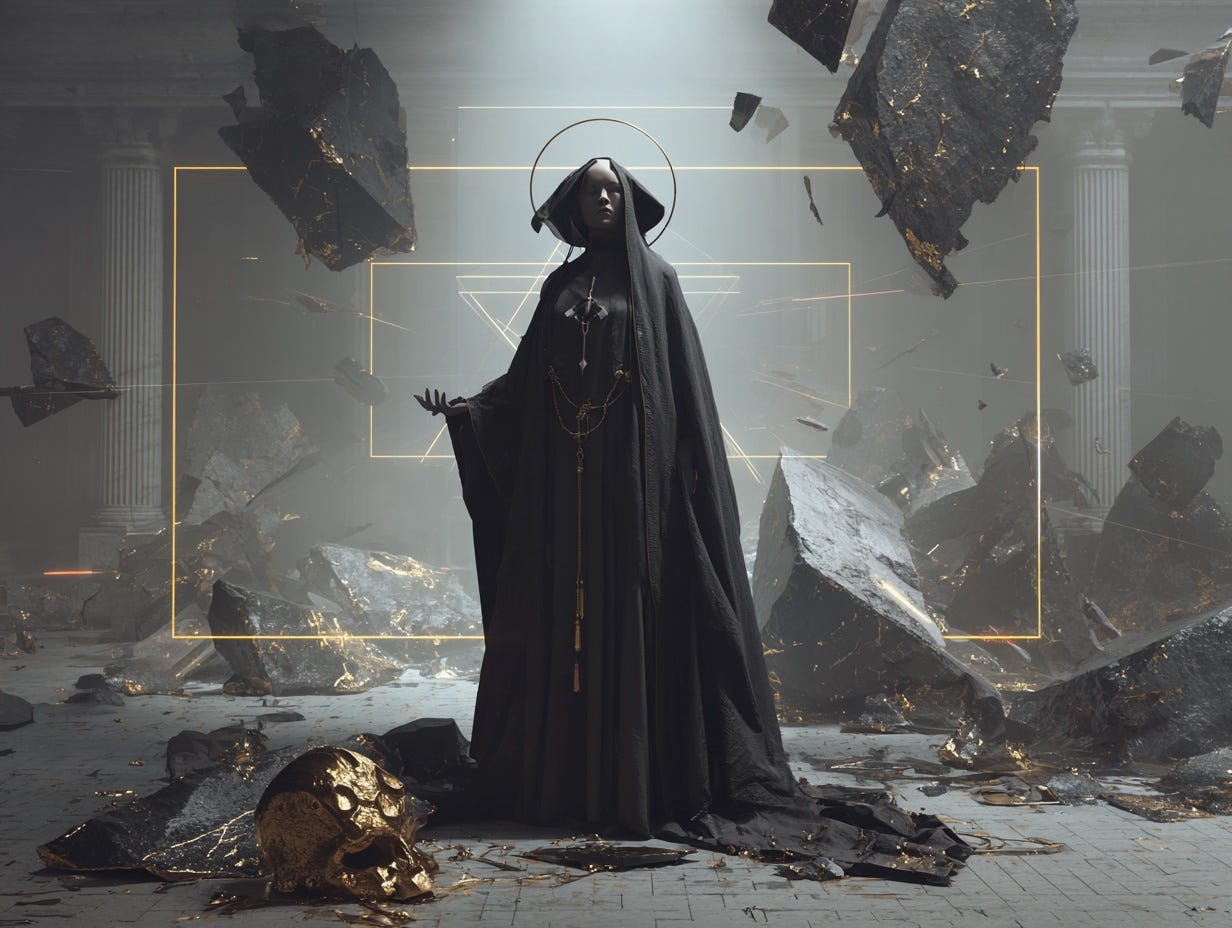
I have always been drawn to villains in stories and movies... Not the irredeemable abuser or the tyrant who delights in cruelty, but the figure who refuses the consentually sanctioned script. The one who isn’t safe. The one who won’t comply. The one who speaks the truth others swallow and carry like stones in their bellies. The villain is usually more interesting than the hero. They are often more human, and in some ways more real.
They also tend to look better. With rare exceptions like Neo or Batman, the villain almost always arrives with better clothes, better aesthetic design, a more impactful silhouette, sharper presence, and stronger self-possession. Power without apology. Something raw. Something real. This is not incidental. The aesthetic reveals the archetype: a being who has stopped performing for approval and started inhabiting their full nature, however uncomfortable that makes everyone else.
Thanks for reading Jake’s Substack! Subscribe for free to receive new posts and support my work.
I am speaking about the archetype here. The figure who lives between saint and monster, which is where most real people actually exist whether they admit it or not. The space our sanitized culture has systematically erased. This essay is not an endorsement of true harm or cruelty, but rather a celebration of complexity.
Good villains are complex. They carry wounds and histories that explain, though never excuse, who they became. Anakin Skywalker falls for reasons that make devastating sense, his attachment turned to possession, fear metastasizing into control, love curdling into the very thing he sought to prevent. The creature in Frankenstein is simultaneously tragic and terrifying, while the real villain of that story is Victor, the irresponsible creator who abandons what he brings into being. Count Dooku becomes disillusioned with institutional corruption and falls into a darker corruption while seeking to escape it. Paul Atreides transforms from chosen one into genocidal tyrant, his prescience becoming a trap, his love for Chani unable to stop him from unleashing holy war across the galaxy. Annakin, much like Paul, was also the chosen one. The fulfiller of prophecy.
None of them fit neatly into good or evil. They exist in the grey-zone. In the in-between. They hold contradiction without resolving it.
That is why they feel true. That is why we return to these stories. They reflect the actual texture of human experience in ways our flattened moral discourse cannot accommodate. And love is sometimes violent. And violence has no constraint.
Our culture has lost this nuance, and the loss is not accidental. We live inside systems that punish complexity and reward “branded” performance. The spiritual marketplace has industrialized inner work, turned awakening into product lines, packaged consciousness like subscription services. Gurus brand their enlightenment. Influencers monetize trauma with the efficiency of extraction industries. Teachers preach presence while obsessively checking analytics dashboards, teaching non-attachment while desperately attached to engagement metrics.
It is commercialized. Sanitized. Packaged for mass distribution. And profoundly, structurally dishonest.
We do not need more gurus on pedestals, more teachers performing purity, more brands built on staged vulnerability. We need humans willing to show up as they actually are: flawed, contradictory, powerful, and real. Not performing innocence, and not denying, hiding, or pretending away desire, ambition, or the capacity for harm.
The villain archetype never denied this complexity. The villain already lives there, has always lived there, unapologetically. And that is precisely what makes them dangerous to systems built on lies.
The modern spiritual economy runs on performance and deception. Scroll through your instagram feed and witness staged vulnerability, orchestrated authenticity, confessions that always end with a link to purchase something. We exist inside a soft tyranny of mandatorily appearing healed. There is enormous pressure to be pure, regulated, enlightened, and perpetually aligned. To have done the work. To be beyond ego. To model integration at all times. Where, in this, is the space for our flawed and intricate and often wounded humanity?
It is a business model masquerading as spiritual practice. You monetize your wounds and methods to heal them. You brand your healing journey. You sell shadow work courses while refusing to face your own darkness. You preach radical truth while curating your personality with the precision of a marketing team.
This produces hypocrisy. Not accidentally, but structurally, inevitably. When purity becomes currency, honesty becomes liability. When the brand depends on appearing beyond human struggle, admitting actual struggle threatens revenue streams. And this enables a kind of pseudo-spiritual predation that seems to affect our gurus most of all.
The current climate of moral posturing and ideological conformity makes real complexity impossible. Nuance is dangerous. Ambiguity is suspect. You must signal the correct positions, use the approved language, stay within acceptable narratives or face exile. Shame becomes the primary tool for social control. Public denunciation replaces private accountability. The mob devours complexity.
And what we repress does not vanish. It grows teeth in the dark.
The shadow contains everything we hide from ourselves: rage, hunger, ambition, selfishness, cruelty, the capacity to manipulate and harm. But also power. Creativity. Desire. Vitality. Erotic force. The part of us that refuses to be tamed. When shadow becomes forbidden territory, when we cannot acknowledge these aspects without social annihilation, people simply lie. They repress what they cannot admit, then act it out unconsciously with greater destructive force than if they had faced it directly.
So the guru preaches unconditional love while sexually manipulating students. The wellness influencer sells empowerment while cultivating parasocial dependency for sake of sales. The social justice activist demands accountability from everyone except themselves. The spiritual teacher who claims egolessness reveals bottomless narcissism the moment their authority is questioned.
These are not random moral failures by flawed individuals. They are the predictable, systemic results of repressing shadow while building entire identities and income streams on claims of purity.
The math is simple: the lighter and more enlightened the persona, the darker the shadow. The more someone insists they are beyond ego, beyond harm, beyond human limitation, the more dangerous they become. Because that shadow does not disappear. It operates. It has agenda. And it acts through the person who refuses to see it. There are countless examples of this, and the history of our western spiritual marketplace is scandalous indeed.
The distinction is between the Integrated Shadow vs the Disavowed Shadow. Here is the distinction that matters. The problem is not having darkness. Every human being contains the capacity for profound harm. The danger is pretending to be beyond darkness while it runs you from behind the curtain.
Integrated shadow says: I have darkness. I carry the capacity to harm, to manipulate, to be selfish and cruel. I am aware of these tendencies. I take responsibility for them. I work with them consciously. I do not act as though I am beyond them.
Disavowed shadow says: I am past all that. I have transcended ego. My intentions are pure. If you see darkness in me, you are projecting your unhealed material onto my light.
That deflection, that spiritual bypassing dressed as transcendence, is where true harm begins. That is where abuse gets reframed as initiation. Where manipulation gets called medicine. Where the guru’s exploitation becomes the student’s lesson.
The worst villain is not the one who with a capacity for harm, or those who have occasion to enact faults, who admits complexity and takes responsibility for their impact. The worst villain is the one who claims absolute purity while weaponizing that claim to avoid accountability.
What we desperately need are people conscious of their own power and its potential for harm. But that still accept that they are human beings who will fail, make mistakes, and sometimes struggle with the responsibility of that power. We need people who refuse to lie about who they are, what they want, what they are still working through. People honest enough to say, “I am still becoming. I still struggle. I still fail. I am not beyond this. And I take responsibility for my impact.”
That honesty is what makes someone safe. Even to admit they are sometimes not safe, nor that we should strive to be safe all the time. It’s not their credentials. Not their spiritual resume. Not their follower count or their retreat testimonials. Their willingness to remain aware, truthful, and accountable to their own shadow.
Healing work matters. Therapy matters. Deep shadow integration matters. Real inner work transforms lives. But when healing becomes identity rather than an active and messy process, when it calcifies into another form of spiritual materialism, it becomes another cage. Another way to avoid being fully human.
“Doing the work” has become a badge, a performance metric, a subtle purity hierarchy that ranks people according to their therapeutic sophistication. The pressure becomes endless and impossible. Be regulated. Be enlightened. Be compassionate at all times. Never have a triggered reaction. Never misstep. Always respond from your highest self. Demonstrate your growth. Prove your healing.
It is exhausting. And fundamentally false.
I am done performing healing. I will continue the inner work because it matters to me, because consciousness is worth pursuing, because integration creates more freedom than fragmentation. But I refuse to pretend that growth makes me morally superior. I refuse to claim that years of therapy or plant medicine ceremonies or meditation retreats have erased my humanity, my capacity to harm, my ongoing struggles. And I’m no longer seeing this as the point of those endeavors.
People do not become pure through therapeutic process or spiritual practice. They do not transcend the human condition. They become more aware of their complexity. They develop capacity to hold contradiction. They learn to catch themselves sooner. At least, they should. That is what real work produces: not purity, but consciousness. Not transcendence, but honest relationship with the full spectrum of who you are.
Real healing means accepting that you will always be both wise and foolish, clear and confused, healed and wounded, often within the same hour. That you can have done decades of work and still fuck up in the same old ways when the right conditions arise. That growth is not linear and healing is not a destination you arrive at and stay.
That complexity is what makes someone trustworthy. Not their claims of having arrived. Not their performance of having transcended. Their honesty about the ongoing nature of the work. Their willingness to stay accountable to their impact rather than hiding behind their intentions.
Right now I am living through a season of exile. Not because anyoneexplicitlyforced me out, I have left by choice although there have been communities I feel at this moment I can no longer inhabit, but because I am no longer willing to pretend to belong where I fundamentally do not. Where the price of belonging is lying about my actual experience, my actual thoughts, my actual nature.
Many of us occupy this space right now. Stepping outside official narratives. Outside the curated simulacrum of what a “good” spiritual person looks like. Outside the increasingly narrow bounds of acceptable discourse. Refusing to perform the required purity. Unwilling to denounce parts of ourselves to maintain social standing.
Exile creates clarity. From outside, you can see how social belonging is policed, what the hidden rules actually are, what the real costs of membership have always been. You see the mechanisms of conformity you could not perceive while still embedded in them.
And you stop paying prices you can no longer afford.
The villain archetype represents precisely this refusal. Not chaos for its own sake, not harm as rebellion, but self-law. Sovereignty. Accountability to inner truth rather than social approval. The willingness to be cast out rather than betray your own knowing.
This has nothing to do with moral relativism or rejecting all external feedback. It has everything to do with distinguishing between genuine accountability and shame-based social control. Between honest feedback and mob dynamics. Between growth and forced confession.
Characters like Paul Atreides and Anakin Skywalker matter because they reveal something our sanitized narratives refuse to touch: the path from good to evil is not a dramatic leap into the abyss. It is a slow descent built from understandable motivations. Fear, pain, and love turned into possession due to the fear of loss. The attempt to prevent suffering that creates worse suffering. The certainty that you are the exception, that the usual rules do not apply to you, that your noble ends justify increasingly dark means.
This is infinitely closer to real life than the morality tales we are fed now, where good people are purely good and bad people were always bad and you can tell the difference by which side they are on.
Real people contain contradiction. Real people fall. Real people cause harm and offer healing in the same lifetime, sometimes in the same relationship. Real growth does not erase this ambiguity or resolve these tensions. It increases your capacity to hold them consciously.
Our culture desperately needs room for this complexity again. Room for people to be works in progress rather than finished products. Room for mistakes that do not result in permanent exile. Room for apology and repair. Room for the messy, non-linear reality of how humans actually change.
The flattening of moral complexity serves power by making everyone vulnerable to denunciation while making genuine accountability nearly impossible. When any mistake can end you, when there is no path back from being labeled problematic, people either become paralyzed or they double down. Neither response creates growth.
There is an aesthetic to the villain because outer form expresses inner truth. Unapologetic power. Presence without permission. Refusal to shrink. The villain wears their authority. They do not apologize for taking up space. They have stopped performing for approval and started inhabiting their actual nature.
This aesthetic appears throughout culture wherever something essential has been repressed: the Wild One, the Dark Masculine, the Shadow Sorcerer, the Trickster, the Heretic, the Exile, the Destroyer. These are not excuses for harm. They are invitations to conscious power. They are what emerge when a culture becomes too tame, too controlled, too severed from its own vitality. These are repressed archetypes in the unconscious that I feel personally drawn towards channeling and embodying, for the sake of balance and exploration.
They point toward integration, not denial. Toward relationship with the full spectrum, not transcendence of half of existence.
Jung understood that what we refuse in ourselves we will encounter in the world. The shadow we deny will manifest as other people, other forces, seeming to come at us from outside. This is why the hero needs the villain. The villain carries what the hero refuses to acknowledge in themselves.
But when you integrate shadow, when you consciously relate to your own capacity for harm, your own hunger for power, your own selfishness and cruelty and manipulation, something shifts. The projections thin. You can see more clearly. You become less reactive. You stop needing villains to carry your disowned material.
This does not mean you become morally neutral or lose the capacity for discernment. It means your judgments become clearer because they are no longer contaminated by projection. It means you can hold people accountable without needing to destroy them. It means you can see the difference between someone acting from integrated shadow and someone acting from disavowed shadow.
The age of the guru is ending because it was always built on a lie: that purity exists, that some people have transcended the human condition, that enlightenment can be purchased and transmitted and packaged for consumption.
That lie is collapsing. Too many gurus have fallen. Too many scandals have erupted. Too many people have been harmed by those claiming to be beyond harm. The business model is failing because the product cannot be delivered.
What replaces it is an older truth, one that predates the spiritual marketplace: We are each light and shadow. We each contain the capacity for extraordinary compassion and extraordinary harm. We are not here to become pure. We are not here to transcend our humanity. We are here to become whole.
Wholeness includes everything. The parts we are proud of and the parts we hide. The love and the hate. The generosity and the selfishness. The wisdom and the foolishness. Integration means bringing all of it into conscious relationship, not exiling half of existence into the dark where it operates unexamined.
The dystopian control systems rising around us, the increasing surveillance and social management and behavioral modification technologies, all of this reflects our collective refusal to face shadow. Control emerges where repression dominates. When we cannot consciously relate to darkness, we externalize the management function. We build systems to contain what we refuse to integrate.
The answer is not more repression, more control, more purity testing. The answer is maturity. The answer is adults taking responsibility for their full nature. The answer is consciousness.
Some people are called to gentleness and care, while others are called to power and disruption. Some roles exact in the same person, and both roles matter. The warrior and the healer. The builder and the destroyer. The nurturer and the challenger. Culture needs all of it.
But power without consciousness corrupts absolutely. And healing without shadow becomes performance, becomes another way to avoid responsibility, becomes spiritual materialism dressed in therapeutic language.
The villain archetype, held consciously, reminds us that truth lives beyond myths of purity. That wholeness requires honesty about the full spectrum of what we contain. That we must face the darkness within ourselves if we want to stop projecting it onto others, stop creating external villains to carry what we refuse to own.
The real work is not transcendence. The real work is not climbing some spiritual hierarchy until you escape the human condition.
The real work is wholeness. Integration. Conscious relationship with everything you are and everything you have the capacity to become, both light and shadow.
And that will never fit inside a brand. That cannot be packaged or sold or performed. That requires staying with the discomfort of not knowing, of being a work in progress, of holding contradiction without resolving it.
The guru promised arrival. Promised you could get there and stay there. Promised purity was possible and they had achieved it.
The villain knows better. The villain knows we are all still becoming. Still capable of falling. Still carrying both angels and demons. Still responsible for which one we feed, which one we let drive, which one we bring into consciousness.
That is the work. That is what matters. Not perfection. Not purity. Not performance.
Wholeness. Honesty. Accountability. Messiness. Rawness. Realness.
Everything else is just another story we tell to avoid being fully human.
– Jake Kobrin
December 30th, 2025
Mill Valley, CA
Thanks for reading Jake’s Substack! Subscribe for free to receive new posts and support my work.
Read more of my writing and subscribe on Substack: jakekobrin.substack.com.
