Putting Down the Oracle
Originally published on my Substack, Writings From The Edge of the Known, where I write regularly. Subscribe there for new essays.
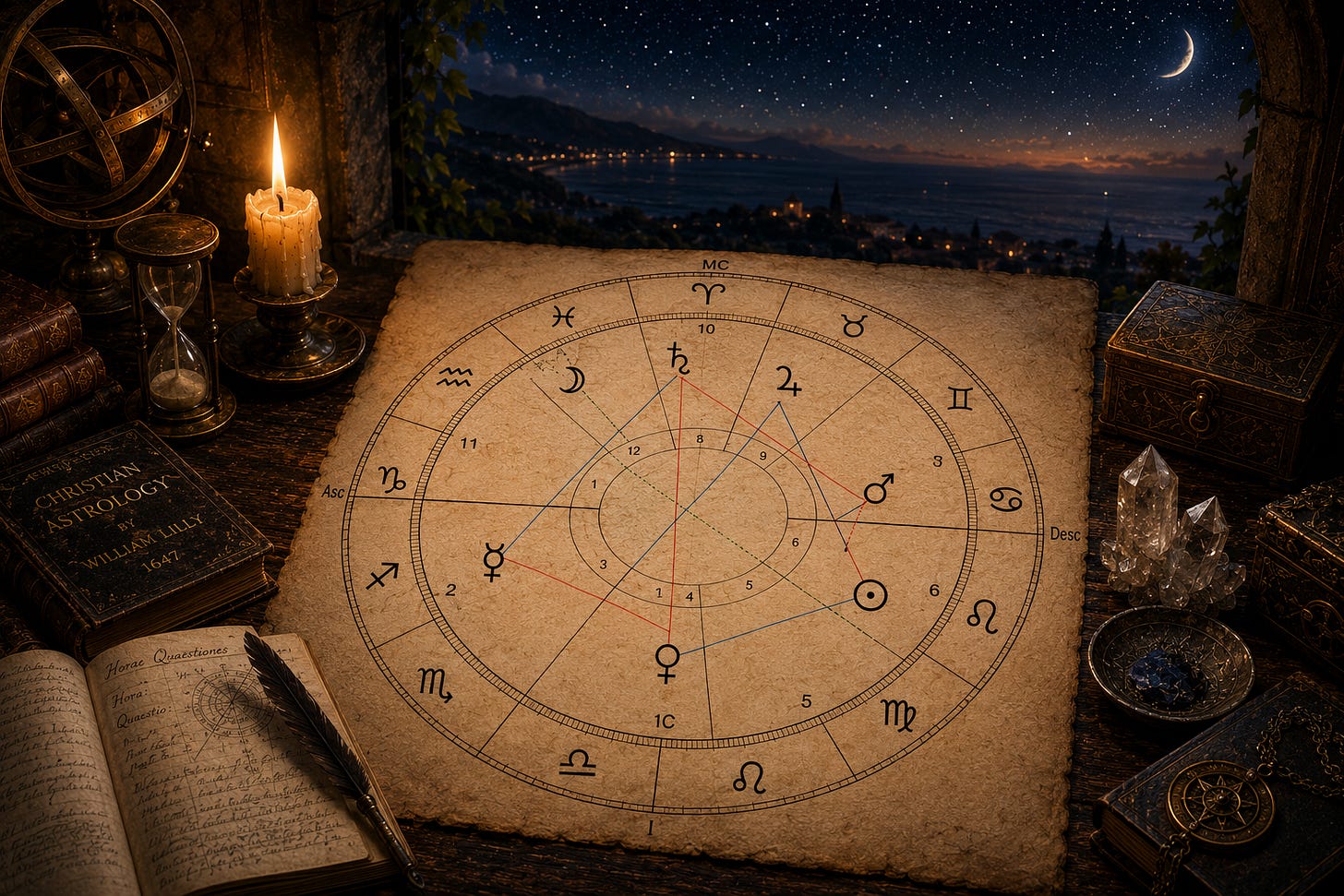
A few years ago I became convinced I had found a way to read the future.
The tool was horary astrology, a predictive branch of the classical western astrological tradition, and it works very differently from the natal readings most people picture when they hear the word astrology. A natal chart maps the sky at the moment of your birth and describes character, tendency, the broad weather of a life. A horary chart answers a single question, the chart cast at the moment of its asking. The craft is old, and its foundational text in English is William Lilly’sChristian Astrology, published in 1647. Lilly answered questions about stolen goods, runaway servants, marriages, wars, and plague for paying clients, and he recorded his methods in enough detail that astrologers still use them nearly four hundred years later.
I found my way in through the books of Anthony Louis. I no longer remember what first put horary in front of me, but I remember the feeling. Here was a secret art most people had never heard of, and it claimed to deliver hard answers. While living in Bali I met a few people who had studied it seriously, some of whom read horary charts professionally for clients. That made it feel like a living craft.
It resisted me at first. Horary is dense with old rules, and the rules interlock. I committed anyway. For a long stretch I kept up an email correspondence with Louis himself. I would interpret a chart using what I was learning from his book and send him my judgment, and he would write back with his own reading, showing me where I saw clearly and where I went wrong. Over time the method opened up. I became proficient enough that while living in Berlin I taught a workshop on it, attended by a small crowd of nerdy astrologers. Horary is advanced material, and that is exactly who shows up for it.
The method deserves a short explanation. You ask a sincere question and note the exact time and place you asked it. Then you cast a chart for that moment, as if the question itself had just been born. The chart is read through significators. Say Sagittarius is rising when the question is asked. Jupiter rules Sagittarius, so Jupiter becomes your significator. It stands for you, the one asking. The matter you asked about takes its significator from the ruler of the relevant house. A question about a partner points to the seventh house, a question about career to the tenth, a question about money to the second. With the players assigned, you study how they relate. When the significators apply to a favorable aspect, the matter tends toward yes. When they separate, or the aspect is blocked, or the planets involved are weak and afflicted, the answer leans no. The Moon carries the story between them, and the astrologer’s job is to read that conversation. Judging a full chart involves far more than this sketch, but that is the method in a nutshell.
What sold me was that it seemed to work.
In 2023 I was preparing an exhibition at a gallery in Dubai that specialized in NFT and cryptocurrency art. They planned to show my digital paintings on large screens alongside my large hand-painted abstract canvases. We spent months on calls. We signed contracts, and I bought my flights. Somewhere in that stretch I asked a friend, a practicing horary astrologer, to cast a chart on whether the exhibition would succeed. The verdict came back strange. According to the chart, the show would never happen at all. Nothing in my situation suggested that, and I brushed it off. Then, out of nowhere, the gallery canceled. The explanation was thin, something about legal restrictions involving cryptocurrency and my American nationality. Through a friend of a friend I hired a lawyer in Dubai and argued my case over the phone. The exhibition never happened, and the chart had called it months in advance.
Other hits followed, small spooky accuracies that stacked up, and I came to believe I had found the most precise instrument of divination available. I had years of history with tarot and theI Ching, and I had come to treat tarot as a mirror, a way of seeing your own inner state reflected back in images. Horary felt like a different animal. It made claims about events and said what would happen.
Then, over the last few years, the ledger turned.
I brought serious questions to serious charts and used the answers to justify major decisions, and the answers failed. A relationship ended, and reading after reading told me we would reunite. Every new chart bought the hope more time. We never did reunite, and the charts helped me stay attached to a hope that had no future. Later I met someone I was excited about, and a chart said it would come to nothing. I let myself get preemptively disappointed. The relationship worked out and lasted well beyond what the chart allowed. The questions went past romance. I consulted horary on where to live and how to steer my business, real decisions with real stakes, and the answers were no better there. Counted honestly, the misses outnumber the hits, and the margin is wide.
It took me years to admit and observe its inaccuracy.
It took that long partly because of how I was using the charts. Looking back, I sometimes asked questions whose answers I had already chosen. The chart supplied permission, and I followed it willingly.
There is a particular temptation for those of us drawn to the occult. You want the hidden thing to be real, and beyond that, you want to be one of the few who can wield it. Horary flatters that wish precisely because it is difficult, technical, and old. Mastering it feels like initiation. And sometimes it delivers a result so exact that you feel your head spin. I understand the seduction because I lived in it for years.
So here is my warning, and it is the reason I wrote this. Do not hang a major life decision on a horary chart or any other form of divination. Major decisions deserve evidence, experience, the counsel of people who know you, and your own judgment. Give the chart a seat at that table, but it shouldn’t be the thing you rest on. Study horary if astrology calls to you. The study deepened my understanding of the whole art of astrology, and I regret none of the charts I cast. Treat its answers the way you would treat advice from a brilliant friend who is often wrong.
The same caution applies to tarot, and I say this as a tarot reader. As prophecy, tarot is mild at best, and its strength lies in reflection. A spread can surface how you already feel about a situation, show you a blind spot, and give you language for something you could not articulate. That clarity can help you choose. The reader matters too, since the wisdom a person brings shapes the reading as much as the cards that fall.
So is any of it real? Is magick real? Is prediction possible? I hold those as open questions, and I have had experiences strange enough to keep them open. What I can report is my own experience, and that experience has made the decision for me. The mystery has held, but I’ve lost certainty with it. My years with horary and other forms of divination have taught me a great deal about astrology and magick and the systems they are built upon.
But probably, the most valuable lesson was to stop asking it what happens next, to learn to rest in uncertainty, and to take responsibility for our own choices.
—- Jake Kobrin
Mill Valley, CA
July 2026
Writings From The Edge of the Known is a reader-supported publication. To receive new posts and support my work, consider becoming a free or paid subscriber.
Read more of my writing and subscribe on Substack: jakekobrin.substack.com.
