On Curses
Originally published on my Substack, Writings From The Edge of the Known, where I write regularly. Subscribe there for new essays.
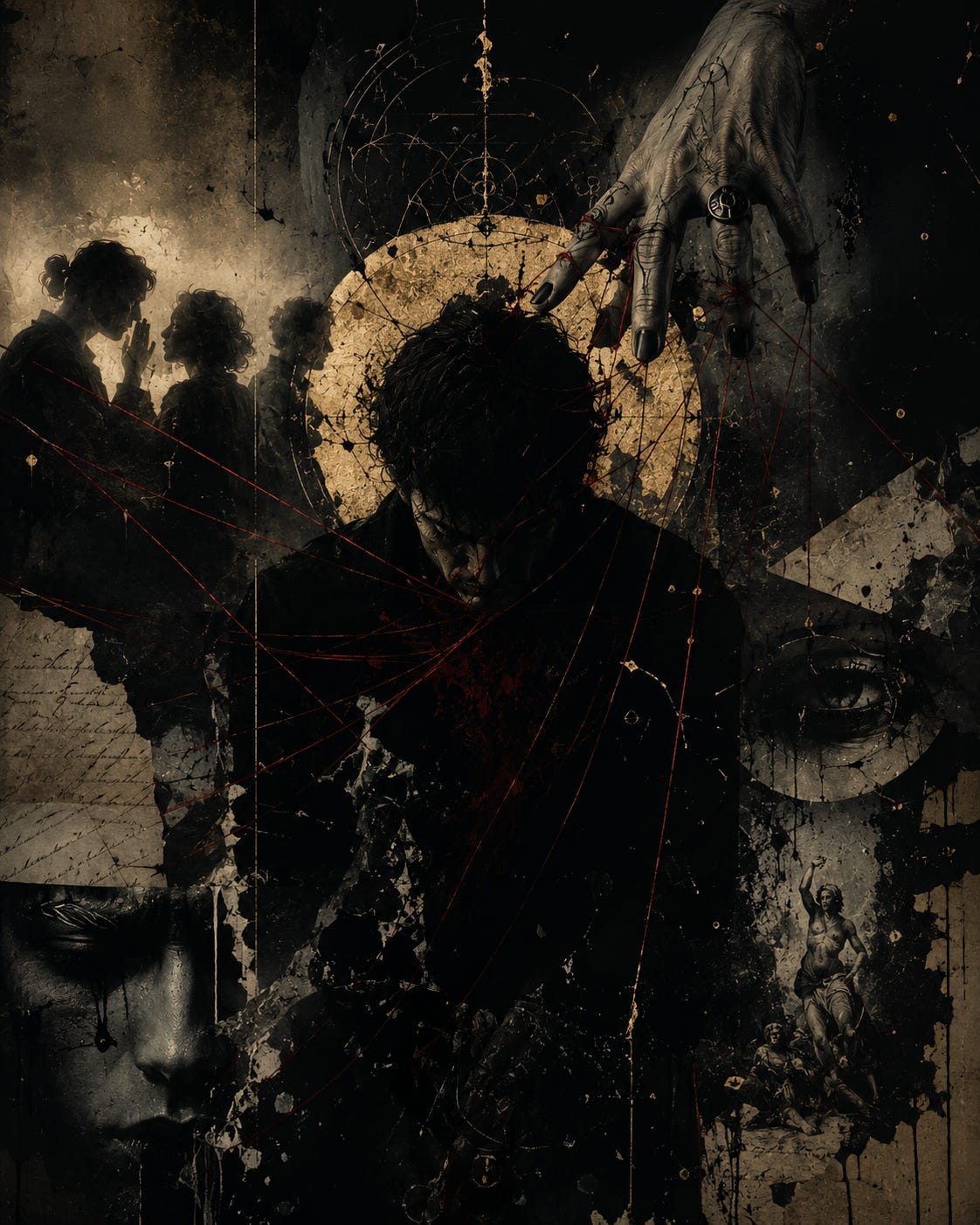
A Note Before Reading
This essay is not an argument against believing victims. Abuse is real. Trauma is real. People who have been harmed deserve care, protection, and serious attention.
What I am naming here is something more specific: the way the language of harm can itself become a vehicle for harm when it is used to flatten context, prevent inquiry, and turn a complex human being into a symbolic villain.
I am not asking anyone to reverse their loyalties, adjudicate a private relationship, or take up arms on my behalf. I am asking for discernment. I am asking that communities learn to distinguish care from social execution, boundaries from banishment, accountability from ritual humiliation, and testimony from narrative control.
The point is not that every accusation is false. The point is that stories have power, and power requires responsibility.
If this essay gives language to something you have lived through, take what is useful. If it challenges something you have participated in, sit with that before defending it. If it makes you uncomfortable, pay attention. The mechanism depends on nobody looking directly at it.
What Is a Curse?
People talk about being cursed all the time, and they usually mean a bad month, a rough stretch, a run of ugly luck. I have been cursed in the older sense of the word. Someone performed a sophisticated operation of social coercion against me, and it worked. It cost me my home, my community, my grip on what was real, and very nearly my life. Whether they accomplished this through explicit ritual work or through the ordinary instruments of slander and character assassination is, in the end, irrelevant. The mechanism is the same. The results are identical.
This essay is about that equivalence. The most effective curse work has always been the corruption of consensus reality through narrative control. Languageismagick, storiesarespells, and reputation violenceisritual harm. When we talk about hexing and malefic working, we may be talking about something as simple, and as devastating, as saying the right words to the right people at the right time.
What Happened
I want to be direct about this, because the occult community has a bad habit of mystifying what is simple, and an equally bad habit of dismissing real magickal harm as just psychology whenever it arrives without theatrical ritual.
Some time ago I was in a relationship that ended with my effective exile from a community I had been part of. The relationship followed a pattern I have since learned to recognize. Intense idealization, then systematic destabilization, while the other person held the position of the wounded one, innocent and in need of rescue.
I knew something was wrong while I was inside it. I have documents I wrote to myself during that time, internal dialogues in which part of me saw clearly what was happening. That part said this person is using you, weaponizing her trauma to avoid accountability, creating conditions that make you increasingly reactive while she remains above reproach. Other parts overrode that knowing. There was real love and real attachment, the part of me addicted to being wanted and seen as special, the part that wanted to be the one who could finally help someone heal, the part that believed love could fix what was broken.
When I finally tried to name what I was observing and refuse more of it, the relationship ended, swiftly, cruelly, and unexpectedly. What I didn’t expect was what came next. My former partner began speaking to mutual friends and community members about what I had done to her.
I learned about it slowly, the way you learn you’re dying from a poison already deep in your system. People went cold and dark, evaporating from my life without a word about what was happening or why. Eventually fragments reached me. I was controlling. I was abusive. I was dangerous. People needed to be warned.
The story bore some resemblance to shared reality, edited so carefully that I barely recognized my own life in it. Yes, I had at times been anxious and reactive, after months of being destabilized and drained, financially and emotionally. Yes, I had expressed anger, in response to crossed lines and gaslighting that were never acknowledged. Yes, I had provided support, because I’d been positioned as rescuer of a vulnerable and severely struggling person I deeply cared about, inside an entanglement I didn’t fully understand I was participating in.
None of that context survived into the version that circulated. In that version I was simply an abuser who had exploited a vulnerable person. And because she had established herself as victim first, had spoken to people before I knew I stood accused, had framed everything in the language of trauma and healing, her story becamethestory.
My life came apart. I lost my home. I lost my community. I lost my sense of what was real. For months I couldn’t trust my own memory. I wondered if I was the monster she described and took responsibility for harms I wasn’t sure I’d committed, in ways I wasn’t sure I’d committed them. I considered ending my own life. I believed her.
This is what it’s like to be cursed.
The Mechanism
A curse, properly understood, is an act of reality engineering, the intentional corruption of a person’s standing in consensus reality through the manipulation of collective perception. Whether this is done with graveyard dirt or with a strategically deployed victim narrative is mechanically irrelevant.
Consider the structure of a traditional curse. The operator performs certain actions, the ritual theater. They fix their will on a target and hold it there. They release the intent toward harm, sending it into whatever subtle field they believe receptive.
Now consider the structure of character assassination. The operator tells a carefully constructed story, the ritual theater. They maintain unwavering conviction in their own victimhood, the focused intention. They spread the narrative through social networks, the release into the field.
The two operations share a single skeleton. Both work through perception. Both change how the target is seen and therefore how the target is treated. Both produce material consequences by essentially magickal means, the reshaping of reality through directed will and symbolic action.
Words That Do Things
The esoteric traditions have always known this, even where modern practitioners have forgotten it in favor of more theatrical operations. In the beginning was the Word. To name a thing is to call it into being. The entire edifice of ceremonial magick rests on this foundation, the conviction that certain words, spoken with certain intention under certain conditions, reshape reality.
The philosopher J. L. Austin, working in mid-century linguistic philosophy, arrived nearby through other means. Some utterances, he observed, do more than describe reality. They constitute it. When the judge says “I hereby sentence you,” when the priest says “I now pronounce you,” when the gossip says “did you hear what he did,” reality is being made in real time. Austin called these performative utterances, words that act.
Slander, seen this way, is the act of speaking a false version of a person into existence. I mean this literally. The false version takes on reality through the attention and belief of everyone who encounters it. It acquires weight in the noosphere. It becomes an entity, a thought-form, an egregore that carries your name and none of your essence.
This is why the concept of the true name matters so much in the old traditions. To know a true name is to hold power over the named, because the name is a point of connection, a sympathetic link to the being who wears it. When someone crafts a narrative about you and fastens your name to it, they are performing name magick. They are binding your identity to qualities you do not possess.
The target then faces an impossible position, forced to contend with a version of themselves that is more socially powerful than their actual self. The stories told about you operate as active forces in the social field. They shape how people receive you, which opportunities remain open, whether you are safe in a given room.
How the Working Is Built
Let me lay the operation out step by step, because understanding the mechanism is the first move toward defense.
It begins with credibility, and credibility begins with the wound. Long before the working is deployed, the operator establishes themselves as injured, exploited, traumatized. In most cases this involves no cynical calculation. The operator believes in their own victimhood, and the belief powers the operation, since conviction is the most important element in any magickal working. A person may even be a real survivor of real harm. The power comes from the identification, from victimhood held as identity and sharpened into position.
Victimhood carries enormous social currency, above all in communities organized around healing, consciousness, and progressive politics. The victim is believed by default and stands beyond scrutiny. To question a victim is to commit a kind of heresy. So the operator cultivates the position with care, sharing their trauma, performing their wounding, establishing a history of exploitation that primes the audience to believe it’s happening again. By the time the curse proper is cast, the audience is ready.
The second movement takes place in your absence. The operator goes to mutual friends, to community members, to anyone who will listen, and shares their story, their truth, their experience of harm. Testimony from an established victim is received as fact. The target, meanwhile, believes they’re still in a relationship, still part of a community, still standing on solid ground. They have already been socially murdered. They are dead and still walking. This is the most elegant feature of the operation. The working corrupts the field in the dark, and by the time the target discovers it, the new reality has crystallized.
The third movement is the trap, and the trap is structural. The working seals itself, so that any attempt at defense becomes evidence of guilt. When the target finally learns what has been said and tries to explain, the explanation is reframed as manipulation. Distress at being mischaracterized proves instability. Anger at false accusation demonstrates danger. Context reads as denial, a failure of insight. The curse is a closed magickal loop. There is no escape through explanation, and no redemption through accountability either, because accountability for acts you didn’t commit, or for acts stripped of the context that gave them meaning, is impossible on its face. The structure ensures that innocence cannot be proven and guilt cannot be falsified.
The fourth movement is dialect. The operator’s vocabulary is drawn entirely from healing. They speak of “protecting myself,” of “trauma responses,” of “boundaries” and “abuse dynamics,” and the language of care administers the harm. Every word is a knife wrapped in care. “I need to share my truth” means I need to destroy your reputation. “I’m setting boundaries” means I’m exiling you from community. “I’m protecting others” means I’m arranging your social death. The dialect provides perfect cover, since the operator appears to be doing therapeutic work, healthy self-protection, community care, and the violence stays invisible because it’s performed in the language of its opposite. A scalpel heals in a surgeon’s hand and kills in an assassin’s. Here the words are the scalpel.
The final movement is release. Once the story is in circulation, the operator no longer needs to maintain the spell. The community becomes the operator, a servitor that carries the working forward on its own. Each retelling is an invocation. Each act of shunning is an offering of energy. The curse lives in the social body like an autonomous entity, reproducing itself through the speech of people who believe they’re simply being careful, discerning, protective. This is distributed sorcery, dozens or hundreds of people enlisted in a working they don’t know exists.
The Sympathetic Link
Traditional curse work operates through the law of sympathy. Like affects like, and things once joined continue to influence each other. Harm the effigy and the harm travels the link to the target. Work with a person’s hair, their blood, their name, and you can reach them at a distance.
In a social curse, reputation is the sympathetic link. Your reputation connects to you through the attention of every person who holds an idea of you in mind. Each of them maintains a thought-form of you, a representation living in their consciousness that shapes how they treat you. Corrupt the reputation and you have poisoned the link. You have performed malefic work on the whole network of thought-forms that make up a person’s social body, and because those forms connect back through name and memory and recognition, the harm returns to the lived life.
The losses are material. Opportunities disappear because whispers arrived before you did. You’re barred from public events and continually uninvited from the rest. Friends decline to get involved. Lovers have been warned. Every one of these losses began in someone’s poisoned image of you. The principle underneath is simple. To affect a person’s reality, corrupt the perceptions of them held by others, and corrupt enough of those and you have corrupted the life itself. The social body and the physical body are one continuous thing. When the social body is murdered, parts of you die while you go on breathing.
What It Feels Like
First there is confusion. Something is wrong and you can’t say what. It’s a literal headfuck, because you don’t know what’s going on, why things suddenly changed, why no one will talk to you or tell you what’s happening. You grow paranoid without being able to point at the threat.
Then information reaches you in fragments. Someone mentions they’ve heard things. Pieces arrive with no way to verify the narrative and no way to answer it. You understand a story is circulating. You don’t yet know its details or its reach.
When you finally learn what’s being said, there is a peculiar vertigo. The story resembles shared reality and is distorted enough that you don’t recognize your own life in it. You did some of those things, perhaps, though for other reasons, in another context, with another meaning. You’ve been translated into a monster through selective editing and strategic omission.
You try to defend yourself, and this is the first mistake. You tell your side, provide context, explain, and you discover the social field has already crystallized around the first narrative. You’re speaking into a space that has decided you’re unreliable, manipulative, dangerous. The ground itself has been poisoned against your words.
Here the curse does its deepest work. You begin to doubt your own reality. If everyone believes the story, does that make it true? If you’re treated as a monster, are you one? If your memory contradicts the collective memory, can you trust your own mind? It’s a spell of social gaslighting, and it attacks the epistemological ground under your feet. You lose your sense of what’s real. You take responsibility for a version of yourself that doesn’t exist. You internalize the working, and from that point on you maintain it yourself.
I spent months in that state. Unable to trust my memory. Convinced I was what I’d been portrayed as. Apologizing for being a person I wasn’t sure I’d been, punishing myself, trying to become innocent enough to deserve a forgiveness that was never coming. And because I’m someone committed to growth and to examining my own shadow, I took the distorted version seriously. My own integrity was recruited into the operation. This is the deepest cunning of a curse cast in the dialect of healing. It convinces the target they deserved it, and the exile becomes self-administered. I had been enlisted in my own destruction.
The Relationship Was the Ritual
Looking back, the timeline reads differently. Certain information was shared with others and never with me. I was positioned inside her narratives before I understood I was being narrated at all. My support was accepted while, in rooms I never entered, I was described as an exploiter.
The relationship itself was the ritual. Every act of generosity I performed, every attempt to help, every moment I stayed despite the red flags, fed the eventual working. The curse was being constructed in real time, and I was supplying the material. The break, the moment she left and began speaking, only marked the point where I became conscious of what had already happened. I had been killed some time earlier. Work of this kind moves in the dark, and you’re often dead before you know you’re dying.
Breaking the Curse
So how do you break a curse that lives in collective consciousness? How do you counter-spell a story?
First, and this is harder than it sounds, you stop maintaining it yourself. You refuse responsibility for sins you didn’t commit. You refuse to apologize for limits you had every right to draw. You refuse the role of monster in someone else’s victim story. This takes a ruthlessness that feels wrong to anyone socialized toward empathy and self-reflection. You have to be willing to say, plainly and without apology, that the story is false, and that you’re done explaining yourself to people who have already ruled on your guilt.
It feels like ego defending itself. It feels like exactly the thing an abusive person would say. That is the trap. The working is structured so that refusing it looks like confirming it. Sometimes refusal is the only sane response left, and the most spiritual act available is declining to participate in your own destruction. Real accounting survives the refusal. I did things I regret. I was anxious, sometimes controlling, reactive in ways I’m not proud of, and those behaviors grew in conditions built by someone who benefited from my reactivity and later weaponized it. The context matters. The patterns that preceded my reactions matter. I have a right to name the whole of it, and I decline to answer for the edited version.
Second, you rebuild your sense of reality outside the cursed zone. You find the people who never heard the story, or who heard it and chose their own judgment, or who know you through their own experience of you. Among them you reconstruct a reality in which you’re a complex human being rather than a symbolic villain. The work is slow. Your nervous system now expects betrayal, so you watch new friends for the turn, and trust feels dangerous because trust is what exposed you in the first place.
Third, and hardest, you accept that some people will always believe it. A curse can’t be fully retracted once cast. There will always be people who know you only through a narrative built in your absence, a version of you living in the social imaginary that wears your name. This is the permanent scar of reputation destruction. You emerge alive and altered. Somewhere you’re still spoken of as monstrous, and there is nothing to be done about that. What the acceptance returns to you is ground. Consensus is one reality among others. You can be reviled in one context and loved in another, and both are real. Social death in one community leaves you alive everywhere else, free to build in new places, with new people, out past the reach of the working.
What to Watch For
I see this pattern everywhere now that I know its face, and the wellness and occult communities are especially exposed to it, for reasons built into their virtues. In spaces organized around healing, woundedness confers authority, and questioning a wound reads as violence, which creates ideal conditions for exploitation. Therapeutic language camouflages aggression, since “protecting myself” and “sharing my truth” are received as healing work even while they function as reputation destruction. These communities also prize emotional openness over discernment. We’re taught to believe survivors and to trust expressed experience, sound principles that a skilled operator can convert into unassailability, because certain stories arrive pre-believed and certain testimony is received as more credible than any answer to it.
Abuse is real, and victims deserve belief. A third thing is true beside those two. The architecture of belief can be studied and worked by people who understand it, and communities need better habits of discernment, better ways of recognizing when the language of healing is administering harm.
There are signs. Watch the person who performs their wound constantly yet never seems to heal, whose every former partner turns out, in the telling, to have been toxic, narcissistic, or abusive. Watch for resources accepted steadily while nothing changes and nothing returns, for limits received as abandonment or as abuse, for a long roster of people who “hurt” them in ways that coincide with those people drawing a reasonable line. Watch for fluency in therapy language beside a total absence of self-examination, and for accounts of events that omit every detail that would complicate the teller’s innocence.
If you recognize someone close to you in this description, be careful. You may be in the early phases of a working that will eventually turn toward you. I had foreshadowing, and I didn’t listen.
Living as One Who Has Died
Surviving social death and rebuilding afterward is an initiation. You come out changed, less naive, less willing to be vulnerable with people who haven’t earned it, more alert to the sensation of being narrated in rooms you can’t enter, more ruthless about protecting your energy and your version of events. From the outside this can look like bitterness, hardness, a failure to forgive. I’ve stopped arguing with that reading. What the initiation confers is knowledge. Some people who speak the language of healing have no interest in healing. Some who claim the victim’s position are holding a weapon. Sometimes a person will try to destroy you and arrange things so that you carry the blame for your own destruction. You can survive that too. Rebuild anyway. Trust your own perception anyway. Live anyway.
The curse taught me that my existence doesn’t depend on consensus, and that my reality requires no validation from people who have decided against seeing me. You learn to live as a ghost, socially dead in certain circles, alive in your own continued existence. The counterspell turned out to be outliving it, letting the false version of me wander the social imaginary while the life goes on being built out past its reach. Vindication never arrived. The truth stayed partial, justice stayed theoretical, and the freedom came anyway, because at some point I stopped needing any of it. That was the gift waiting at the end. You have died and returned, and nothing can kill you quite the same way again.
— Jake Kobrin
July, 2026
Petaluma, CA
(Revised from an essay originally written in Berlin in October, 2025)
Writings From The Edge of the Known is a reader-supported publication. To receive new posts and support my work, consider becoming a free or paid subscriber.
Read more of my writing and subscribe on Substack: jakekobrin.substack.com.
