Liber Universa
Originally published on my Substack, Writings From The Edge of the Known, where I write regularly. Subscribe there for new essays.
Liber Universa
by Jake Kobrin
❧
A condensation of the most impactful ideas I have gathered through my exploration of the Western Esoteric Tradition, and an attempt to convey them as accessibly as I can.
❧
“Do what thou wilt shall be the whole of the Law.”
— Aleister Crowley, The Book of the Law
❧
I first released this as an ebook in 2020, offered for free. I was surprised by how many people chose to donate to read it anyway, and by how much it seemed to resonate with so many. I’ve returned to it now because, while I still love some of the ideas from that original essay, I’ve grown a great deal as a writer in the six years since. I wanted to mature the piece, sharpen it, and put it back out into the world.
❧
Image by MidJourney AI
❧
We get to decide what life means, what reality is, what we’re here to do. We can choose a way of living that looks like no one else’s, even one radically different from everyone around us, and we don’t owe anybody an explanation for it. That freedom is the basis this essay is written on, and everything here grows out of it.
We’re each unique, and we’re each bound to each other. Free will is real, and so is consequence. Whatever we do to others reaches us in time, because we’re tied to every other living thing. If you want to live somewhere worth living, it’s best to act from love, since love brings us closer to harmony with each other and with our place in the cosmos. Any action is permitted. The questions are what it costs, and who ends up paying.
In the spirit of ontological anarchy, there are no rules beyond this one, and even this one is more an ideal than a rule. Do what you will. See the world however you please, and take whatever actions follow from that. There’s no court of nature waiting to sentence you.
Whatever the laws and creeds of governments and religions say, there is no right and wrong in nature. The only real laws are the laws of the living web we belong to, and the physical laws science has roughly mapped. As much as I might like to, I can’t walk out of my room through the wall. I have to use the door. Past those physical limits, we can do as we like.
So we can do almost anything, as long as we stay aware of what each action sets in motion. The work of living is choosing actions whose consequences we can live with, for ourselves and for the people around us. Whatever we do to others comes back to us in the end. If you want good things in your own life, work for good things in the lives of others. That isn’t a law, but it’s wisdom, and it will serve anyone who takes it up.
None of these ideas are new, or completely original, or mine. A man who sometimes signed himself M Therion set them down first, though he caged the meaning in sinister imagery and dense prose. “The Law is for all,” he wrote, and I take him at his word. These ideas aren’t only for scholars with the education to parse his Latin. They’re for everyone. His writing changed my life and gave me the nerve to live closer to myself, and what follows is my attempt to carry the best of it into plain modern English, filtered through my own perspective.
Most people walk this without a name for it. You inherit a set of rules, live an unhappy life without knowing why, and slowly work out which ones are actually yours. That sorting is individuation, and I came to it the long way, like everyone else. I’m not writing as someone who has arrived. I’m still on the path, still deciding which of those rules to follow.
❧
I · Ontological Anarchy and Neurological Relativism
“I don’t know what anything ‘is’; I only know how it seems to me at this moment.”
— Robert Anton Wilson
We’re all different. It sounds trite and obvious, but it bears repeating, because so much of our conflict begins right there. No two nervous systems are alike, so no two of us read the same world from the same signs. We can share a language and still see different worlds. Learning to accept this, what I’m calling neurological relativism, is essential to compassion. Each of us has the right to see the world the way we see it, and even when someone else’s view contradicts mine, I’m bound to protect their freedom to hold it.
No worldview is objectively true. Each one is true for the person who holds it. Some of the trouble is in language itself. We almost never say anything that’s flatly, objectively so. Robert Anton Wilson built a stripped-down English he called E-Prime to work around the problem, and although I won’t go into it here, it’s worth looking into.
Language is symbolic, and symbols have to be interpreted. I say the word love and assume you’re holding in your mind the same thing I’m holding in mine, but I don’t know that. Your experiences of love have been different from mine, and they color the word before you’ve finished hearing it. If a single word slips this much between two people, you can see how hard it is to agree on the shape of the whole world. Better to accept that each of us reads reality differently, all the way down. That acceptance is itself a kind of compassion, since the difficulty is one we all share.
Borrowing from the Buddhists and the other esoteric paths I’ve explored, I take this much as firm: all we can really verify is that there’s a perception of a stream of sensation. The commonsense idea that an Ego sits behind the stream and watches it can’t be proven, though denying it seems to lead to worse confusion than tentatively accepting it. We say “I am lifting my arm” when the more honest sentence is, “there is the consciousness of the tendency to perceive the lifting of an arm.”
What we think we know about the self and the outer world is very little, and more misleading than not, because it’s such a small fragment of what the whole self and the whole universe must be. Blake said everything capable of being believed is an image of the truth, and he surely knew the other half of it too, that everything capable of being believed is also self-hypnosis. In that sense we are the arbiters of our own realities, and reality presents a different face to each of us, shaped by everything that has shaped us. No two beings are alike, so no two perceptions are alike, and no two universes are alike.
I’ve spent years experimenting with my own nervous system, through psychedelics and other plants and chemicals, and through older means: fasting, ritual, meditation, chanting, long solitude, breathwork. Every time I managed to alter my nervous system and produce an altered state, a new “Me” appeared, and a new world appeared with it, and the two mingled in strange ways. The change in perception always came first, and the change in the world followed it.
As my perceptions changed, the world around me changed too. The fabric of reality seemed to rest on my perceptions, and on other things I had taken for solid, like my sense of self. Each of us, shaped by a nervous system no one else has, lives in a world no one else can enter, and most of us never suspect we could change it.
This is a problem for anyone whose belief system depends on fixed laws and shared verdicts. Most governments, religions, and social codes want everyone to behave the same way, believe the same things, and follow the same rules, or be punished. I reject this, because people are unique down to the very core of how they perceive themselves and their world. Every person has the right to define their own life and the beliefs that frame it.
Neurological relativism brings an ethical and behavioral relativism with it. It lets people experiment with what actually works for them, and it puts the responsibility for that squarely on them. To clear away the fixed dogmas is to trust each person to learn for themselves what fits and what doesn’t, and to live with the results. It treats people as capable of authoring their own way of living. To live like this is to do away with the shackles of borrowed creeds and to embrace freedom, which is nothing more than the natural power and knowledge waking up inside each of us.
❧
Image by MidJourney AI
❧
II · On That Which Remains
“Who would deny that when I am sipping tea in my tearoom I am swallowing the whole universe with it, and that this very moment of my lifting the bowl to my lips is eternity itself transcending time and space?”
— Daisetz Teitaro Suzuki
“Don’t grieve. Anything you lose comes round in another form.”
— Rumi
There is, though, a truth beneath the shifting perspectives of each of us. “The Kingdom of God is within you,” says the Christian scripture, and the East offers a matching image: our many perspectives are the facets of a single diamond, the diamond some have called God. Each of us is both part of that whole and inseparable from it.
The ancients watched the sun go down and prayed in terror, certain the sun was dying and might never come back. They made sacrifices and wailed at the dark, begging the great giver of life to return and warm them. We call this primitive, because we know the sun doesn’t die or go anywhere. The earth turns, the light is hidden from where we stand for a while, and then it returns. The sun goes nowhere.
Our view of life and death is as primitive now as the ancients’ view of the sunset was then. We see life as finite and death as its end. But the death of a body in the physical sense ends only the ego and the consciousness of that organism, not life itself. There is death, and there is That Which Remains, the continuity of existence that runs beneath every rising and falling life. Only a rigid mind, full of manufactured distinctions, could mistake one fluctuation for the end of the whole. From the side of life there is only life, continuous and unending. Death is one of its motions.
This same mistake about the dying sun is where we get the myth of the Dying God, which begins in Osiris and runs on through Jesus and into our newer stories, the superheroes and boy wizards who gain their powers through cataclysm and rebirth. There’s nothing wrong with the myth in itself, and it’s true enough that people are initiated through death and come back with new wisdom. The danger is that it rests on a false picture of life, and at its worst it has made death-cults out of whole cultures. We’re coming now into a new understanding, away from the belief that life ends when the skin-encapsulated ego perishes, and toward the recognition that life is continuous and inseparable from the infinitude of existence.
That Which Remains, the undifferentiated energy that Terence McKenna called hard as heck to talk about, since it transcends language, is what the cultures of the world have called God, the Universe, the One, the All. It isn’t really One either, since one can’t exist without a separate other to perceive it. It is None, and out of None arises Two, so that this lonely unity can know the joy of perceiving itself through our many separate perspectives. As M Therion put it in De Lege Libellum:
By Light shall ye look upon yourselves, and behold All Things that are in Truth One Thing only, whose name hath been called No Thing for a cause which later shall be declared unto you. But the substance of light is life, since without existence and energy it was naught. By Life, therefore, are ye made yourselves, eternal and incorruptible, flaming forth as suns, self-created and self-supported, each the sole centre of the Universe.
This unity, the holon Ken Wilber describes, which transcends and includes all things, has been the subject of the poetry and art of every culture, and of the parables of every faith.
It’s hard to describe, and the realization of it comes only through initiation and first-person experience, or maybe better, no-person experience. And nothing changes a life more. To wake into it is to drink the elixir of immortality, because you see that life outlasts the death of the body. What we really are is deathless. Once the fear of death loosens, life stops looking like a field of enemies and becomes more like a playground, a place to create and explore.
The fear of death feels like the most natural thing we have, but look at it closely and you find it was taught to us, layer by layer, and that what it guards was never actually in danger. I won’t pretend I’ve fully gotten free of it. It still finds me. But I’ve had enough glimpses to suspect the fear is learned rather than given, and that a life lived with less of it would be a different life. That’s the wager this essay is making, and I’m still making it.
And the seeing doesn’t stay, which is the hard part. Whatever clarity these states offer tends to close over again, and you can find yourself a week later as anxious and grasping as if you’d never glimpsed anything. I don’t think this is failure. A human life isn’t built to hold that view without interruption. What a glimpse does is change what you take to be possible, so that even back in the ordinary fog you no longer quite believe the fog is all there is.
Reason can’t carry you here. Reason is only a way of arranging the contents of the mind. This requires direct perception, the bare experience of the transcendent. Through it a person comes into love, because love can only exist where fear has gone, and fear can’t fully go while the fear of death sits at the root of it. M Therion again:
This Love is the force that uniteth things diverse, for the contemplation in Light of their Oneness. Know that the Universe is not at rest, but in extreme motion whose sum is rest. And this understanding, that Stability is Change and Change Stability, that Being is Becoming and Becoming Being, is the Key to the Golden Palace of this Law.
There has always been a current of wisdom aimed at this one thing, to unite a person with direct perception of that truth so that love can grow where the fear of death used to be. It has surfaced in nearly every culture and tradition on earth, under different names. The Sufi calls it annihilation in the Beloved. The Zen monk calls it the face you had before your parents were born. The Christian mystic calls it dying daily. These aren’t the same map, and the people who drew them would have argued bitterly, but they were describing the same view from different sides of one mountain.
❧
Image by MidJourney AI
❧
III · On the Essence
“When, by analyzing his own mind, a man comes face to face, as it were, with something which is never destroyed, something which is, by its own nature, eternally pure and perfect, he will no more be miserable, no more be unhappy. All misery comes from fear, from unsatisfied desire.”
— Swami Vivekananda
“Love is eternal, the aspect may change, but not the essence.”
— Vincent van Gogh
“Every man and every woman is a star.”
— Aleister Crowley, The Book of the Law
When your perception stops clinging to the small transient self and recognizes itself as part of the larger process of life and transformation that some have called the Self with a capital letter, you come into contact with what I’d call our essence. Underneath all the stories of who we’ve been told we are, by our parents, our culture, our schools and churches, there is something we simply are. It has been there the whole length of this incarnation, untouched by those influences. They shape our habits and our way of perceiving, but the essence runs deeper. You could call it temperament. It is the fundamental personality of the self.
You can see it earliest in a child, before the world has talked the child out of it. Watch a three-year-old for an afternoon and a whole temperament is already there, owing nothing to instruction. One reaches for every stranger. One studies the room before crossing it. These aren’t habits yet. The habits come later, on top, and most of them are repairs. The thing underneath was there first. I can see mine in photographs from before I could talk, the same pull toward the strange and the hidden I still feel now, before any book or teacher could have put it there.
We are like stars in that each of us is the psychological center of our own universe. As a sun holds its planets, each of us has a pull toward certain people, ideas, places, and experiences, and that pull builds a world distinct from everyone else’s. And we are like stars in another way too. Within us, inseparable from the continuity of all existence, is a boundless potential of power and light that we can align with and bring into being through a life. The same creative power the myths give to the gods is the creative essence of a human being, the faculty to imagine something and, through cunning and craft and intellect, make it real.
Each star has to burn for the whole field of stars to function as a whole. Woven into us is the entire history of the planet, the untold strivings of the millions of beings who fought to survive long enough to bring our species this far. Every one of our ancestors was a victor against odds that should have ended the line. That alone is a miracle. It takes an enormous amount of energy to make a single human life. You wouldn’t exist without a reason, without a true purpose, without a role in the play that only you can fill. You are a star, as is every woman and every man.
Why then do the customs and institutions of our world work so hard to abrogate the individual and deny us our essence? Why do their rules and laws generalize so heavily, denying people the right to choose and to answer for their choices? Can a star not decide for itself what is right, within its own world? For that divine essence to be honored, this freedom has to be granted.
It helps to keep the essence separate from the personality, because the world keeps trying to sell you the second as the first. The personality is the set of strategies you built to get through childhood, the masks and defenses, most of it assembled under pressure by someone too young to choose well. It isn’t nothing. It got you here. But it’s scaffolding, and the scaffolding isn’t the building. You feel the difference as a kind of ease. When you act from personality there’s effort in it, a faint performance, a watching of yourself to see whether it’s working. When you act from essence the watching stops and the thing simply comes out of you whole. Learn that ease and you have a sense no teacher and no book can give you, because only you are close enough to feel it.
You have a divine essence, and it is unique to you. Because of that, some ways of being will feel natural and right to you that won’t feel right to others, and some ways everyone else calls right will feel wrong in your own heart. You have to have the courage to follow what feels right for you and not what is instructed to you from outside. Cultivate a passionate devotion to your own truths, and be willing to be radically iconoclastic if you have to be. Those feelings come from the forces that connect you to the wholeness you are in truth, and they’re a natural and pure expression of your essence.
❧
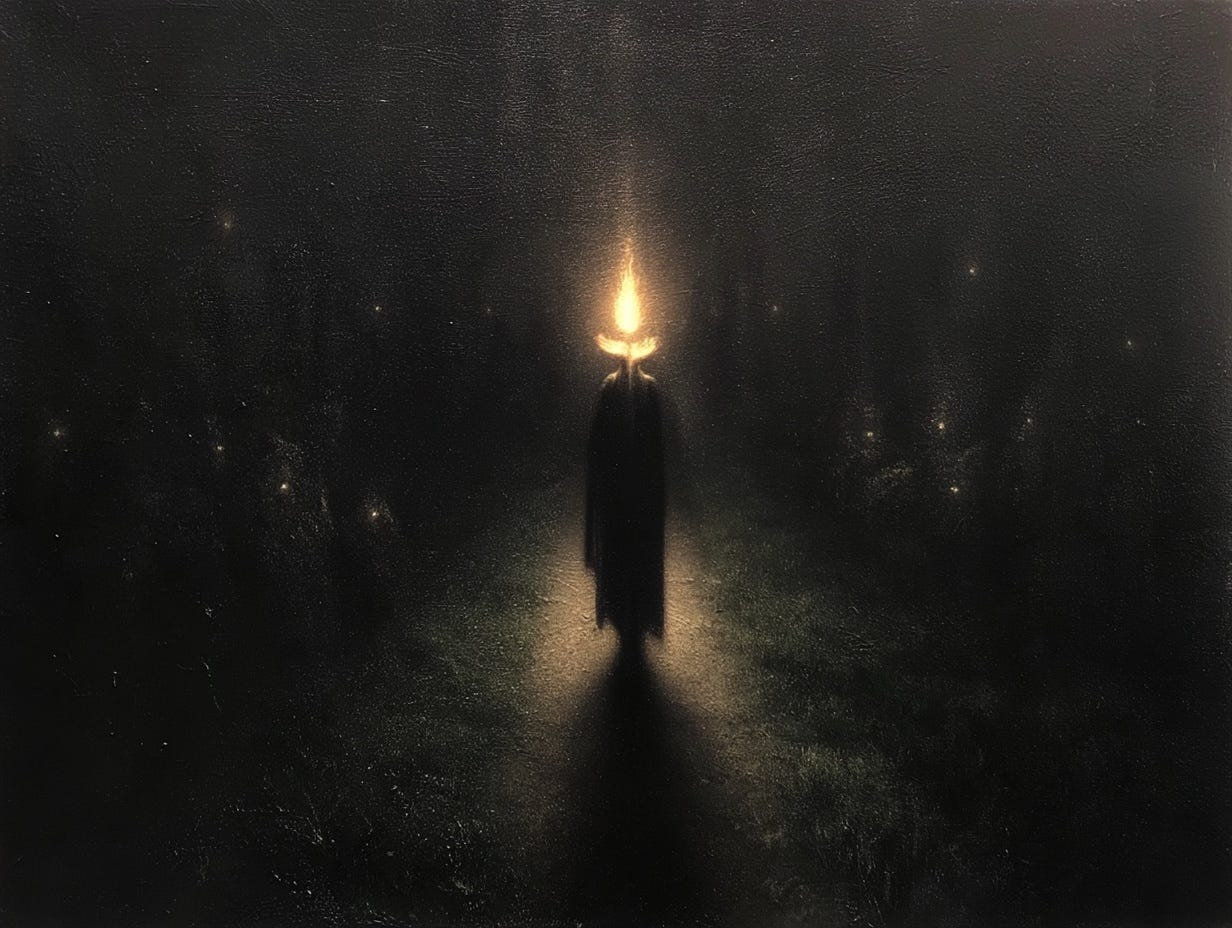
Image by MidJourney AI
❧
IV · On the Will
“Take up one idea. Make that one idea your life; dream of it; think of it; live on that idea. Let the brain, the body, muscles, nerves, every part of your body, be full of that idea, and just leave every other idea alone. This is the way to success, and this is the way great spiritual giants are produced.”
— Swami Vivekananda
“A man who is doing his True Will has the inertia of the Universe to assist him.”
— Aleister Crowley
Another way of saying the Will is intention, in the sense that “I will” is close to “I intend to.” The Will is a decisive action driven by the intention and direction of the divine essence, and it’s also the power to carry that action through. It’s a natural outpouring of the essence, informed by the realization of truth, and it reaches beyond the small self into the continuity of existence. In the Buddhist tradition the Will is your dharma. In Taoism it’s the Tao, the Way.
We may all be woven into a fabric larger than our individuality, but we each also have a unique essence that colors what we love and want and are drawn to. We are both the star and the whole sky. As a star, there’s a particular way the universe wants to express through you, a role only you can play. To find that role and enact it in the world is your will, and it’s your duty to discover what it is.
Doing your will isn’t only the right action you can take. It’s also the only way you’ll ever actually be happy. There’s an epidemic of depression in the world, and I’d suggest much of it comes from people not doing their will. They aren’t doing what they came here to do. They’re thrown in every direction by distraction and never settle on the one thing that would give them meaning. Many people already know their will and have decided it’s impossible, because of the dampening voices they inherited from their families and cultures, or because they fear being shamed and cast out of the flock. Such a fate would be a liberation, not a tragedy.
There is nothing else worth doing in life than the full and potent expression of your essence. You are a unique and irreplaceable facet of the divine image, meant to fill roles no one else can. No one else can tell you what your will is. You have to do the work of deciding for yourself, and hone in on it through sincere aspiration and hard experience. Once you know it and dedicate yourself to it as much as you can, you’ll likely find yourself much happier.
The key to doing your will is to be yourself, which means following your own impulses and delights without shame, much as a small child does, and going against the grain of what’s called proper or popular. Say you were raised somewhere the love of men for men is seen as vile and worthy of punishment, and you’re a man who loves men. Then it’s your will, however hard, to live it out and not hide it in shame, and to seek an environment where your whole self can stand in the open. The same goes for smaller things. If everyone around you loves techno and you hate it, and you love classical music instead, then follow that without hesitation. You can enjoy both, on different occasions, as I do. By honoring what is uniquely yours, you come closer to discovering your will. Don’t fear the ostracization of those closest to you, because the radical expression of your true nature is of far greater worth than being imprisoned by the values of the world around you. The same goes for what your parents think. If they always wanted you to be a doctor or a lawyer, but you have a deep desire to paint, then it’s your duty to follow that calling, even if your family disowns you for it. Such is the cost of the true will.
The cost is real, and worth being honest about. People around you may prefer a version of you that isn’t yours, and when you choose your own life over their version, they can take it as a betrayal. You can’t keep both their approval and your own path indefinitely. At some point you pay, or you don’t do your will. The grief that comes with that is real, but it’s survivable, and the self you refused to give up is the one that was capable of being happy in the first place.
All these roles, “I love classical music,” “I am a painter,” “I am gay,” “I am straight,” however we define ourselves in catalyzing our ego-identities, are no more than false selves, with about as much substance as the clothing we wear over our true selves. So the highest expression of a human being, and the greatest fulfillment of the will, is to discover who we truly are, the true nature of the self. The Western esoteric tradition calls this the Great Work. The East has called it enlightenment. Others have called it Gnosis. My hypothesis is that through pursuing the small will, following our bliss as Joseph Campbell put it, we’re given the experiences and initiations we need to realize the larger one. Through doing our will, we experience reunion with the unity we were never actually separate from, only cursed with the illusion that we were.
❧
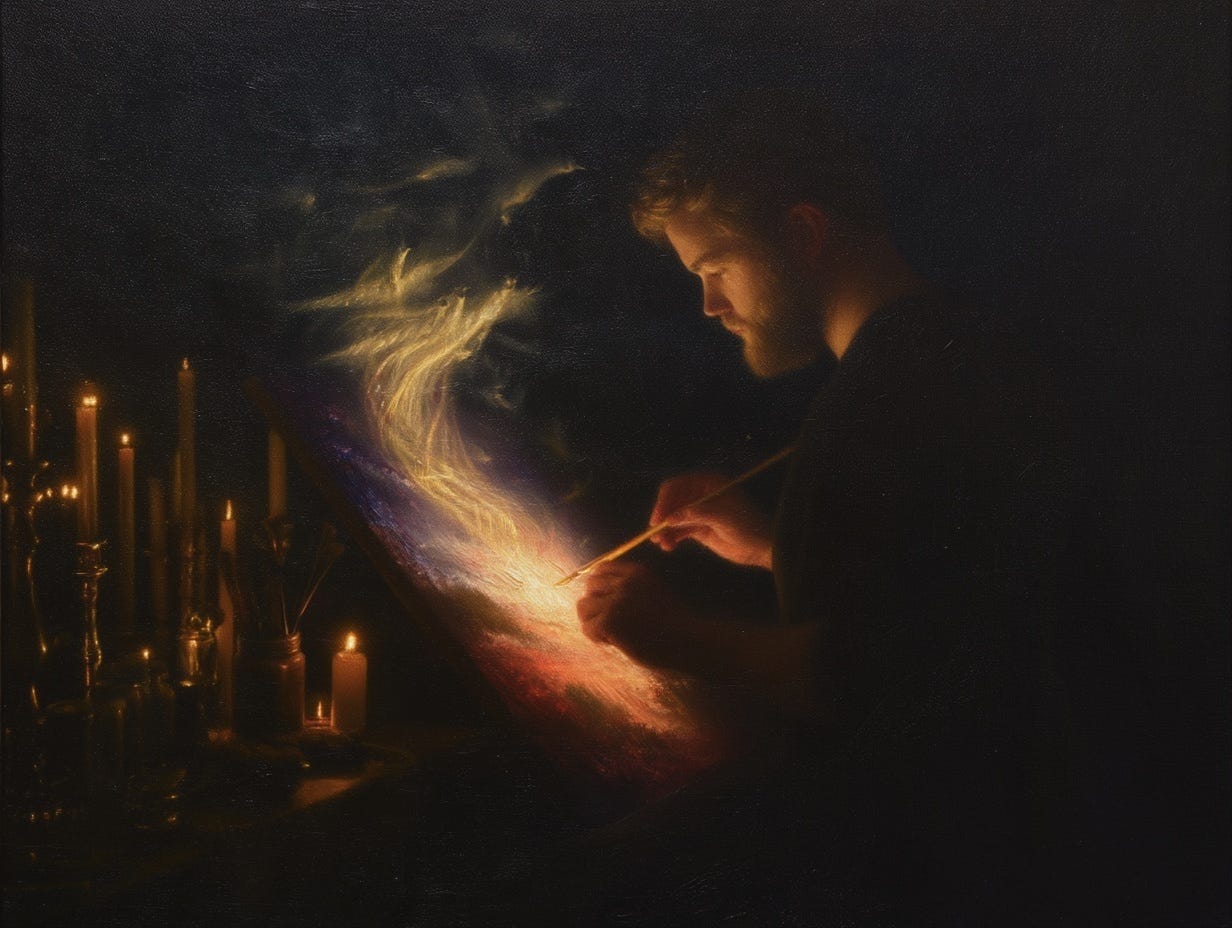
Image by MidJourney AI
❧
V · On Making
“The man who never in his mind and thoughts travel’d to heaven is no artist.”
— William Blake
“What is now proved was once only imagined.”
— William Blake
The will, once you’ve found it, has to be made into something. This is the part the inward paths tend to leave out, and it’s the part I’ve given my life to, so I won’t leave it out. Realization that stays inside the skull is only a rehearsal of realization. The essence wants out. It wants to leave the body and stand in the world as something other people can encounter, and the name for that is making. I don’t mean only art, though art is my own way into it. I mean any act by which an inner pattern is pressed into outer matter and made to hold its shape: a garden, a company, a child raised on purpose, a discipline, a whole life arranged so its days say what the maker actually means.
I’m a painter, among other things, and I’ll tell you what the act is actually like, because most of what’s written about it is romantic nonsense. It’s a struggle in the dark with something that doesn’t exist yet and so can’t help you. You start with a charge, a pressure behind the eyes, a sense that something wants to come through, and then you face a blank surface that knows nothing about it. Everything you put down is wrong at first. The hand is always clumsier than the vision. The gap between what you saw and what you made is the permanent condition of the work, and learning to keep going inside that gap is most of the craft. Amateurs quit there, mistaking the gap for a verdict on their talent, when it’s just the toll everyone pays, every time.
What actually happens, when it goes well, is stranger than inspiration. You work badly for a long time, and the work starts to talk back. The painting begins to want things. A shape you put down for one reason demands a second you hadn’t planned, and you follow it, and somewhere in there the thing stops being yours and becomes its own. Any maker who has felt this knows it’s the same shape as the spirit-contact described in any grimoire. You set the conditions, you do the disciplined work of preparing a vessel, and then something arrives that you didn’t invent and couldn’t have. This is why I don’t separate my art from my magick. They’re one act under two names.
A creative block is rarely a shortage of ideas. More often there’s something you don’t want to make, because making it would cost you, would expose a wound or contradict the version of yourself the people around you are used to. The will is stubborn about this. It won’t let you make the safe thing well, and the part of you that knows your real work would rather produce nothing than produce a fake. Which means the way through a block is usually not more technique. It’s admitting what you’re avoiding.
There’s a reason most traditions give the creative power to their gods first, and to human beings only as a borrowing or a theft. Prometheus steals fire. The craftsman gods build the world. We come closest to that power in the act of making, because making is the one place we plainly do what the myths say the gods do, imagine something and then bring it into being. And once a thing is made it goes out and does work the maker never sees and can’t control, the way a child does once it leaves the house. That loss of control is part of making, not a flaw in it.
So when you’ve found your will, don’t hoard it as a private clarity. Make it. The world isn’t improved by people who have privately realized their essence and kept it indoors. It’s changed by what they build, and the building is the proof that the realization was real, because an essence that never leaves the body is hard to tell apart from a daydream. The whole of this essay comes down, in the end, to one instruction in two halves that are really one: find the thing that’s yours to do, and then do it, out in the world, where it can be seen and used and argued with and loved. That doing is the Great Work in its plainest clothes, and everything else is preparation for it.
❧
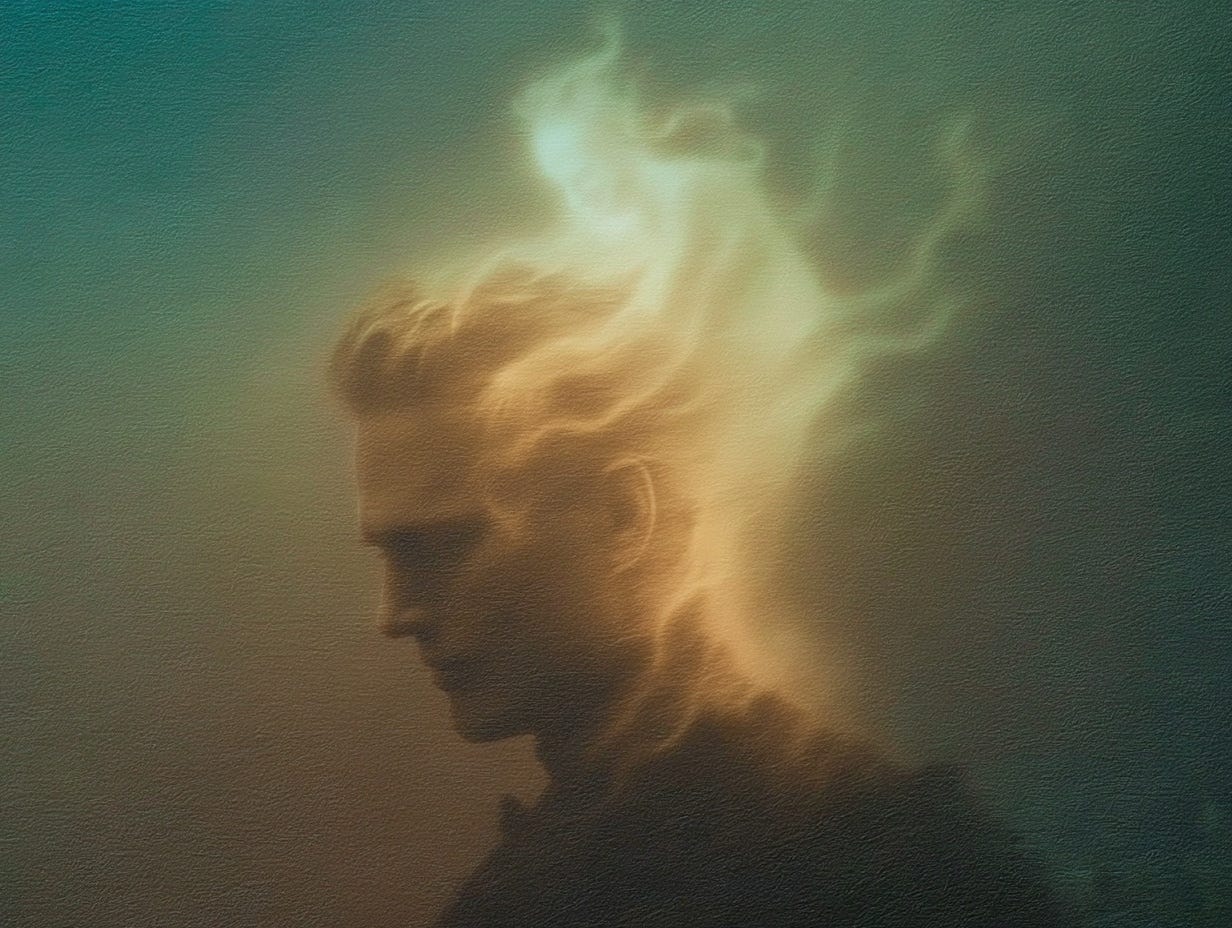
Image by MidJourney AI
❧
VI · On the Flexibility of Belief
“There is no part of one’s beliefs about oneself which cannot be modified by sufficiently powerful psychological techniques. There is nothing about oneself which cannot be taken away or changed. The proper stimuli can, if correctly applied, turn communists into fascists, saints into devils, the meek into heroes, and vice-versa.”
— Peter J. Carroll
One of the living veins of the Western esoteric tradition is Chaos Magick, popularized by Peter J. Carroll and other practicing occultists in the Britain of the 1970s and ‘80s. What impressed me most in Carroll is the idea that our worldviews are flexible, and only valid so long as they serve some use. Once you’ve had Gnosis of the true nature of the self, you’re free to be whoever you want to be, knowing the ego-self was always an illusion anyway.
The magickian is able to flow between worldviews as they see fit. There may be a time when a materialist worldview is useful, and a time when an animist or magickal one is. None of them is true in the final sense, though each is an aspect of the truth. From the chaos model, a worldview is only as good as the results it helps create in your life.
This isn’t an abstraction. A person can take up a strict materialist picture for a while because they need its discipline, because they need to stop reading meaning into every coincidence and do the plain work in front of them. The same person can later take up a frankly animist one, talk to objects, keep an altar, because it returns them to attention and wonder. Neither picture is true. Both are tools. The useful question stops being “is this real” and becomes “what does holding it do to me, and is that what I want.” A belief is something you pick up for a purpose and put down when you’re done with it. The trouble starts when you forget you’re holding one and mistake it for simply seeing.
The same goes for all our tastes and identities, which we may be under the illusion are real. “I am gay or straight,” “I like this music,” “I wear these clothes,” none of it is objectively real. We came into the world without any of it, so we can change, modify, and adopt beliefs, tastes, and opinions as our intentions require. This is a particularly psychedelic idea, because most people live convinced their views and tastes are real, fixed things. They aren’t, and they aren’t inherent to you as your true self, the thing that remains when the ego is gone.
It’s interesting to watch what happens when someone meets a worldview that contradicts the one they’re running. There’s an instinct to defend it, and beyond defending it, to spread it, to want the world to share it. You see this on a large scale in political and religious movements, and you see it just as clearly in ordinary people and their opinions about life. This past year, the start of the global pandemic, has made it worse.
I find it useful, and a little funny, to think of worldviews as entities, spirits that latch onto people and feed on them as hosts. People in the grip of an ideology behave a lot like ants infected with cordyceps. The fungus doesn’t kill the ant outright; it steers it, walks it up a stem, fixes its jaws to a leaf at the height the fungus prefers, and fruits from the back of its head to rain spores on the colony below. Do people possess their ideas, or do the ideas possess the people? Often it looks like the idea comes in, takes over, and runs the person from there, and the person then defends it to keep it alive. It takes a strong-willed and wise individual to let ideologies into their sphere without surrendering to them. This is the ego-trap, and it’s as old as humanity.
None of us knows. All our worldviews are maps of a reality we’re partly hallucinating, and a map is for using, not worshipping. Those who see this can use it to free themselves. Those who can’t are ruled by it, and the grip is hard to break. Chaos Magick is decentralized and non-referential. It follows the vein of neurological relativism and ontological anarchy. It recognizes that our words and concepts are passing things, and it works without the comfort of any fixed point to revolve around. Buddhist thinking says something similar, that there is no center, nothing to hold onto, and everything we think is insubstantial and only relatively real. Any of it could be shattered by a stronger and more convincing view. Our shared reality has gone through countless revisions and will go through many more.
For those who crave solidity and want to know what is real, this is deeply disturbing. For those who’ve learned to surf the waves of chaos and ride the sea of uncertainty, it’s a liberating and empowering thing. The experiments Carroll lays out in Liber III vel Jugorum are a fascinating way to take apart our concepts of the ego-self and move toward the realization of the true one.
❧
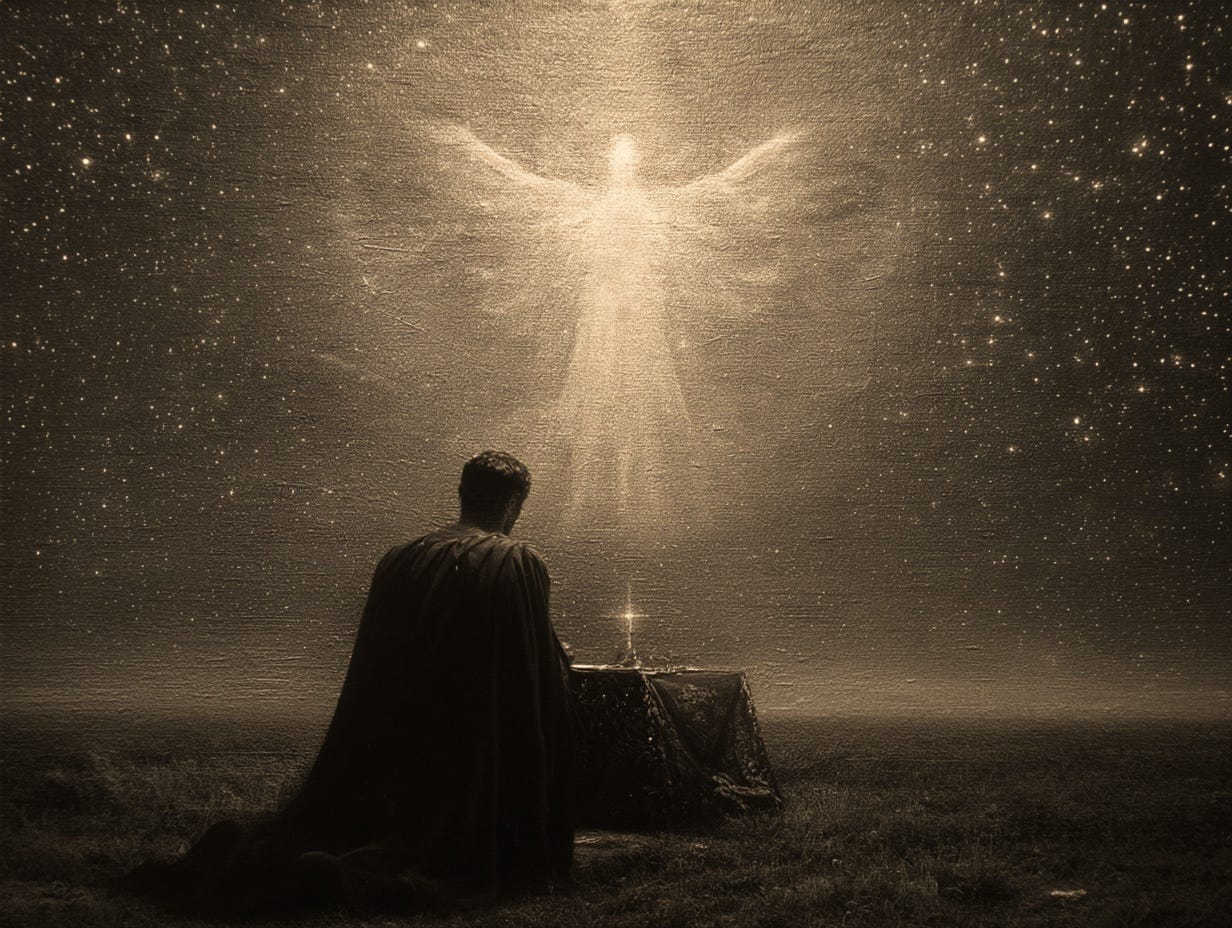
Image by MidJourney AI
❧
VII · Radical Self-Reliance
“Make your own Bible. Select and collect all the words and sentences that in all your readings have been to you like the blast of a trumpet.”
— Ralph Waldo Emerson
“Do not believe a thing because you have read about it in a book. Do not believe a thing because another man has said it was true. Do not believe in words because they are hallowed by tradition. Find out the truth for yourself. Reason it out. That is realization.”
— Swami Vivekananda
We are each the priest or priestess of our own religion. Our salvation, growth, and discovery are fully in our own hands. Each of us has a personal God, a higher self, a Holy Guardian Angel, distinct from anyone else’s, even though at the transcendental level it’s the same. So every person is incomparable, and every path is by definition unique. Rank doesn’t matter. A high Buddhist tulku might be a master at being So-and-So Rinpoche, and have no experience whatsoever at being Jake. I might be wherever I am along my own path, and have no way of knowing the path for Jenny.
This is where the real danger of the path lives, and it has a name. The psychologists call it transference, the habit of taking the authority that belongs to your own depths and pinning it onto another person. It’s a natural thing to do, and on the spiritual path it’s nearly fatal, because the path is frightening and a teacher who seems to have arrived is a welcome sight. You hand them the map. You hand them the authority to interpret your own experience back to you. Before long you can’t tell whether a thing is true because you tested it or true because they said it.
I’ve done this and watched others do it to me. No one can take a step of your path for you, and a teacher who lets you believe otherwise is allowing your dependence, which is the one thing a real teacher won’t take from you. The good ones spend their effort handing the authority back and pointing you past themselves. The false ones point at themselves.
All we can really do is set ourselves alight in prayer and ask for guidance on our own path, from our own higher self. Enlightenment, Gnosis, attainment, and mastery are personal quests that no one can do for you. Now and then a person does meet their guru in the flesh, the way Ram Dass met Neem Karoli Baba, but it’s the exception, not the rule, and most so-called gurus are not what they claim to be.
So keep your teachers, and keep them in their place. Use them the way you’d use a good map of a country you still have to cross on your own feet. I can’t find realization for you. Through your own efforts and your own experiences, you have to make use of your time here to find the means of ecstasy that bring you into contact with pure knowledge, also known as Gnosis, and through that realization, the freedom it brings.
We can have many guides and teachers, and not one of them can walk the path for us. No one can make enlightenment happen for you. No one can tell you which experiences and lessons the unique being that is You requires. The Dalai Lama can’t do your enlightenment for you, and neither can the coach you met on holiday in Ubud. You are the priest of your own temple, the lord of your own path, the Hierophant of your own religion, and only you can build the relationship with the higher self that is yours alone.
❧
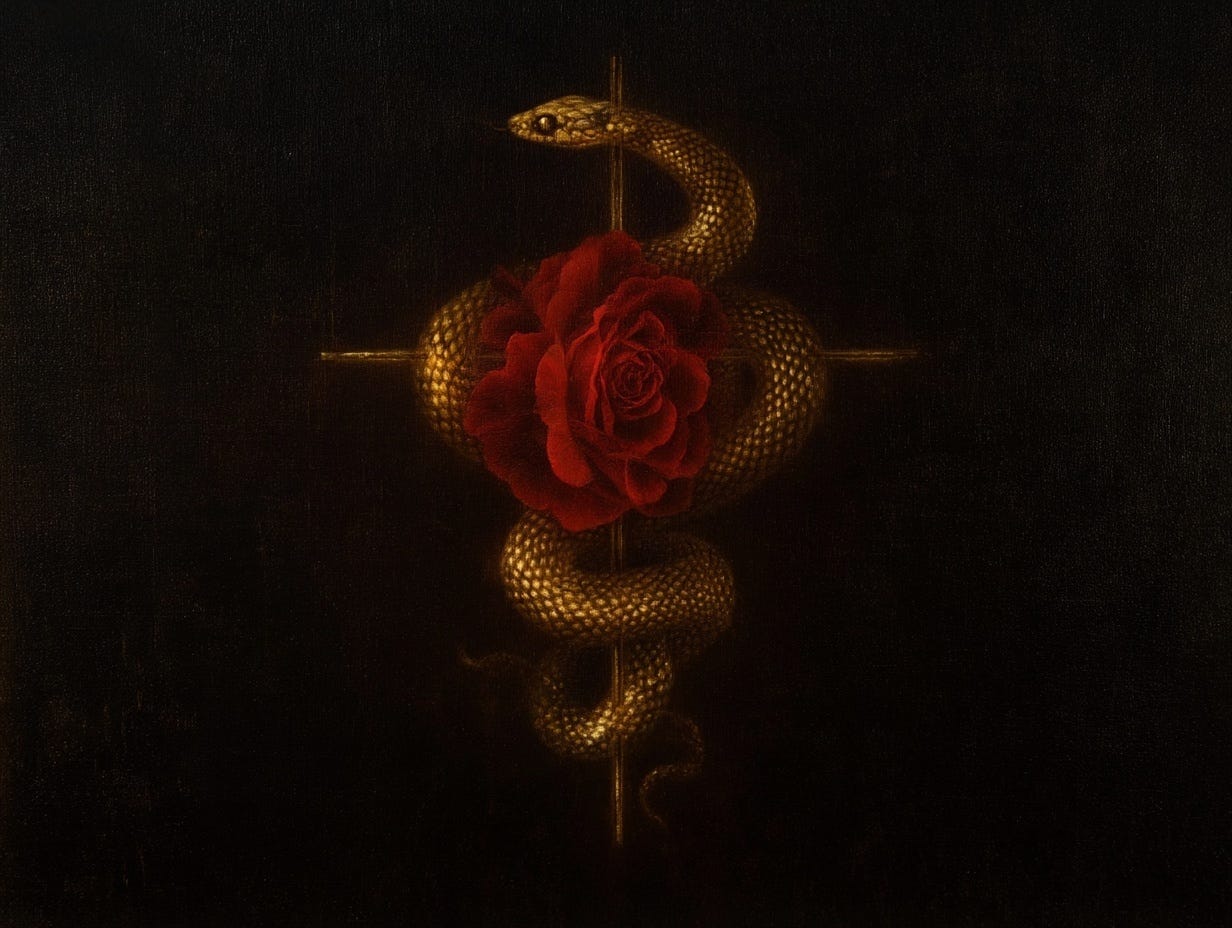
Image by MidJourney AI
❧
VIII · On Sin and Consequence
“Freedom is a two-edged sword of which one edge is liberty and the other responsibility, on which both edges are exceedingly sharp; and which is not easily handled by casual, cowardly or treacherous hands.”
— Jack Whiteside Parsons
Freedom is really what this whole essay is about. You’re free to do anything, though you’d be wiser to do only what serves your highest will. As Jack Parsons wrote in his essay “Freedom Is a Two-Edged Sword,” the other edge is consequence, what the Eastern traditions call karma and what science calls Newton’s third law, that for every action there is an equal and opposite reaction.
Christianity speaks of sin, of actions so absolute that committing them damns you and corrupts your soul beyond redemption. I reject that black-and-white thinking. The highest fulfillment of a man or woman is to follow the true will, to realize the true nature of the self, what’s also called accomplishing the Great Work, reaching enlightenment, ascension. By that measure, the only sin is anything that restricts, distracts, or thwarts a person from their true will. The only sinful act is the one that perpetuates the illusion of the separate self and blocks the way back to our inseparable nature.
Notice what this does to the old list of sins. Half of them fall away, the ones that were only ever about controlling bodies and pleasures that frightened the people writing the rules. And something the list never named rises to the top, the slow and respectable habit of living a life that isn’t yours. There’s no commandment against it. No church will deny you communion for it. You can do it for fifty years and be praised for your reliability the whole way. And it costs you the one thing you came here with, the chance to be the particular star you are, and leaves you near the end with the grief of someone who suspects he was never really here. That’s the sin worth fearing, and almost no one is taught to fear it, because the institutions that teach us our sins are often the ones asking us to commit this one.
Take the most abused of all natural human functions, sex, the physical act of love. If there are sins, love isn’t one of them. Yet of all the things ever called sins, love has been the most punished and persecuted. Of all the things we know, the springtime of love is closest to paradise. And as all things pass, love passes too, and too soon. This most exquisite and tender of human emotions, why should it not be free, for its little moment of eternity?
Nothing is so black and white. Under certain conditions, indulgence in sex can pull a person away from the realization of their will. Under the right conditions, sex can also be a marvelous sacrament, a way into ecstasy where Gnosis can be attained and the rational mind falls quiet long enough for the truth to be glimpsed. Sex is at the crux of the mysteries, east and west, because all things are born of the union of opposites, which is exactly what sex is, and exactly what created the person reading this.
There is the lust of the body, and there is the lust for the force of ecstasy, and the undeniable lust for eternity. Sex serves the longings of the body and also the soul’s yearning to know itself as the center of creation. With sex as a sacrament, we can return again and again to the fountain of truth and lose ourselves in the fires of being, united for a moment with the eternal force, and come back renewed as from a miracle. Sex of this kind, love in its fullest form, is at the heart of every mystery and the center of every secret. It is the splendid and subtle serpent that twines about the cross and coils in the core of the mystic rose.
Drugs have run all through human history as catalysts of growth and tools of initiation. After sex, they’re about the most vilified thing in society. They can be misused, and I still hold that every person has the right to experiment with their own consciousness and to live with the consequences. The road isn’t clean. The same substance can open one person and wreck another, and the difference is rarely the substance itself, more often the person, the dose, the setting, the reason for reaching. The freedom I’m arguing for has never meant freedom from consequence. It means the freedom to meet the consequence having chosen with open eyes.
As for consequences, every action yields a result. If your will is to be fit and healthy, but you spend your days on the couch eating bags of processed food, then your actions and your will have parted ways, and the result won’t be what you wanted. I still strongly believe human beings have the intelligence and the capacity for self-reflection to weigh the likely consequences of an action and decide for themselves whether to proceed. I’m not saying we should all go off on a spree of harm and violence. I’m saying people are fundamentally capable of deciding what’s right and wrong for themselves, where the laws of governments and religions assume they aren’t.
Things are never so black and white. Two men plunge a knife into another man’s chest. One is a murderer, one is a surgeon. The action is the same. The intention behind it is different, and the result is too. One takes a life, the other saves it. Even to fully oppose killing doesn’t hold up, since there are times when the killing of one person is necessary to protect another, or a whole community. Again I’m only arguing for the freedom of each man and woman to decide what is right for themselves, and whether a given action aligns with their values and will.
The world doesn’t sort into the clean piles the codes pretend it does. People are hurt by things the law calls harmless, and helped by people whose methods no rulebook would approve. What decides whether an act was medicine or wound is usually intention and result, the two things a code is least able to see. A law can judge only the outer shape of a deed. It can’t see who you were when you did it, or what it set in motion afterward. Only the person acting is close enough to see those, which is why the responsibility can’t really be handed to any authority outside them. The freedom and the weight are the same thing. To take one is to take the other.
❧
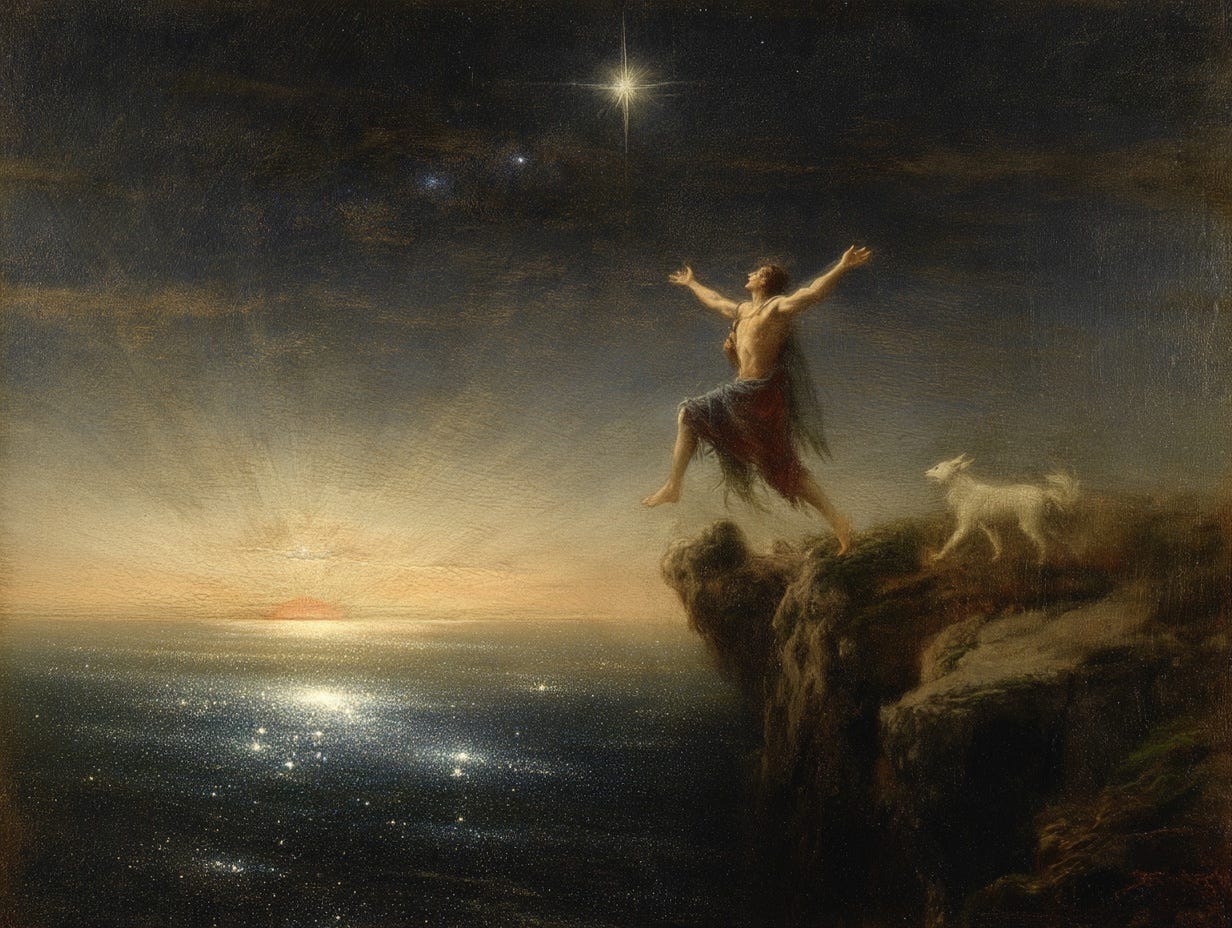
Image by MidJourney AI
❧
Coda · The Playground and the Chains
“The most important kind of freedom is to be what you really are.”
— Jim Morrison
“We live in illusion, the appearance of things, but there is a reality, and we are that reality. When you understand this, you see that you are nothing, and being nothing, you are everything. That’s all there is.”
— Kalu Rinpoche
All the world’s wisdom traditions, and all the yogic and esoteric techniques of the Western and Eastern religions, are built to help us realize the true nature of the self, that we’re not only a small skin-encapsulated ego but are inseparable from a vast and ineffable continuity of life, energy, and existence, which some cultures have called God. Realizing it loosens fear and attachment, and life becomes more joyous, more playful, and less threatening. This is why the Fool of the Tarot is both the end and the beginning of the journey. The qualities of the fool, spontaneity, unrestrained action, enthusiasm, curiosity, humility, belong to children and to realized masters both, the ones who have beheld the self as it is. All suffering comes from the illusion of being a separate, isolated ego, and the cure for it is love, the reunion with the larger self we’re part of.
The methods are many, and the world’s literature is full of prescriptions from every age and culture: meditations, rituals, initiations, fasting, the use of drugs or sex, and the abstaining from these, and countless other conditions that alter consciousness and let a person experience the self beyond the self directly. It’s worth feeling out which of these you’re naturally drawn to, and which books and teachers you can reach. We’re fortunate to live somewhere nearly every book on the subject is within reach, and where hours of teaching sit free for the watching. Still, and this bears repeating, realization comes only through your own actions and experiences. No amount of reading produces Gnosis, though the ecstatic literature of the ages can help point the way.
We are all unique, and we are all connected. In our innermost hearts we’re all the same, and each of us holds the same bountiful and unending capacity for creation and magick, the birthright of every human being. Each of us has a purpose, a true will, a unique way to help the other beings here wake to the nature of existence and set down the fear that coils about their souls. In doing this we help turn the world into something exhilarating and worth exploring, instead of something dull and threatening. As Christ said, “Whosoever shall not receive the kingdom of God as a little child shall in no wise enter therein.” We have to reclaim our divine essence and the innocence and spontaneity of the child and the fool, and meet life as a playground instead of a tragedy to be survived. We reach it through radical vulnerability, and through the honest admission that, given the limits of our minds, none of us really knows much of anything.
The one thing you really need to do is be yourself, settle into your own essence, and follow it until you arrive at your true will. Once you’ve found it, find the pattern of living that brings you the most joy, freedom, and fulfillment. You’re free to learn and grow and play through the many faces of life, and to experience the consequences of your actions, as a curious child does on the way to growing up. This is what we actually are, lest we forget. There are no rules in this world except the law of free will and the law of karma. Upon realizing this, rejoice. You may be inside the illusion of a prison, but there are no chains on your spirit in truth.
None of this means nothing hurts. There’s real loss in a life, grief that doesn’t answer to any reframing, stretches where every line in an essay like this one sounds like a slogan painted on a wall. The pain is real. What can change is what you take it to mean. A child falls off the swing, cries, and is back on it within the hour, because the fall was a fall and not a judgment on the whole idea of swinging. Somewhere most of us learn to read our falls as judgments, and that habit, more than the falls themselves, is the thing that holds us down. Setting it down doesn’t stop the hurt. It stops the second wound, the one you add yourself.
And then you set it all down, because that is part of it too. Everything you make, you’ll leave. The garden goes back to weed, the work fades, the body that did the making is handed back. You could take that as the argument against building anything, and it isn’t, because the fact that you can’t keep what you make is what turns the making into an offering rather than a way of getting. What’s made knowing it will be lost is given over to a continuity that carries it on in forms the maker won’t be there to see, the way That Which Remains carries on every wave it briefly lifts into a self. We’re not here to accumulate. We’re here to spend ourselves, to use the whole inheritance and arrive at the end with the essence expressed and the hands empty. That’s the only success the universe offers, and it’s enough.
May you devote all your actions to the service of love. May your will be sharp and unfaltering and given to the awakening of humanity. May you help yourself and those around you find your way back to the true nature of our spirit, which is an inseparable part of an infinite being whose essence is love. As The Book of the Law says, Nuit is “divided for love’s sake, for chance of union.” Division is the cause of our suffering, and it’s also what lets us know the joy of reuniting in love. So blissful is that union that we agreed to the illusion of separation, and the amnesia that comes with it, just to taste the bliss of its salvation.
❧
“Love is the law, love under will.”
— Aleister Crowley, The Book of the Law
❧
— Jake Kobrin
May, 2026
Petaluma, CA
(originally written in Ubud, Bali, 2020)
Writings From The Edge of the Known is a reader-supported publication. To receive new posts and support my work, consider becoming a free or paid subscriber.
Thanks for reading Writings From The Edge of the Known! This post is public so feel free to share it.
Read more of my writing and subscribe on Substack: jakekobrin.substack.com.
