Do What Thou Wilt: Why Freedom Demands Responsibility
Originally published on my Substack, Writings From The Edge of the Known, where I write regularly. Subscribe there for new essays.
An Ethic of Personal Responsibility
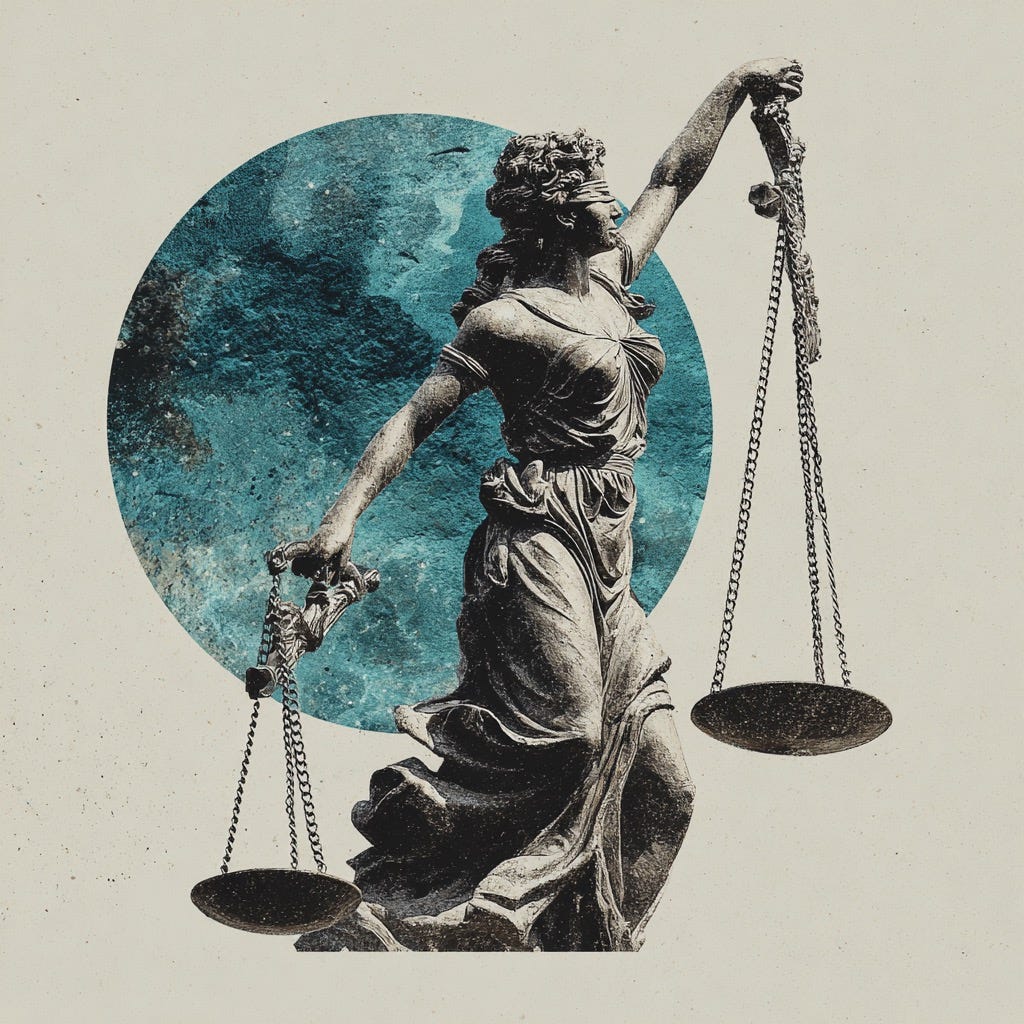
Art by MidJourneyAI
The universe doesn’t care about your choices.It won’t punish you for cruelty, nor reward you for kindness. The stars do not keep ledgers. Yet when we speak of justice, we may be pointing toward something real: not moral law, but the tendency of all systems, including the greater system of our universe, towards equilibrium. There is no cosmic judgment, but rather natural compensation.
This is not nihilism, but rather, clarity.
Nature Has No Ethics
Consider the natural world without importing our frameworks. A hawk tears into a rabbit. Lightning strikes a child. A virus replicates until its host dies. Where is the moral dimension here? We can call these events tragic or brutal, but only by importing our own framework. The rabbit’s fear is real, the child’s death is real, but the “wrongness” exists nowhere except in minds capable of constructing such categories.
David Hume saw this clearly: you cannot derive an “ought” from an “is.” No amount of observation of nature will yield moral commands. We can describe what happens, but the leap to what should happen requires something beyond description. Ethics are human artifacts, as much inventions as the wheel or the alphabet. Useful, perhaps necessary for social animals, but not discoveries about the fundamental nature of things. We did not find them inscribed in nature. We wrote them ourselves.
Nietzsche went further. He argued that our moral systems are not even rational constructions but accumulated prejudices, the residue of power relations and survival strategies that we have sanctified and forgotten were ever chosen. “There are no moral phenomena,” he wrote, “only moral interpretations of phenomena.”
Consequences, Not Karma
While the universe lacks moral structure, it has physical structure. Consequences are real even when judgment is not.
If you touch fire, you will get burned. If you betray trust, you will lose relationships. If there is poison in the water you drink, you suffer. These are not punishments from a cosmic administrator. They are the physical, social, and psychological aftereffects of actions in a world of cause and effect. Justice, insofar as it exists, is simply equilibrium emerging from the dynamics of bounded systems. Not because balance is “good,” but because systems have dynamics. Actions propagate through networks of cause and effect until forces balance.
The Stoics understood something true in their concept of natural law, even if they moralized what were simply systemic constraints. Strip away their cosmic teleology and what remains is accurate: actions have natural consequences that flow from the structure of reality itself. Marcus Aurelius observed that “what is not good for the beehive cannot be good for the bee,” recognizing the embedded nature of individual existence within larger systems, though he mistook systemic dependency for moral truth.
You are free to do anything. You are not free from what follows.
Personal Responsibility in an Amoral Universe
Here is where it gets interesting. The absence of cosmic law does not eliminate responsibility. It intensifies it.
Sartre saw this with painful clarity. We are “condemned to be free.” When there is no divine plan, no karmic safety net, no ultimate redemption arc, you become the sole author of your actions and their reverberations. You cannot defer to higher authority. You cannot claim you were following orders from the universe. Sartre’s term for attempting this escape is “bad faith,” the lie we tell ourselves that our choices were not really choices, that we were compelled by nature, society, or circumstance.
But you are not compelled. The choice was yours, the consequences are yours, and no invisible hand will clean up your mess.
“Do what thou wilt shall be the whole of the law” is not permission for carelessness. It is a statement of terrifying freedom. Aleister Crowley’s maxim, often misunderstood as libertine license, is closer to existential burden. You can do anything, which means you must live with having done it. There is no cosmic forgiveness. There is no predetermined narrative to excuse you. Just you and what you’ve set in motion.
Everything Is Permitted, Nothing is True (But Nothing Is For Free...)
The popular misreading of the chaos magick axiom “nothing is true, everything is permitted” treats it as license for hedonism or violence. Dostoevsky’s Ivan Karamazov poses the question starkly: “If God does not exist, is everything permitted?” He intends this as a horrifying proposition, an argument meant to prove its own impossibility. The logic goes: if removing God leads to this conclusion, the conclusion is so absurd and dangerous that God must exist. It’s meant to frighten us back into belief.
But what if we don’t flinch? What if instead of recoiling from the proposition, we examine it as a straightforward claim about reality? Not a catastrophe to be avoided, but a condition to be understood. Yes, everything is permitted. Now what?
Remove the comforting idea that some actions are metaphysically forbidden, and you are left naked before your choices. Why not lie, cheat, and harm?
The utilitarian has an answer: because the sum of suffering increases. But this assumes we should care about that sum, which is itself a moral claim requiring justification. Utilitarians like Peter Singer can construct elaborate calculations of aggregate welfare, measuring pleasure against pain, lives saved against resources spent. But the entire edifice rests on an unproven axiom: that we are obligated to maximize well-being. Why? Singer cannot answer without circular reasoning. He starts by assuming we should care about reducing suffering, then uses that assumption to prove we should reduce suffering.
The Kantian has an answer too: because you cannot universalize such maxims without contradiction. Lie, and you undermine the institution of truth-telling on which your lie depends. But Kant’s categorical imperative is an elegant structure built on an assumption, that rational consistency equals moral obligation. Why should it?
The answer that remains when these frameworks dissolve is simpler and more brutal: not because a rule prevents you, but because you must inhabit the world you create. If you are cruel, you live in a world shaped by cruelty, surrounded by those who have learned cruelty from you or in response to you. If you break every bond of trust, you live untrusted and alone. These are not punishments. They are just what happens.
The universe permits everything. Your nervous system, your relationships, your community may not. And you are not separate from these systems. You are embedded in them.
Virtue Without Teleology
The ancient virtue ethicists, Aristotle foremost among them, claimed that excellence of character leads to eudaimonia, which means approximately flourishing. But Aristotle assumed a cosmic order, a natural purpose to human life that virtue fulfills. Remove that teleology and what remains?
Perhaps this: certain dispositions and practices produce certain textures of lived experience. Courage, temperance, wisdom, these are not morally mandated, but they generate particular patterns of relationship, particular internal states, particular ways of moving through the world. Some of these patterns are self-reinforcing and sustainable. Others collapse under their own weight or destroy the conditions of their own possibility.
You can be vicious. You will simply build a particular kind of hell for yourself and those around you. Not even a metaphorical hell but the actual texture of your daily experience, your relationships, your internal state. This is not cosmic justice in a moral sense, but merely consequence. The structure of reality constrains which patterns can persist.
The Weight of Freedom
Most people want to be told what to do. They want rules, guidelines, moral certainty. It is lighter that way.
Immanuel Kant tried to give us rational certainty through his categorical imperative: act only according to maxims you could will as universal law. If everyone can do it without contradiction, it’s permitted. If not, it’s forbidden. Clean, logical, decidable. John Stuart Mill offered calculative certainty through utilitarianism: measure the pleasure and pain, sum the consequences, choose whatever maximizes happiness. Reduce ethics to arithmetic. Divine command theorists took a different path: certainty through revelation. God commands, we obey, no further questions needed.
Each system promises the same comfort: a method for determining right from wrong that doesn’t require you to stand alone in the dark and decide. Follow the procedure, get the answer, rest easy.
But all of these are strategies to avoid the vertiginous freedom at the heart of existence. They are elaborate structures built to shield us from the recognition that no cosmic authority, rational or divine, can make our choices for us or guarantee their rightness.
If you accept that ethics are constructions, that nature has no opinion, that you are genuinely free, then every choice becomes heavier. You must decide not what you are allowed to do, but what kind of world you want to participate in building. Not because you should, but because your actions are world-making whether you acknowledge it or not.
This is personal responsibility at its most radical. Not obedience to law, divine or rational, but authorship of reality. Nietzsche’s Übermensch is the one who can bear this weight, who can create values in full knowledge that they are creating them, without the comfort of believing they were discovered.
Living in the Ruins of Moral Certainty
We live after the death of God, as Nietzsche proclaimed, after the collapse of rational moral systems, after the recognition that nature is indifferent. Some philosophers have tried to rebuild. But perhaps what was lost was never there. Perhaps we were always alone with our choices, and the moral systems were elaborate mechanisms to avoid seeing this clearly.
The universe doesn’t care. But you live in it. And what you do changes it. That is not morality. That’s change and movement. The only law is the law of consequences. The only judge is the world itself, rendering its verdict not in judgment but in what follows.
You are permitted everything. You are responsible for all of it. There is a strange freedom in this, and a strange terror. Both are real. Neither is moral. Both are yours.
Read more of my writing and subscribe on Substack: jakekobrin.substack.com.
