A Small Book About the Oldest Thing We Do
Originally published on my Substack, Writings From The Edge of the Known, where I write regularly. Subscribe there for new essays.
Last year a person I loved left my life without dying. One text, then silence, then a town full of people looking through me. There was nothing to bury and nothing to answer, and I found out fast that our culture keeps no shelf for that kind of loss.
Grief for the dead comes with instructions. There are rites for it, casseroles, language a thousand years deep. Grief for a person who is alive, and who has decided you no longer exist, comes with nothing. So I went looking for company in the old stories, because nothing in the present tense could hold what was happening. Orpheus. Inanna hanging on her hook. Gilgamesh refusing to bury his friend. A centaur with a wound his own medicine could not reach. A Persian poet whose beloved walked out of a room eight hundred years ago and never came back.
What I found there became a book.
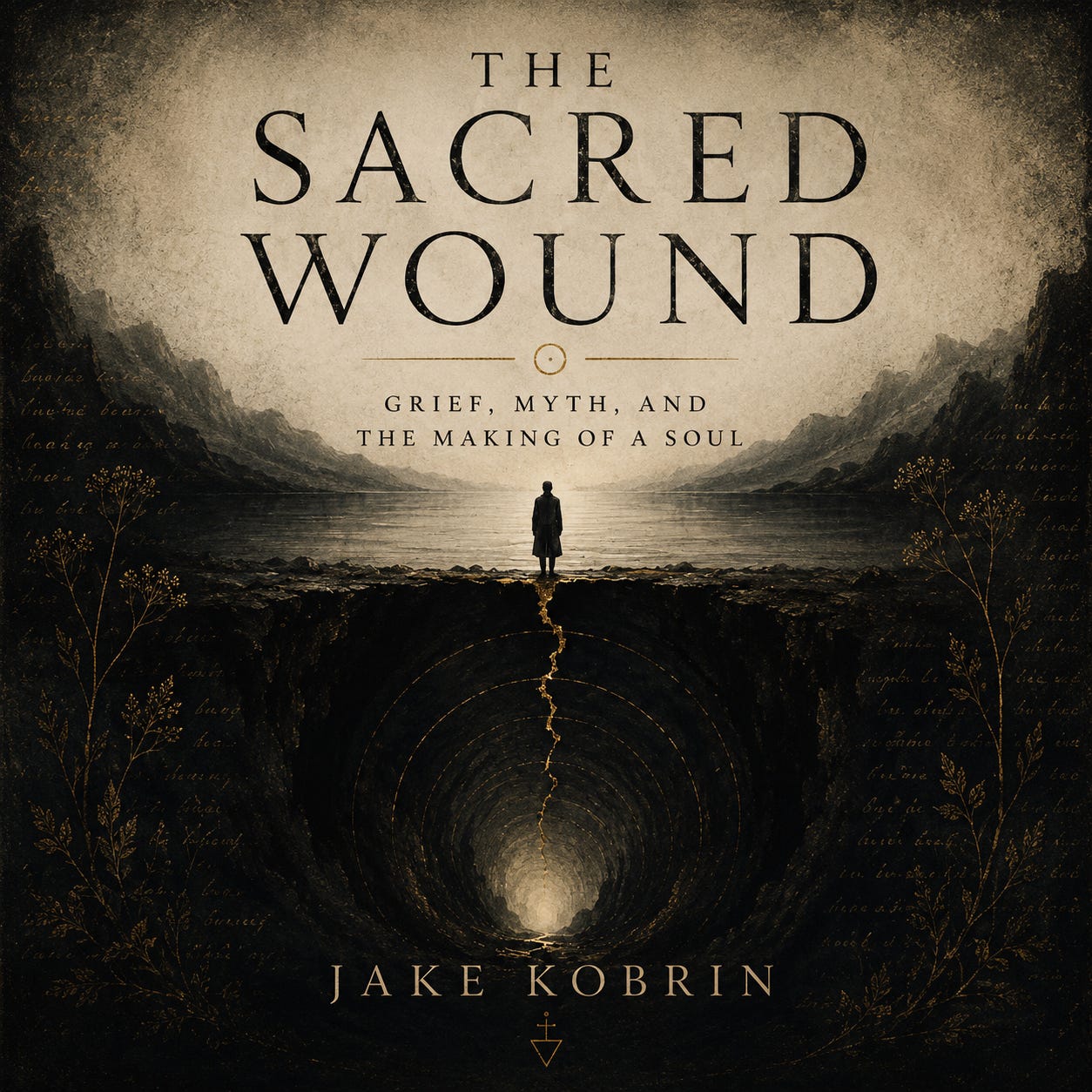
The Sacred Wound. Grief, Myth, and the Making of a Soul is out today, and you can download it on donation, which means you name the price, and the price can be nothing.
It began as a podcast I made last year. I sat down to record an episode about grief and the subject refused to fit inside one. A year of journals, myths, dreams, and revisions later, it has become the small book I wish someone had handed me at the start.
(Listen here to that episode.)
Here is what it is. Seventeen short chapters that treat the old myths as maps rather than decoration, in the way Robert Johnson and Robert Bly used to work. My own story runs through it, the breakup, the exile, the letter I should never have read aloud, but the book belongs to the wound itself, whatever opened yours. Death, divorce, the friend who went silent, the loss that has no name and no funeral. Alongside the myths are the depth psychologists who taught me to read them, Jung, Hillman, Marion Woodman, James Hollis, Francis Weller, and the practices that actually held me up, the dream book, the candle, the strange old discipline of sitting down with a pen and letting the figures inside answer back.
It is short on purpose. You can read it in an evening, and it was written in the first year of the wound, which gives it whatever heat it has.
The premise underneath all of it is simple, and I believe it more now than when I started. Grief joins you, against your will and at the worst hour of your life, to everyone who has ever loved anything. Every civilization we can dig up left descent stories, and left graves with gold laid in, directions for the road, someone singing. When you grieve, you are doing one of the first things our species ever did on purpose. The book exists to hand you that company.
Download it here.Pay what feels right. If it helps you and you can leave something, that keeps the next book coming, and there is a next book. If you can't, take it anyway and give it to somebody in the dark.
THE GATES
Grief has more doors than the obvious one, and many people stand in a grief they cannot name because nobody ever showed them the floor plan. Weller has mapped five entrances, five gates as he calls them, and I have found the map accurate enough to hand to anyone.
The first gate is the one everybody knows, the loss of someone or something we love. Death, divorce, the friend who stopped calling, the animal, the house, the health. This is the grief our culture at least recognizes, even if it hurries us through it.
The second gate surprises people. It is the places that have not known love, the exiled parts of ourselves, the qualities we hid so early and so well that meeting them again is a mourning. Shame lives at this gate, and so do the regrets, the choices we made against our own nature and never went back for. You can grieve a self you were never allowed to be. Many people are doing exactly that and calling it depression.
The third gate is the sorrows of the world. The forests, the oceans, the news, the daily documented diminishment of the living earth. This grief is ambient and mostly unclaimed, and it accumulates in people who believe they are only tired.
The fourth gate is what we expected and did not receive. We are born expecting a village, a wealth of welcome, initiation, elders, communal life woven around us, and most of us got a small family doing its best in a box. The ache at this gate has no memory attached, because the loss is of something that never arrived, and so it registers as a lifelong hunger with no name.
The fifth gate is ancestral grief, the sorrow that came downstream to you, the unwept losses of your grandmothers and their grandmothers, wars and migrations and vanished worlds, carried in families the way a river carries silt.
There are doors even that map leaves to others. The psychologist Pauline Boss named one of them ambiguous loss, the kind that offers a mind no body and no verdict, the person absent and present at once. The soldier missing in action. The parent alive inside dementia. The beloved who is out there somewhere, breathing, and gone. Her research found it among the hardest griefs to carry, because the mind cannot file it and so keeps the case open around the clock.
I walked through three of these doors in one year and only understood it later. The first gate, by way of the ambiguous kind, a living woman lost past reaching. The second gate, when the wreckage showed me exiles in myself I had never once mourned. And the fourth, when the village I assumed I had, seven years of friends in a small town, declined to appear at the exact hour it was needed.
Naming the doors changed nothing about the pain and changed everything about the confusion.
If you do one exercise in this book, do this one. Name your gates. More than one will be open. They draft together, the way open doors in a house do, and the cold you feel is usually coming from the one you have not looked at.
— Jake Kobrin
Read more of my writing and subscribe on Substack: jakekobrin.substack.com.
